

Two cases the newly supermajority-conservative Supreme Court considered in December pose the greatest risk to Roe v. Wade in a generation. The people most in jeopardy of losing the right to end unwanted pregnancies are those without the means to travel outside of the 21 states poised to ban or severely limit abortions if Roe is overturned. But those were the people least likely to be featured on primetime news shows covering the cases.
The Supreme Court heard oral arguments on December 1 in Dobbs v. Jackson Women’s Health Organization, a Mississippi case that threatens to overturn the landmark 1973 ruling that made abortion legal nationwide up to the point of fetal viability, at about 24 weeks. Then on December 10, the Court decided that Texas’ S.B. 8, which imposes a bounty-hunting system to outlaw abortions after six weeks (before most people realize they’re pregnant), can remain in effect while abortion providers challenge the law in a lower federal court.
Though abortion rates have been steadily declining for the past two decades, women of lower socioeconomic status and women of color still receive abortions at higher rates than wealthy and white women (American Journal of Public Health, 10/13). In 2014, 49% of women who received abortions were living below the federal poverty level, and 26% made 1–2 times the federal poverty level. And Black and Hispanic women obtained abortions at 1.8–2.7 times the rate that white women did (American Journal of Public Health, 10/17).
Additionally, not all people who are able to get pregnant identify as women. These groups are particularly vulnerable because they already lack adequate access to reproductive healthcare, but are rarely acknowledged in news reports (FAIR.org, 11/12/21).
White sources led
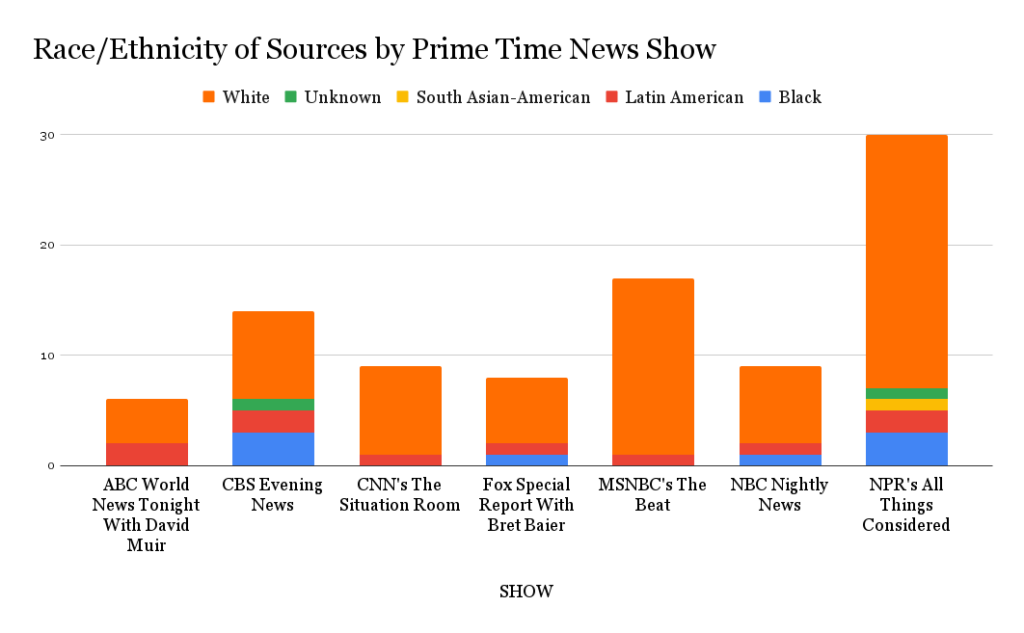
FAIR analyzed weekday reports mentioning abortion from November 29, two days before the Mississippi case oral arguments, to December 10, the day the Supreme Court ruled the Texas law could remain in effect, on CNN’s Situation Room, NBC Nightly News, MSNBC’s The Beat, ABC World News Tonight, CBS Evening News, Fox Special Report and NPR’s All Things Considered.
We found 93 sources across 27 segments, counting each quoted individual once per segment. Not counting duplicates that appeared in more than one segment, there were 57 unique sources.
Of the 93 total sources, more than two-thirds (63) were women. Seventy-seven percent were non-Hispanic whites: 42 white women and 30 white men. Ten were Latina women, with soundbites of Justice Sonia Sotomayor’s questioning accounting for nine of those 10 instances. (The other was Delva Catalina Limones, who spoke on behalf of the Avow Foundation for Abortion Access—CBS Evening News, 12/1/21).
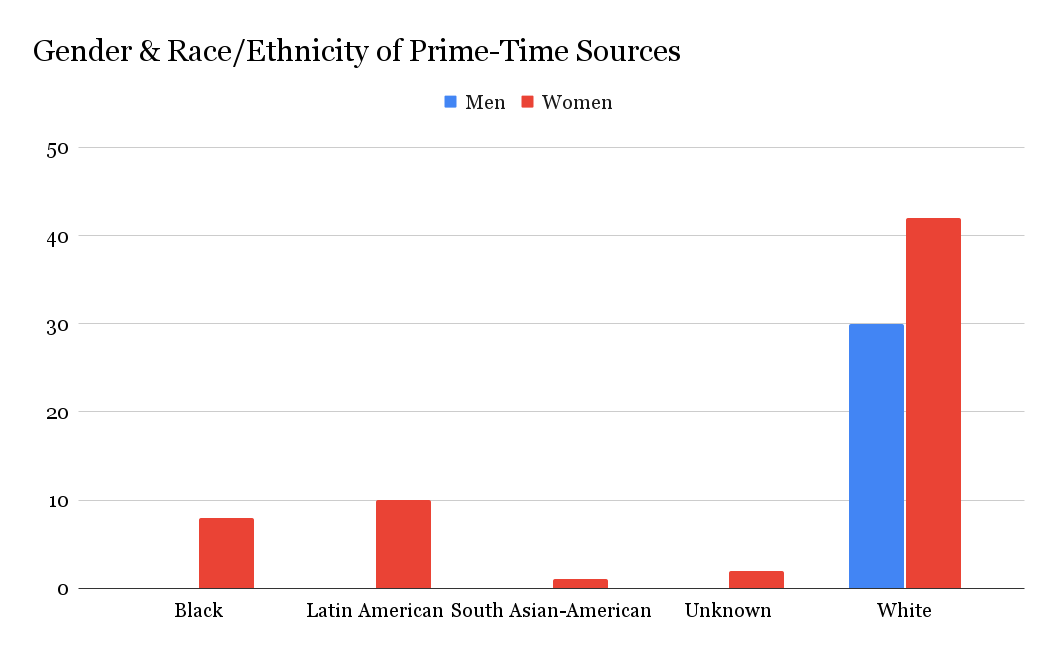
Eight sources were Black women, two were anonymous women whose race/ethnicity could not be determined, and one was a South Asian woman. No sources openly identified as transgender or gender nonbinary.
Repeat sources skewed even more heavily white, with Sotomayor the only person of color among 13 sources who appeared more than once in the study period.

On ABC, CNN and MSNBC, no people of color aside from Sotomayor appeared as sources.
Who are the experts?
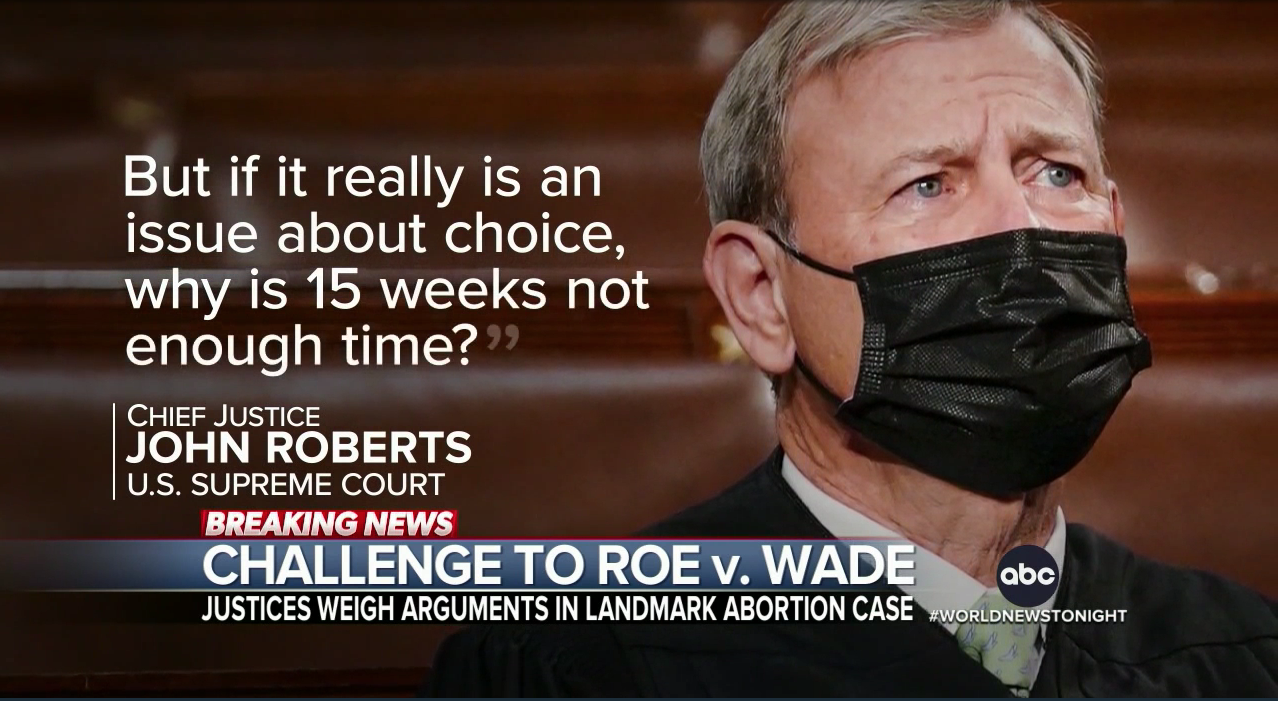
On ABC World News Tonight (12/1/21), all sources featured were government officials. Most soundbites were taken from the Supreme Court hearing.
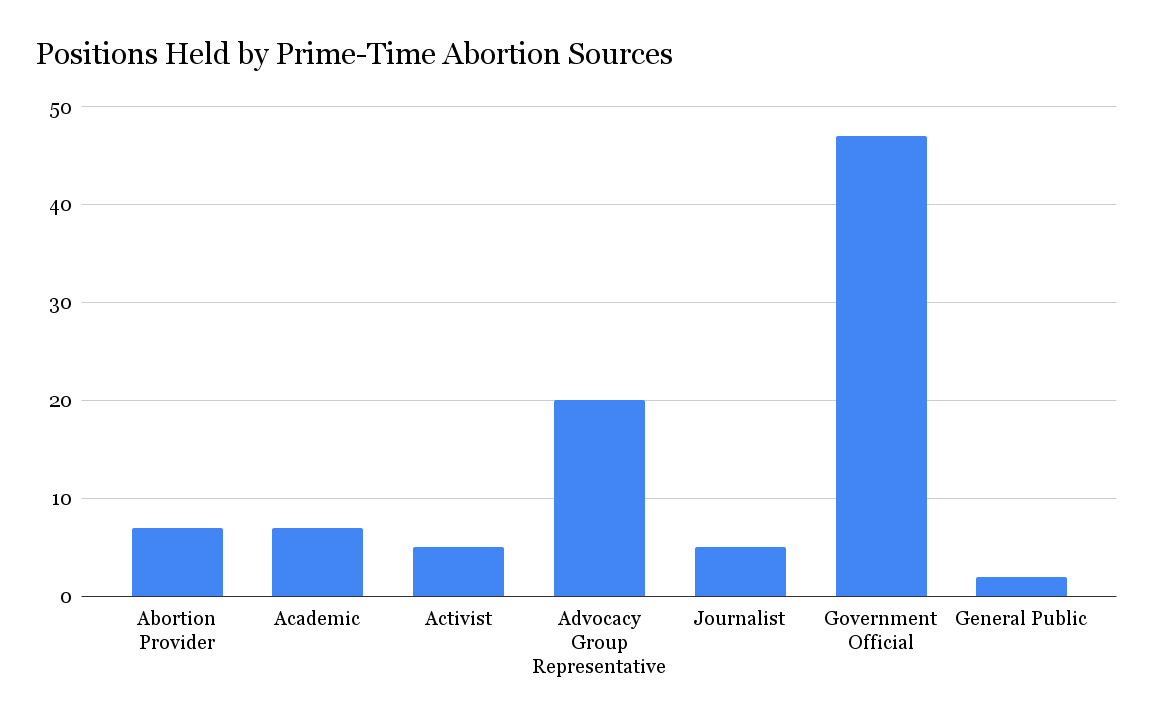
Half of all sources were current or former government officials. Soundbites from Supreme Court justices accounted for the majority of these, making up 35% of all sources. Right-leaning justices were featured 21 times and left-leaning justices 12 times. Of the partisan office-holders, Democrats were featured nine times and Republicans five times.
Eight percent of sources were academics, and 5% were journalists. Nearly 22% were advocacy group members (including lawyers associated with those groups), nearly 8% represented abortion providers, and 5% were activists not affiliated with an advocacy group.
FAIR also analyzed the sources’ expertise. A majority (65%) were interviewed for their legal expertise, while 8% had medical expertise.
Only six sources (7%) disclosed having had personal experiences with abortion. Half of those were politicians: California Rep. Barbara Lee and Missouri Rep. Cori Bush, who are both Black, and Washington Rep. Pramila Jayapal, who is South Asian. One was a civil rights attorney, Barbara Phillips, who is Black.
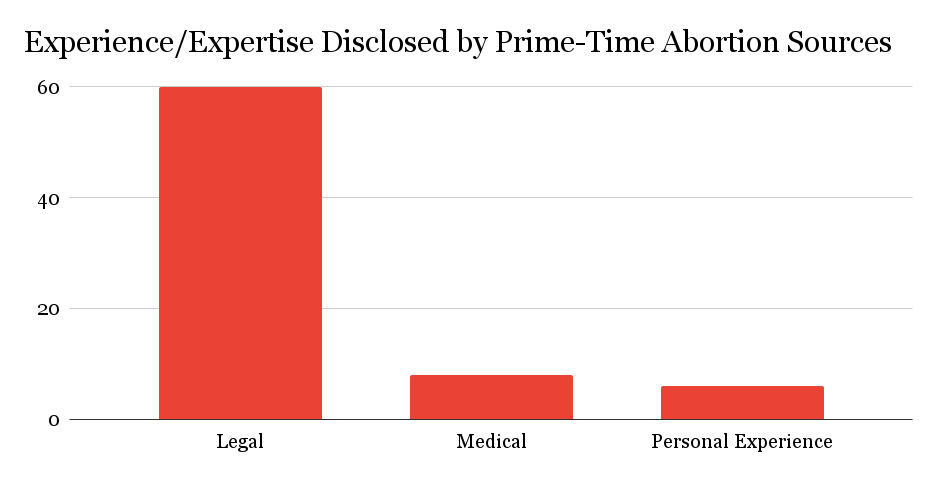
It’s notable that out of the six sources who disclosed having had abortions, only two were people from the general public, lacking a powerful platform in government, advocacy or law.
The legal and political logistics of the Mississippi and Texas cases are certainly an important part of the discussion, but an overreliance on Supreme Court soundbites and other official sources across the board both skewed the racial demographics of the discussion and detached the issue from the stark and complicated realities of people’s everyday lives.
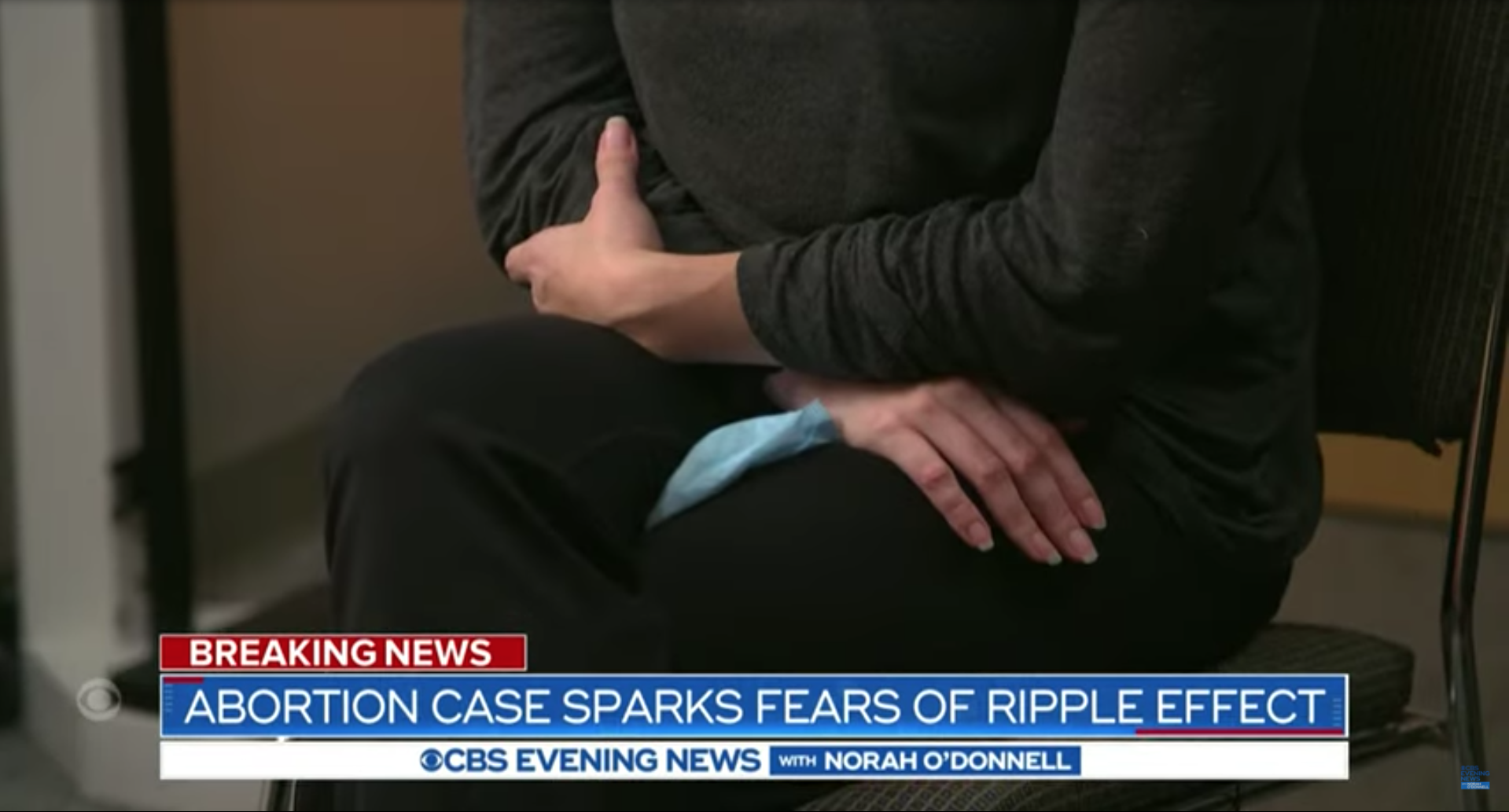
“I cried,” is all an anonymous mother of two who had to travel from Texas to Colorado to obtain an abortion is heard saying on CBS Evening News (12/1/21).
The quality of the two interviews with people from the general public was brief and visceral. When CBS reporter Janet Shaimilan (Evening News, 12/1/21) asked an unidentified woman what she did when she realized she could not obtain an abortion in Texas, the woman responded, “I cried.” That two-word soundbite was the only quote from that source—or anyone who disclosed having experience with abortion—in the segment.
On NPR’s All Things Considered (11/29/21), another unidentified woman talked about her experience with an illegal back-alley abortion in the 1960s.
“The best way I can describe it would be the equivalent of having a hot poker stuck up into your uterus and scraping the walls with that,” she said. “It was excruciatingly painful. The attendant that was there held me down on the table.”
Extractive journalism
It makes sense that people might hesitate to publicly discuss personal experiences with such a stigmatized procedure. But nearly 1 in 4 American women undergo abortion in their lifetime. The issue is not that people are unwilling to publicly share their stories: National movements like Shout Your Abortion publish thousands of crowd-sourced first-hand accounts. News outlets are certainly not suffering from a lack of possible sources to draw from—or the resources to reach them with.
ShoutYourAbortion.com emphasizes the importance of “talking about abortion on our own terms.” In order to hear a wider variety of experiences from a more diverse group of sources, news outlets need to give people the agency to tell their own stories in a way that feels safe and empowering—not extractive and exploitative.
All too often, reporters parachute into scenes of crisis, interview vulnerable people until they pluck what their editors deem as “valuable” soundbites, and leave. Outlets profit from these stories and individual journalists receive accolades for their reporting; meanwhile, the sources who told their stories in the first place don’t see their conditions improve. This practice has become such a norm that critics call it “extractive journalism” (Bureau of Investigative Journalism, 12/8/20).
Free Press’s Alicia Bell spoke on CounterSpin (6/12/20) about extractive journalism in relation to the civil rights protests following George Floyd’s murder that year. Instead of resorting to extractive reporting, journalists should think:
“How can this be generative for this community? What kind of follow up can there be? How can I collaborate with journalists and newsrooms that are on the ground all the time? What does that look like?” That starts to shift that extraction to being really relational.
Better primetime reporting on abortion would require abandoning journalists’ overreliance on official sources who have more connection to policy than to its real-life implications—a bias that typically results in framing abortion bans as a broad theoretical problem or a political football. Restrictions on abortion deeply impact millions of people’s health, well-being and the very trajectories of their lives. Journalists ought to be working much harder to cultivate those experts, in all their diversity, as sources.
Research assistance: Dorothy Poucher
Correction: An earlier version of this article described the Supreme Court as newly-conservative. The Supreme Court has had a conservative-leaning 5–4 , but recently obtained a 6–3 supermajority. Changes have been made to reflect this correction.



Wow! Tone it down Effy C. (nickname for your F-C Bombing)
Maybe instead of slinging mud about things in the past, and F & C bombing about off-topic conspiracy theories no one can confirm nor cares about…
….we can start talking about why men in our culture do not foot as much of the burden and hazard of birth control medicine and procedures? Why don’t we think of males when it comes to the prevention of unwanted pregnancies? Why don’t we question the historical norms of whose role this should be? Am I missing something?
Why should it mainly be women footing the tough choices? Why should it only be women who are exposed to potential reproductive harm from the birth control pills, and procedures?
Why can’t the roles which orbit around reproductive choices, and pregnancy be more fluid and balanced?
It’s weird how when it comes to reproduction the focus is always on women and men are forgotten or relegated to being (unwanted) background noise on comment sections (lol.)
If gender and sex roles are shifting, maybe the historical norms regarding whose role it should or should not be to prevent pregnancy, will shift too?
How we’ve stayed so hyper focused on what women have to do or not in order to prevent unwanted pregnancy, while giving males a free pass to stay doing what they do, seems unbalanced.
Men are just as culpable in a pregnancy right?
Maybe we need to at least talk about this? Like what – if any – available pills and medical procedures are there right now for males to share in some of the birth-stymying roles?
The determined effort of Leftists to pretend that abortion is a people’s issue, not a women’s issue, does not help the cause.
Many of the older women that used to be mainstays of the battle for abortion rights have drifted away from activism, alienated by the new gender games that force activists to pretend that any people can get pregnant and need an abortion.
A lot of the energy needed to actually fight and lobby is instead wasted in chastising potential activists about their ‘non-inclusive language.’
And women lose out. There are no organized feminist groups proudly serving women, adult human females, any longer.
Could it be that the language neutral wedge being driven down our throats, is somehow part of a larger agenda intended to promote division among the 99% of Americans who actually work for a living?
Frankly, I’m a guy who misses the womyn in our recent past who actually kicked ass.
Bradley what do you mean by “
language neutral wedge being driven down our throats.” ?
Can you explain this by giving an example of what you mean? Thanks and peace
Jennifer Bilek has done some research on the money flowing into the transgender lobby that is so powerful, so quickly.
Arcus Foundation funding is part of almost every non-profit’s budget, and they are required to be ‘trans inclusive’ to keep the money flowing. Thus such ludicrous and alienating spectacles as the La Leche League USA re-writing their mission statement and materials to remove the words ‘mother’ and ‘woman.’
Their mission now is: La Leche League USA helps parents, families, and communities to breastfeed, chestfeed, and human milk feed their babies through parent-to-parent support. LLL USA encourages, informs, educates, supports, and promotes the use of human milk and the intimate relationship and development that comes from nursing a child for as long as mutually desired.
Yes, it all designed to keep the masses arguing among themselves, keeping the Left small and irrelevant and stupid-looking on the fringes, keeping as many people in poverty as possible, keeping the fat cats out of the crosshairs.
Thank you for the information.
I’ve always assumed there was a larger agenda regarding the policing of pronouns, and attempts to portray those indifferent to transgender issues as not being fully “woke.”
Even more importantly, thanks and peace and stuff are sentiments often communicated by people willing to live and let live- and especially so, when they aren’t busy fending off detractors laser-focused on identifying suspected microaggressions.
Bradley, has anyone ever told you that you take yourself way too seriously?
It takes some serious chutzpah to equate accuracy with self-indulgence.
“The determined effort of Leftists to pretend that abortion is a people’s issue, not a women’s issue, does not help the cause.”
The counter to the above goes: “An Injury To One Is An Injury To All.” Which is the creed to one of the largest trade unions in the world btw. Hopefully you still know what a trade union is?
Gotta know who is being injured in order to be of assistance, to be in solidarity.
Women have all the babies, women get pregnant, abortion rights are women’s rights. Pretending otherwise makes one unable to be an effective ally.
Just how more division can be sown into this thread in the name of unity?
*Just how much more
To deny abortions to women is to deny these women the right to control their own lives. There can be many reasons for needing an abortion. For example the woman’s own health; the lack of ability to care for a child; the desire not to ever have a child, or a desire to create in other ways.
The current law Roe V Wade is a good one–but many on the current Supreme Court seem to deny the rights of women to control their own bodies. How peculiar you are Supreme Court—slavery ended years ago–and yet you do not see that the ability pf women to have control over their own bodies is just another form of slavery. Shame on you as some of you SUPREMES are making the idea of democratic republic into
a sad joke , and a wrong foisted upon the populace.