

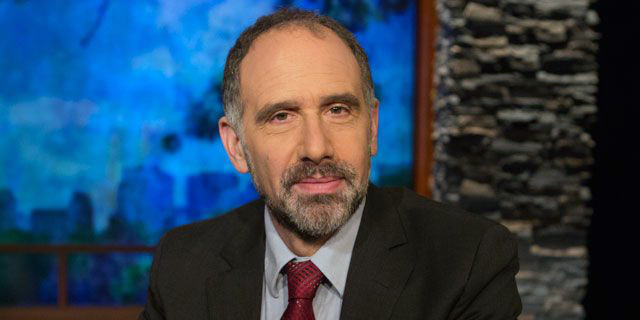
Janine Jackson interviewed Dean Baker about taxing the rich for the February 8, 2019, episode of CounterSpin. This is a lightly edited transcript.
[mp3-jplayer tracks=”CounterSpin Dean Baker Interview @http://www.fair.org/audio/counterspin/CounterSpin190208Baker.mp3″]
Janine Jackson: One in three GoFundMe campaigns in this country are for medical expenses. One in five households have zero or negative wealth. Millions of people are one paycheck away from hardship. And this is the same society in which there are people who can’t remember how many houses they own, or are puzzled about why furloughed federal workers would be going to food banks.
Inequality is a life or death issue, which makes it especially disconcerting that some folks with media megaphones seem proudly ignorant of the basic mechanisms by which resources are distributed. Some myths and misunderstandings are being thrown into relief as we’re seeing a strikingly bold (for recent times) conversation about progressive taxation, occasioned by proposals from New York Rep. Alexandria Ocasio-Cortez, among others. But if the present debate goes further than we’re used to, does it go far enough?
Dean Baker is co-founder and senior economist at the Center for Economic and Policy Research. He joins us now by phone from Utah. Welcome back to CounterSpin, Dean Baker.
Dean Baker: Thanks a lot for having me on.
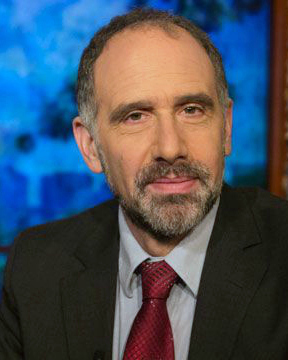
Dean Baker: “We could disagree, is 70 percent the right rate, but to act like that’s just impossible, we’re going to see our economy collapse—that’s nuts.” (image: BillMoyers.com)
JJ: Corporate media have trouble, or often don’t bother, to distinguish between ideas and those espousing them. So when Ocasio-Cortez suggests the idea of a top marginal tax rate of 70 percent, that gets sucked into the vortex of her coverage—you know, coverage of her—as with wealth tax proposals from senators Elizabeth Warren and Bernie Sanders.
Before we talk about the limits of those ideas, I wonder if you could just talk a bit about both top marginal tax rates and increased taxes on extreme wealth, given that media often present those ideas as kind of ideas from Mars, or proof that these politicians are wild-eyed fantasists.
DB: Yeah, well, the reaction to both proposals has been fascinating. Both the public reaction, where there’s clearly been a lot of support—people are saying, “Yeah, you have a lot of real rich people, why shouldn’t they pay more in taxes?”—but more so from the media and from some establishment politicians.
So the reaction is, “Oh, here’s flaky Alexandria Ocasio-Cortez, where’s she get off, 70 percent?” And, in fact, that’s a number that many of the world’s most prominent tax economists have said, “This is the maximum tax rate,” in the sense of maximum amount of revenue.
And there was a widely read article by Peter Diamond, who’s a professor at MIT, and Emmanuel Saez at Berkeley, both very, very prominent. Diamond won the Nobel Prize, Saez the John Bates Clark award, two of the most prestigious awards you can get in the profession, so these are people in very high standing. And they came up with that number; there are all sorts qualifications and reservations, but in any case, they didn’t think it was ridiculous.

So when you have a new member of Congress propose that, well, the media jumped on that like, “Oh, she’s just being flaky.” And, in fact, it’s a very reasonable thing to put on the table; whether that’s the right rate, of course you could debate that. But it certainly was not a ridiculous proposal, and again, Paul Krugman had a very nice piece, where he’s contrasting that with the Republican proposals to cut taxes on the rich, where they were saying that they would pay for themselves, which was ridiculous. But that was treated like these are serious people.
So it’s been fascinating that there’s been such a rush to dismiss these kind of far-out proposals by radical leftists, when they’re reasonable proposals—which, again, is not to say that they’re necessarily the best policy, but they’re certainly reasonable proposals to put on the table, and to be debated.
JJ: We read that Michael Dell—who has $30 billion or so—at the World Economic Forum, apparently said, “Name a country where that’s worked—ever.” The 70 percent top marginal rate. Missing something, you could say.
DB: Yeah, of course, one of the co-panelists said, “The United States,” because that was in fact the rate in the United States, until Ronald Reagan lowered it with his tax cuts in 1981. And if we go back a little further, it was 90 percent in the Eisenhower days; Kennedy had lowered it to 70 percent.
So, again, one could argue whether these are the best rates. But to treat this as a crazy idea out of far left field is just wrong. And some of the back and forth—because I was on Twitter with Dell, and there were others involved, obviously—and what I find most striking, Dell’s kind of a poster child here, because what is Dell’s expertise in this area? He’s very rich, no doubt about that, but he obviously knows nothing about tax rates.
I mean, again, we could disagree, is 70 percent the right rate, but to act like that’s just impossible, we’re going to see our economy collapse—that’s nuts. He knows nothing about it; he just has $30 billion, so therefore he thinks he’s qualified to talk about it.
JJ: It’s good, I think, that we’re talking about taxing extremely high incomes and wealth—for all kinds of reasons. The LA Times’ Michael Hiltzik was saying, it helps move us away from this notion that wealth is “self-made,” that these folks owe nothing to society, and it disrupts the fallacy of trickle-down.
But having said that, it does take the form of a giveback: “You’ve got an absurd amount of money, so you should throw some back in the pot, because that’s the socially decent thing to do.”
You suggest, in this recent piece for Truthout, that while that is not wrong, it’s not getting to the crux, the bigger source, of the rise in inequality.
DB: Yeah. So the point I made in that piece—and, really, I’ve made it in much of my writings over the last 10 or 15 years—is that the distribution of income is not something that just happens. It depends on how we structure the economy.
And I would say the economy is pretty much infinitely malleable. We could structure it all sorts of different ways. And my favorite example here—just because it’s so blatant—is I like to say, “How rich would Bill Gates be if he didn’t have copyright or patent monopolies on Windows software?” If anyone in the world could just start mass-producing computers, and copy in Windows and all the other Microsoft software, and they don’t even have to send them a thank-you note?
Well, needless to say, he would not be one of the richest people in the world. He wouldn’t have $100 billion. I’m sure he’d do fine. But the fact that someone like Bill Gates could become incredibly wealthy was because of how we designed that market.
And it’s pretty much the same story everywhere you look. Finance: Where would all these Goldman Sachs guys be if we didn’t have the bailout in ’08 and we just let the market run its course? There’s many other ways we subsidize finance as well.
Corporate CEOs: They were always well-paid, but if you go back to the pay standards of the ’60s and ’70s, they’d be getting $2 or $3 million a year, not $30 and $40 million.
So we structure rules that allow people to get incredibly wealthy.
And I really prefer that to be the focus, both because as a practical matter, it’s much harder to get the money back once they have it. I mean, there’s all sorts of practical issues that people rightly raise. Sen. Elizabeth Warren says, “Let’s tax the wealthy.” Well, they’re not just gonna hand it over to you. It’s going to be hard to do, which isn’t to say it’s not something we might want to do, but it’s going to be hard.
And secondly, the political issue. If we act as though, “Well, you know, Bill Gates got that fair and square,” we shouldn’t take any of it back. If you go, “Well, we could have structured it differently, and then Bill Gates wouldn’t have it,” and then we don’t even have to have this discussion.

JJ: I wonder, do you think it’s a trap to talk about these things in terms of revenue, in terms of how much money it would bring to the economy? I read a piece by Vanessa Williamson from Brookings, where she said that taxes on the very wealthy “should be judged by their societal impact and not simply by their revenues,” that it has to do with the fact that just having some people be so wildly wealthy is “incompatible with democracy.” And so we shouldn’t get too hung up on how much money it would give to the economy to institute some of these changes. What do you make of that?
DB: I think it’s a very important point, and I remember some years ago, there was a piece on the estate tax that was done by Alicia Munnell, now at Boston College, and she came up with some figure that we get a relatively small amount of revenue from the estate tax. I’m saying relatively small, still substantial, but much less than if you just said, “Oh, here’s how many rich people died, and we tax it a 40 percent rate”—we get a very small amount relative to that.
But she wasn’t writing as a critic of the tax, because of the two points she was making, one is exactly this one: That part of the story is, we don’t want massive amounts of wealth to be handed down, so you get Donald Trump or his kid walking away with billions, and suddenly having all this political influence.
But the other is, part of what they do to avoid the taxes is do things like start foundations, like the Ford Foundation and the Gates Foundation. Now, those aren’t my dreams; I mean, there’s a lot of bad things I could say about the way those foundations are run. But the point is, that’s not altogether a loss for society, because they do do some good things.
So to act like, “Oh, they aren’t going to pay the tax. They’re just going to start a foundation that provides inoculations to children in Africa.” Well, that’s not a bad thing. So to just look at it and say, “OK, how much revenue are we getting from the tax,” that is missing the point.
JJ: Well, and then, though, going back to Michael Dell, he said:
My wife and I set up a foundation…and we would have contributed quite a bit more than a 70 percent tax rate on my annual income. And I feel much more comfortable with our ability as a private donation to allocate those funds than I do giving them to the government.
DB: Well, I guess we’d have to talk to Michael Dell. He still could do that.
JJ: Exactly. But I think what people are saying is, the problem isn’t whether that’s true in real numbers; the problem is running a society on noblesse oblige.
DB: Yes, you know, we don’t want to have to depend on—you know, I wasn’t going to go into my criticisms of the Gates Foundation and the others, but yeah, we don’t want to depend on their goodwill. I mean, people need healthcare, they need education, all the other necessities of life. And it shouldn’t depend on whether Michael Dell, he and his wife, are good people, and they’re going to contribute to that. I mean, it’s nice if they want to, but that shouldn’t be what we depend on.
JJ: Well, a poll from that pinko rag Business Insider showed that Ocasio-Cortez’s proposal, the 70 percent top marginal tax rate, was more popular than the GOP tax cuts, which you alluded to before. People don’t even think that “socialism” is a curse word anymore, which removes a real arrow from some folks’ quiver.
But I think we want to say that none of these proposals, working on pre-tax income, post-tax income, they’re not opponents of one another as proposals, right? And other things, like raising the minimum wage, could fit in there, too. I guess it just does seem like more ideas are on the table than we’ve grown accustomed to, and I wonder how we keep that window open, and how we keep pushing for more?
DB: It has been great that you have people put it on the table, and there’s been a good popular response. And I have to say it, to some extent our best allies in this have been the Republicans and conservatives, because they’ve said things that are just so absurd.
I mean, I remember Scott Walker, the former governor of Wisconsin, was criticizing Ocasio-Cortez’s 70 percent proposal. And he’s talking to— by his account—he’s talking to fifth graders, and he says, so you do some work for your grandmother and she gives you $10, and the government takes seven of it, and they all go, “That’s not fair!”
Of course, it has nothing to do with her proposal. She’s talking about people who get over $10 million. So over $10 million.
And I don’t know whether Scott Walker literally doesn’t understand a marginal tax rate, or he’s just being dishonest about it. But he publicized this, and needless to say he got raked over the coals for it. My guess is he won’t do that again.
But it has certainly pushed the window on how we could talk about these things. So in that sense, we don’t all have to agree that A, B or C is the best or, you know, what I would say is, we probably want a mix of A, B and C.
But in any case, it certainly expanded the window of discussion in a really positive way.
JJ: We’ve been speaking with Dean Baker. He is senior economist at the Center for Economic and Policy Research. They’re online at http://cepr.net/, and that’s where you can also get hold of Dean’s free book called Rigged. His piece, “Progressive Taxes Only Go So Far. Pre-Tax Income Is the Problem,” can be found at Truthout.org. Dean Baker, thank you for joining us this week on CounterSpin
DB: Thanks a lot, Janine; good to be on again.





FIRST: SO THAT WE CAN ALL UNDERSTAND EACH OTHER: WHAT IS “SOCIALISM?”
Leo Emmanuel Lochard “Forgiven Builder” Sunday, February 10, 2019
https://www.youtube.com/watch?v=Kqf6VrwmpQI
LET’S HOLD ON, EVERYONE! LET’S NOT PANIC! LET’S BE SCIENTIFIC AND LOGICAL ABOUT THIS WHILE UTILIZING OUR “EMOTIONAL INTELLIGENCE” for determining with clarity and succinctness the essence of the matter —- “the meat of the discussion!” The sky is not falling down! So, WHAT IS “SOCIALISM?” First, we must define: What is SOCIALISM? Neither the Democrats nor the Republicans are honest in talking about SOCIALISM – Neither know what SOCIALISM really is. According to the political lexicon: It’s government ownership of the means of production (i.e., industrial and other forms of production). Here we have A MIXED ECONOMY – since FDR, we’ve been practicing KEYNESIAN ECONOMICS. Private industry is not owned by our federal government —- When President Truman seized the STEEL MILLS during World War II, the United States Supreme court declared it UNCONSTITUTIONAL. A MIXED ECONOMY is “KEYNESIAN ECONOMICS,” which is a mixture of public sector investments and private sector investments. Therefore, all Americans are really debating and arguing about is “the breadth or extent, degree or level”, of that “public sector – private sector mixture.” If when government (public sector) gives $1.5 TRILLION tax cut to the rich and wealthy and reduces corporate business tax rates is NOT SOCIALISM, then how can UNIVERSAL EDUCATION and UNIVERSAL HEALTHCARE for the poor, working poor and middle class be called “socialism?” Both public sector subsidizing of private corporate business and subsidizing education and healthcare for the American population are financed by TAXPAYERS’ MONEY! So, Americans are just debating to what extent public sector involvement (government investments into our mixed economy) in our mixed economy will extend: “center-left” or “center-right.” The former SOVIET UNION was “socialist” in the true political sense of the word according to classical Marxist definition of SOCIALISM – when the public sector OWNS everything, from industry to education, to government to healthcare, etc…. Here in the USA, government programs are SUBSIDIES allocated to a certain sector of the Economy while everything remains in the hands of private enterprise — examples: TAX CUT to the corporations; tax cuts to the top 1% wealthy Americans; tax cuts to small business such as Tax Increment Incentives; OR “PELL GRANTS” to the working poor; government subsidies of healthcare in the form of MEDICAID in the States of the American Union. Thus, government or ALL TAXPAYERS are subsidizing in some form certain sectors of our economy — determining only, to what extent KEYNESIAN ECONOMICS will be expanded. That’s all. How can taxpayers subsidizing education and healthcare for everyone be socialism when taxpayers also subsidize business expansion and investments in job creation? Neither is socialism — but only “AN EXPANSION OF KEYNESIAN ECONOMICS!” Thus, FOX NEWS, or Hannity or any other “personality cult mass media pundit” — please DEFINE WHAT SOCIALISM IS before asking Americans their opinions regarding whether or not they like it. Everybody must become “on the same page” when it comes to DEFINING SOCIALISM before they all can communicate or talk about it intelligently with each other. Business subsidies by the public sector is not socialism; education grants and MEDICAID for the poor and working poor are NOT socialism either. All production remains in the hands of the private sector. God bless you and God bless the United States of America! The land of the free and the home of the brave: One nation, UNDER GOD, indivisible, with liberty and justice for all! *
“Everybody must become “on the same page” when it comes to DEFINING SOCIALISM”
Therein lies the heart of the problem.
Not everyone has ever agreed on the definition of concepts like “socialism”, “capitalism”, etc.
Much like Plato’s “forms”, they are but conceptualizations of some possible unknown pure forms.
There may likely be no definitive agreement.
I argue that PURE “socialism” and “capitalism” cannot exist in the real world.
All economies are mixed, to varying degrees.
This follows along as part of my greater theories on the tendencies for “Dichotomous Thinking”, ie. “black & white”, “this or that”, “either/or” reductionism.
There are an infinite shades of “gray” between mere black & white.
Similarly, there are an infinite shades/variations of economy between “socialism” and “capitalism”.
It’s not an either/or scenario.
Pure “state control” of everything is likely impossible.
Someone will always seek to extra gain for themselves.
As one does, so do others follow.
Similarly, someone, somewhere along the line, will feel as if others are getting the best of them, thus seeking more for themselves (or in their minds, seeking “equal”, which however, will then be view as unequal by someone else, and so on…). This eventually compounds.
Marx is not the authority of the definition of “socialism”, but only one voice.
Marx borrowed & formed his concepts of “socialism” from others prior to him.
Marx has also been highly criticized for his biases. His concepts of economies were highly reliant on his state of mind, which likely resulted (at least were heavily influenced) by the times in which he lived (“He probably suffered as well from having decided on his conclusions in 1848, before embarking on the research needed to justify them.).
Have you read Capital in the Twenty-First Century by Thomas Piketty?
Marx (like most others) was limited by the limited information available to him at the time (national income databases or info sources were largely nonexistent).
So, while he may have had some thoughtful insights, they were limited by his available knowledge & resources & frame of mind.
Interestingly, some of the core problems of “capitalism” are identical to those of “socialism”…..a few at the top of the systematic hierarchies that believe they deserve more than others.
There will always be “skimming” by those tempted with such.
Any system can be corrupted, and most usually are, by those seeking advantage for themselves.
Take a look at most “Progressive” politicians in the U.S.
Most are multi-millionaires.
Even Ocasio-Cortez enjoyed a privileged life compared to the average American (living in a relative affluent neighborhood, going to a prestigious University, working for a multi-millionaire politician, etc.)
There will never be 100 percent cooperation nor agreement among all persons.
Thus “socialist” or “cooperative” “state control” will always be flawed.
What is fair for some, will be viewed as inequitable for others.
Even Marx’s “definition” of “socialism” (which have largely mostly been reinterpreted/inferred by others rather than Marx himself) is highly deficient.
In reality, Marx wrote very little on socialism and neglected to provide any details on how it might be organized.
Criticisms of Marx’s “Law of value” are evidence of his flaws.
While others’ philosophies are often good reference points, one must also consider their deficiencies.
Marx’s ideas had numerous deficiencies.
Beyond all that, I can’t argue that economic structures that favor the ultra-wealth are any less equitable than those favoring the poor.
After all, modern economies only work when money continues moving (and especially with the growing trend/influence of fractional reserve banking).
The poor spend just as much (if not more so) than the rich.
Allowing accumulation and hoarding of more capital by a few, has proven detrimental throughout history (as noted by Historians such as Plutarch [Life of Lycurcus], Adam Smith [Wealth of Nations], Thomas Jefferson, and others).
It is interesting to note that most “Libertarians” I’m aware of (including folks like the Kochs) benefit highly from redistribution and special-interest legislation.
The Kochs are highly invested in firms like Qualcomm, which benefits greatly from public policies that mandate uses of technonogies that use their components (like V2X), through public funding sources (like highway spending).
But they then use their acquired capital (acquired from “state-capitalism”/”crony-capitalism”) to buy “media” and other propaganda (including lobbying activities) to tell others why it’s bad to do as they did (i.e. rely on public funds).
Ms. J. Jackson, Mr. Dean Baker, Good interview, wish it was longer…..I always wonder why it is that a rich person will spend millions on lawyers and tax accountants to avoid paying their fair share towards supporting the country and the workers who made it possible for them to get rich in the first place? Once again it boils down to pure greed, a plague that infests this present world. When B. Gates, D. Koch and others pitch in a few million to endow a college, or a museum, they really haven’t given a thing, as it becomes a tax deduction for them, which then has to be made up by other less rich taxpayers like you and I. When a man with 10 or 100 million dollars pays a 70% tax how much does he have left to spend? 3 million or 30 million, I know it can be tough to live on that little money, but considering the above average Joe earning 50 K a year pays in at least 30% how much does he have left to spend? 35 K ? Why that won’t even be enough to buy a low priced pick up truck. When B. Gates made his promise to donate 1/2 of his wealth he was at the time worth about 63 billion, now that he has given away 1/2 he is worth at last look (2018 Forbes 400) worth 97 billion, tell me how that works? J. Bezos was earning 191 K a minute while his workers were being subsidized by taxpayer money in the form of food stamps and rental/housing assistance. Capitalism at it’s best, at least for the rich, for the poor working man/woman not so much I think….By the way whatever happened to that trading tax of .005 cents on stock and derivatives, that was the best idea I ever heard of, the Gov’t would earn so much they would hardly need to tax us at all; that is if they don’t waste it on 350 million dollar warplanes…..I’ve had my say, so comments anyone?
“When a man with 10 or 100 million dollars pays a 70% tax how much does he have left to spend? 3 million or 30 million…but considering the above average Joe earning 50 K a year pays in at least 30% how much does he have left to spend? 35 K ?”
While a good point, one that often serves at the base of the inequality/redistribution argument, one must also consider the global economy.
And while I have strong concerns about the rising rate of wealth inequality & concentration in the U.S., there’s another side.
Take a look at the WTID wealth inequality index:
https://www.parisschoolofeconomics.eu/en/research/data-production-and-diffusion/the-world-inequality-database/
One can see that the rise of wealth inequality in the U.S., has followed the same pattern of/in other countries.
In other words, American multi-billionaires are not the only national class accumulating & hoarding more wealth.
Historic wealth concentration in Russia, China, Mexico, Europe, etc. have followed along the same patterns as that of the U.S.
Groups and gatherings, like the World Economic Froum (among others), that represent the ultra-wealthy, have pushed for lower tax rates for the upper incomes across the globe. Numerous countries have responded in kind.
So, it’s not just America that is seeing a welath concentration/inequality issue.
This makes the problem more highly complicated than often presented.
This is important because one must consider what would happen if only American millionaires and billionaires were taxed at such a high rate.
Wealth isn’t just highly valued in America, but across the globe as well.
Thus America would likely lose prominence in the global community, as it’s ultra-wealthy would lose prominence in the global sphere, amongst “competing” nations, whos wealthy are largely allowed to retain their wealth.
Despite the recent trends for “nationalism”, globalism is still the norm. We live in a global world.
Global investors put money where the wealthy are.
China, Russia and the U.S. are three of the main economies where the ultra-wealthy are putting their investments.
Each has laws favorable to the acquisition of wealth for those wealthy individuals.
Consider that Warren Buffetts Berkshire Hathaway is not only one of the largest investors of Tesla, but also of Chinese electric auto maker BYD.
If the U.S. alone were to start removing that favorable condition, investors would likely shift their capital investments towards the other countries, leaving the U.S. strapped for investment capital.
We can see the effects of this now in the outflow of capital to offshore tax havens.
Some $22+ tillion (10 percent of World GDP) is being stashed in tax-friendly haven countries.
The money, on a global scale, is going where it is treated more favorably.
The same would likely happen if the U.S. alone were to institute such high taxes on the ultra-wealthy.
The U.S. can’t dictate to other countries how to structure their tax laws, thus a movement solely on the part of the U.S. could likely prove detrimental.
The U.S. would have to find a way to ensure other countries followed the same policies.
The law of unintended consequences.
The “fix” may prove more problematic than the original issue.
Again, I’m certainly not defending the current schema, as I fear history may repeat itself and led the current concentration of wealth to greater feudal control structures, but one must try to consider all possible variables & implications.
A half-baked plan is just that. You end up with a lot of uncooked, messy goo.
It’s interesting to consider that the concept of the 1% is highly subjective.
Yes, the 99% see/have a distinct 1 percent above them.
But so do the 1%.
They have their own 1% class above them…the .01%.
And so on………
A recent article on works by Economist Gabriel Zucman highlights the vast gains of the the richest 0.00025 percent.
(https://www.rawstory.com/2019/02/richest-0-00025-percent-owns-wealth-bottom-150-million-americans-study/)
Dependent up on which stats/figures one chooses to analyze, the 1% have lost more ground to the .01% over the past couple decades than the 99% have lost to the 1%.
Everyone is comparing themselves to those above.
Everyone is thus considering the gound they’ve lost.
Yet even the bulk majority of the 99% live like kings compared to those with very little (those whom live on less than $1.20/day).
It’s interesting too that “Progressives” like Warren are calling for taxes on what she considers the “ultra-wealthy”, those with worths over$50 million.
Warren herself is worth over $7.5 million.
(https://www.opensecrets.org/personal-finances/net-worth?cid=N00033492&year=2011)
Many would consider her to be among the “ultra-wealthy”.
So why isn’t she including herself on her tax plan?
Take note in how she’s targeting that wealth above her.
That defelctionism continues on, upward.
Everyone wants everyone else to do something, excluding themselves.
Yet real change starts at home, with oneself.
Judge thyself first…….
Bernie Sanders is a member of the 1% economic class.
He is living well above & beyond the means of most of his state’s Constituents.
Where’s my share of his over $2 million net worth?
History and probability stats show that Ocasio-Cortez, with her over new $175,000+ Congressional salary, will eventually become part of the 1% economic class.
One, most sure-fire way to change a persons view on wealth redistribution, is to give them more wealth.
All of a sudden, it’s not enough.
They’ll still compare themselves to those above them, still leading them to the conclusion they still don’t have enough.
Alexis de Tocqueville stated that:
“The last thing abandoned by a party is its phraseology, because among political parties, as elsewhere, the
vulgar make the language, and the vulgar abandon more easily the ideas that have been instilled into it than the
words that it has learnt.”
France Before The Consulate, Chapter I: “How the Republic was ready to accept a master”, in Memoir,
Letters, and Remains, Vol I (1862), p. 266.
Thus most “Progressives” are such in name only.
Former “liberals”, often make the best future “conservatives”.
Jean-Jacques Rousseau wrote that:
“Man is born free, and everywhere he is in chains. One man thinks himself the master of others, but remains more of a slave than they are.”
The 99% are enslaved to the 1%.
Yet, the 1% are enslaved to the .1%.
Yet the .1% are enslaved to the .01%.
Yet the .01% are enslaved to the .001%.
Ad infinitum?
This is the true nature of the hierarchy of wealth & power in the U.S. (and world).
What of the richest 0.00025%?
Even the single wealthiest man in the world, Jeff Bezos, is enslaved to others.
Much of his wealth is enabled by the investors whom invest in his companies, boosting their stock values, enriching him and enabling his comanies to grow.
He has to maintain cohesiveness (thus some semblance of obedience) with that system.
His companies have to keep providing worthwhile returns to his investors.
He may have over $72 billion, but those investors of his, combined, have some tens of trillions.
They control even more.
They could, if they chose so in a collaborative method, destroy him.
Similar to the problem of the anecdote of the Sword of Damocles.
If he (or other billionaires) don’t provide adequately for the larger group, others will step in to do so, replacing them.
Even the assumed “masters” have other masters above them.
The underlying conceptual issue is that money is the social contract enabling mass societies to function, aka a voucher system, but we treat it as a commodity to mine from society.
As a contract, with one side an asset and the other a debt, it is the medium that enables a relatively fluid exchange of value, but since we experience it as commodified hope, we try to store it. Yet a medium and a store serve different functions. For instance, in the body blood is the medium and fat is the store, or for cars, roads are the medium and parking lots are the store. We own money like we own the section of road we are on, as its functionality is in its fungibility.
Currently much of the storing is as government debt. Which not only enables a large military and endless wars, but effectively compels them. We will be disappointed when these turn out to be poor investments.
Along with bidding up existing asset values and creating more values.
When society was small, economics was reciprocal, as it is more efficient and less wasteful to share, than hoard, but as they grew accounting became necessary and that is what money is, an accounting device.
As most people save for many of the same reasons, from housing and healthcare to children and retirement, if these were invested in directly, as community assets, rather than everyone trying to save individually, with their bank account as their economic umbilical cord, than economics would go back to a more reciprocal function and we would have stronger communities and the healthier environments they need, rather than this atomized culture, with money mediating and taxing every relationship.
DB’s point is well-taken… economies are primarily human political constructs, not revealed truths or unquestionable laws of some kind, especially in this day-and-age of micro-planning & analyzation.