


by Adam Johnson

CJR (10/24/18) examines the ethics of publishing mugshots without talking to anyone actually in a mugshot.
The Columbia Journalism Review (10/24/18) ran a piece by Corey Hutchins on the practice of using mugshots by the media—both in terms of using mugshots for routine crime stories, and the broader practice of mugshot galleries that simply generate clicks. The piece didn’t take a clear editorial position on the ethics of publishing mugshots, instead aiming for a “both sides” approach by asking experts what they thought of the practice.
The response was mostly muddied, with a fair amount of hand-wringing and qualified endorsements, but none of the academics or journalists outright opposed the practice. (One expert even pontificated that the problem, such that it was, could be solved with “artificial intelligence” that “might facilitate” efforts to follow up each case presented in a mugshot gallery.) The piece featured journalists, academics in the field of journalism and—as usual with these ethereal debates—zero people whose lives are actually at stake, those who’ve been subject to the practice of having their name sullied by plastering a mugshot online.
To get a fuller picture, I interviewed three such people (whose names have been changed to protect their identities). Each had their lives up-ended because their mugshots were posted online, pre-trial, without any consideration for their well-being or innocence. What Hutchins painted as a thorny theoretical dilemma was, to those profiled, not a particularly difficult problem to figure out: The practice is wrong. It leads to summary public shaming, firings, diminished social status—all before a trial has even taken place. In the age of SEO, it’s a form of extrajudicial punishment that largely harms the poor and people of color.
Pam, a 20-something African-American woman in Chicago, told me over a phone interview her arrest for robbery resulted in her quick termination: “I was working [for the tollway authority] and once my mugshot actually went around, was published, all in the newspaper, the tollway fired me because they see my shot.”
Asked if she knew for sure the mugshot was the reason for her firing, Pam was confident: “There was no other reason for me to get fired. Like, the same day that my face was in the newspaper was the same day they fired me.”

Was it really necessary to ruin this 18-year-old’s life over some stolen shirts? (Chicago Block Club, 6/27/18)
Phillip, an African-American man in his early 20s, also from Chicago, had a similar experience, telling FAIR over the phone his mugshot spreading on social media, after he was arrested for petty robbery, was the reason he lost his job at UPS. “I was informed by an employer that that was one of the reasons why I couldn’t get a job with them, back with my job at UPS,” Phillip told us.
“Despite the fact that the case was dismissed, you still had a hard time finding a job?” I asked.
“Yes, sir. I still do to this day.”
It’s not a difficult line of causation to believe. Most employers don’t want to be associated with people who steal, for obvious reasons, and even the mere posting of a mugshot online, or in one of dozens of mugshot dailies found at 7-11s and barbershops around the country, is enough to terminate employment.
But even if Pam and Phillip weren’t fired for their mugshots, having your face go viral on Facebook, or in a tabloid paper, is still tormenting. Not just with regard to employment, but dating, socializing—any interaction with someone who could potentially search online for you or come across a tabloid. Online reputation isn’t just about material impact, it’s about the paranoia that comes along with not knowing who googled you and saw you were accused of being a thief or a rapist or a murderer—regardless of your guilt, innocence or any mitigating circumstances of the case.
“People walking by my food cart going, ‘Yeah, that’s him, that’s the one who did it,’” Bruce, a 44-year-old white man in Kentucky, told FAIR over the phone about his experience of being in a mugshot tabloid called Crime Times. “If I didn’t have the money to afford a lawyer and to bond out of jail, I’d probably be in prison right now.”
Bruce was arrested for supposedly robbing an elderly woman at knife point. The case was eventually dropped after another (and, according to Bruce, far more likely) suspect was detained. This didn’t stop everyone else assuming he was guilty in the meantime:
I had a hot dog cart I set up in front of an office building downtown, one of the employees got the Crime Times, took a picture of it with their phone, emailed the entire office network of about 5,000 employees, and basically told them the hot dog guy robbed somebody at the mall.
Bruce would eventually fold his hot dog cart and later started a new career, where he’s done well. But his story is the exception, not the rule, something he’s fully aware of:
I’ll always be pissed about it and, you know, just thinking about how all those other folks get treated, you know, black folks, minorities, whatever, ten times worse than what I had it.
What’s striking about Hutchins’ piece is that so many experts refuse to just simply state mugshot publication is pretrial punishment and be done with it. Attempts by journalism experts at salvaging the practice in a slightly woker iteration miss the point of how reputation and SEO works. “While it’s not inherently unethical to publish mugshots,” Hutchins editorialized, “some media ethics specialists argue that newsrooms should contextualize such images for readers.”
The piece quoted Ted Gest, a founding partner of John Jay College’s Center on Media, Crime and Justice, who insisted he wasn’t “‘going to condemn someone’ for publishing mugshots,” but asked, “Is it fair to people if you don’t show the disposition of the case?” Contextualizing or following up on cases is often prescribed as a remedy, as another expert, Kelly McBride of the Poynter Institute, suggests.
But what does this mean in reality? Smears aren’t a function of highly sophisticated readers poring over cases and reaching sober conclusions. They’re about guilt by association and a half-distracted public that doesn’t care in any meaningful way about Getting Things Right. The mere act of putting someone’s image online next to the name of a crime is all that matters—follow-ups that go online weeks later do little to mitigate any actual harm to those affected. They simply serve to make editors feel slightly less terrible about their jobs.
In a follow-up email exchange with me, Gest insisted the mugshot was no different than reporting the name of the person and, thus, it was unclear what the problem was. “You should consider mugshots as part of a broader criminal justice process in which, traditionally, info on arrests are public info,” he said. “Why are mugshots special?”
This is a common theme one hears in defense of publishing mugshots. The question of whether media should be publishing the names of people arrested but not convicted of crimes is worth re-examining on its own, but names don’t provoke the same visceral reaction as photos—our brains are hardwired to notice faces, not words on a sheet or screen.
More broadly, most people would concede that the idea that one must put a public spotlight on things that can be found lurking in the obscurity of police archives, or in the far corners of the internet, is absurd in many key contexts. The home addresses of reporters, judges, even members of Congress, can easily be found in “public” records, if one looks hard enough. Few think these addresses should be plastered on the front page of every paper; this is known as “doxxing,” and there’s a reason it has an unsavory reputation.
Yes, mugshots are “public records,” but so what? The idea that “public info” is interchangeable with “that which ought to be published” is sociopathic in its fidelity to professional dogma over basic common moral sense. The morally relevant question is: What is the public interest in publishing the names and faces of people accused—not convicted—of crimes, and does this benefit justify ruining people’s lives?
To this point, there are extreme scenarios where one might defend the pre-trial publication of mugshots: for example, in the event of a set of serious, repeated offenses—serial rape, murder—where there’s a nontrivial chance random citizens could identify a suspect. Newsrooms could potentially carve out an exception for this after careful consideration, truly internalizing and understanding the harm that could be brought by IDing an innocent person and weighing this against the public safety concerns.
But the current mentality isn’t anywhere near the universe of this thoughtful, deliberate policy. Now the ethos for most newsrooms is: splash as many mugshots as possible online, and, frequently, laugh at them while doing so. Here, a since-deleted tweet from the Portland Press Herald sums up the prevailing mentality:
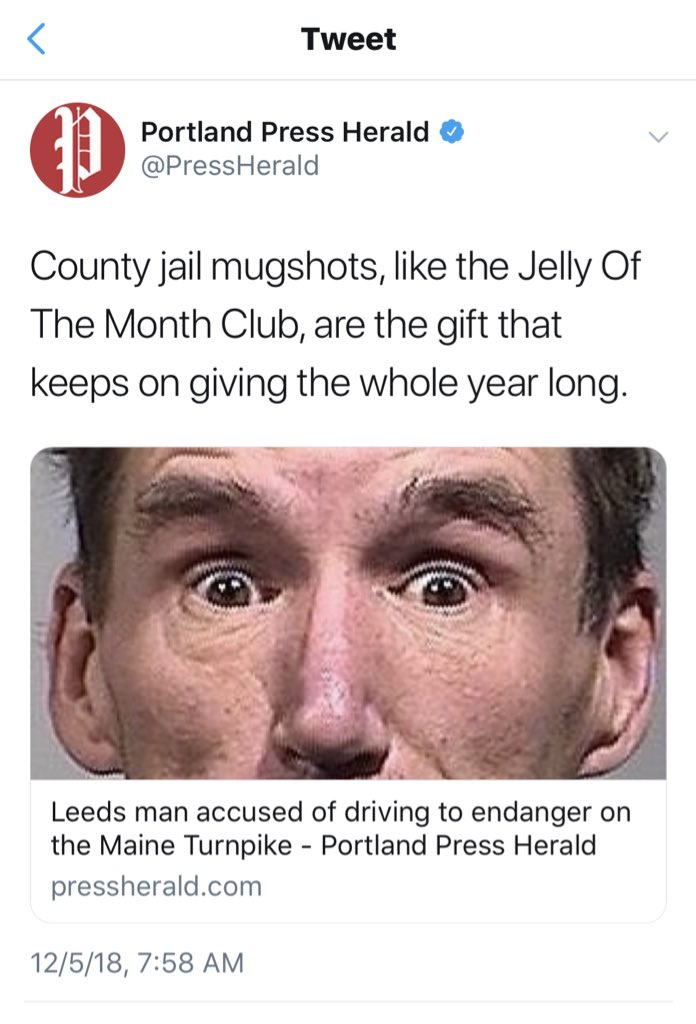
Funny, right? Those losers.
“They’re rednecks and ‘oh look at this,’ like its Jerry Springer, like everybody’s like retarded or stupid, or um, ‘Oh ha ha ha, look at, look at their face,’” Bruce told FAIR, about how people in his hometown in Kentucky viewed mugshots:
“Oh, look at his face, he looks like an idiot.” I would be like, “No man, I’m fucking pissed, because I should not be here. This is wrong,” and then, you know, people thought it was funny.
The runaway racism and classism is baked into the cake of the mugshot industry. Everyone’s just dumb and poor and drugged up and ripe for mockery. “Dumb criminal” or “weird news” or “Florida man” memes populate semi-respectable outlets, from People to local TV news affiliates to city newspapers. Very often stories where mental health issues or indigence or addiction are evident, it doesn’t matter. Goofy mugshots and a person we can mock are all that’s needed for clicks. Local media outlets and their addiction to the titillating mugshots help provide the visual collateral for this predatory, anti-poor and racist industry.
“They’ll put a ‘mugshot of the week’ and put some caption underneath it that’s comedic, making fun of their neck tattoo or their hair or the look on their face, or they don’t have any teeth or something like that,” Bruce continued. “Most people think it’s funny. I didn’t.”
Those who attempt a qualified defense of using mugshots may distinguish between local media using mugshots in the context of a story, and overtly sleazy galleries that are simply just tabloids with mugshots. But it’s important to recognize that the former very often hosts the latter, and from a harm perspective, the difference doesn’t matter all that much. (For more on the practice, read excellent reporting in FusionTV—3/9/16—and the New York Times, 6/3/17). The gap between high- and low-brow mugshot tabloidism is not a great as many in the respectable media would like to believe, and a focus on the more exploitative end of the spectrum deflects responsibility from those relatively upscale outlets who do a slightly watered-down version of it.
As of now, the practice is widespread and cavalier, with little appreciation for the harm the practice has on the presumed innocent and declared guilty alike. (If we’re going to morally accept ruining convicted people’s lives online, then can judges at least start factoring in SEO punishment as a kind of virtual time-served?) The ease and speed with which we can access information changes what it means to be “public” info. It’s why Twitter and Facebook have strict guidelines against publishing private information—we intuitively know that “accessible to the public” is not the same as “ethical to publish.”
Given the permanence of the internet and the reputational risk associated with potential employers, partners and friends, a much stricter and thoughtful policy with regard to the treatment of people who have been arrested is needed. It’s not enough to hide behind slogans about “public information” and “free speech”; the issue is a moral—not a legal—one. These are actual people with actual lives, who often have a hard enough time escaping poverty and a racist, cruel justice system without the added barrier of SEO vigilantes at the local paper or TV station making it that much harder.





You are 100 per cent right. Mugshots are unfair. Names of suspects should not be released. Only names of people who are convicted.
Excellent points by AJ once again.
Its too bad they didn’t publish the mug shots of all the heads of the big banks who blew-up the world economy 10 years ago. Oh, I forgot, they weren’t head accountable for anything. And it would have been nice to see the mug shots of those who fabricated the intelligence and whipped up the hysteria for war over non-existent of WMD’s. How many human lives have been lost and bodies maimed over this horrendous crime?
There should have been mug-shots so that there is a deterrent to others who will do the same shit all over again.
What’s funny abut your three examples is that you never talk about what they were accused of, whether they actually did it, or whether they just got a good attorney to get them off. The good thing about mugshots papers, if they are ethical in printing all arrests, is that they let the public know that their bad behavior will result in public exposure. And why wouldn’t it be a good idea for a UPS company to know that their driver as arrested for DUI over the weekend, or a small business to know that their secretary was charged with stealing from the local Walmart, or a neighborhood to know that the old man down the street was accused of molesting a young female relative? We don’t live in Russia where arrests are secret.
In the end, if you’re going to make a legitimate argument, take a few cases and examine they from beginning to end and prove that some harm was done to someone and that the public exposure of their arrest was not truly warranted or deserved. If you find a needle in the haystack like this, you are probably talking more about bad policing.
“The good thing about mugshots papers, if they are ethical in printing all arrests,…”
I used to work as a Legislative Aide and in PR/Communications in a Prosecutors and DA’s office, and guess whom gets excluded from having their mugshots released/published?
Legislators, most Politicians, most Cops, Judges, Prosecutors, those well connected to the former, kids of the wealthy or kifd of Legislators,Politicians, Cops, and of those well connected to the former, etc…
The releasing of suspects name is uncultured and not right. Suspects are not criminal until convicted by the law court.
I applaud Johnson for noting “The runaway racism and classism is baked into the cake of the mugshot industry.” He also is entirely right to question the feigned even-handedness of the Columbia Journalism Review article that presents “both sides” of a debate with more than two significant positions, highlighting only varying degrees of agreement (and omitting any true disagreement). But much of this article is somewhat confused. For one, it presents zero support for the assertion in the headline about this “mugshot industry” being “profitable”. Maybe it is profitable, but the body of the article does not substantiate the headline in that respect–and seems to hypocritically stoop to the same sort of shaming that the article decries. As to the bulk of the article, I was left puzzled as to what Johnson suggests is appropriate. If this information is truly “public record”, then why should the solution be to restrain reporting rather than to change laws to make this information non-public in the first instance (hence making journalistic coverage irrelevant)? The key is really that reference to classism. It was maybe Marx or Lenin who described newspapers like the New York Times as the mouthpiece of bourgeois imperialism. As Marcia Trudor’s comment highlights, the real role of media is to focus its readers’ attention, and the underlying dispute that Johnson has is that he doesn’t like the ideology that the “mugshot industry” promotes, which is generally the reinforcement of the message that society only thrives in a hierarchical social structure and certain people belong/deserve to be on the bottom of the social hierarchy. The ideology of the mugshot industry (per Trudor) is that when the working class and the poor are accused of crime, that confirms the view that they are society’s inferiors, whereas when the rich and powerful are accused of crimes it is a mistake and aberration and not worthy of attention. The concealment of this normative position is ideology at its purest–very reminiscent of Jeffrey Reiman’s excellent book about the criminal justice system “The Rich Get Richer and the Poor Get Prison.” But I remain unconvinced by Johnson’s article, and that of the FAIR organization in general, that “objective” journalism is possible. All journalism subscribes to an ideology, and we can either balance ideologies–as a counterweight to journalism that promotes bourgeois imperialism have a competing journalism that promotes working class interests in the interest of “pluralism”, meaning you have to promote cannibalists, nazis, and anyone else with a “competing” ideology too–or or we can promote a universalist ideology against a hierarchical one (this is the so-called “communist hypothesis” with philosophical origins in the protestant reformation — see Slavoj Žižek,“Ibi Rhodus, Ibi Saltus!” PROBLEMI INTERNATIONAL, vol. 2, no. 2, 2018).
Alfie Bown just wrote something (“Love in the Age of Data,” on a different topic) that perhaps sums up the underlying problem here: “Data claims to show us what is typical, but it also constructs the typical and makes it visible to us in a flash of understanding, where what is perceived appears to have been waiting patiently for our “visualization” to make plain. The very language of data, then, codes it as a mode of seeing and perceiving reality. *** With all data, an abstract concept of what it might show predates the visualization, after which it appears to relate to our existence in a factual way. *** data-oriented developments do more than reflect what is already desired. For one thing, they code desire differently, presenting particular instances of desire as typical or universal and constructing desire itself (including that of those who deviate) in relation to those data-established norms.”
Johnson seems most concerned about journalists constructing and reinforcing certain consensus/hegemony/stereotypes. But that is what all media does, and Johnson seems to simply dislike mainstream media’s choice of scapegoats (minorities, the poor and working class) preferring to scapegoat the mainstream media itself instead. Left unanswered is what Johnson believes should be “typical” here.