

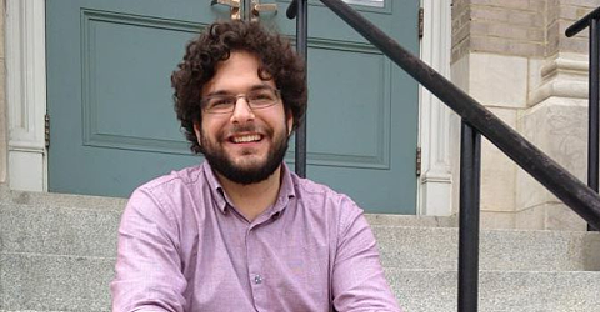
Janine Jackson interviewed the National Homelessness Law Center’s Jesse Rabinowitz about criminalizing the unhoused for the April 24, 2026, episode of CounterSpin. This is a lightly edited transcript.
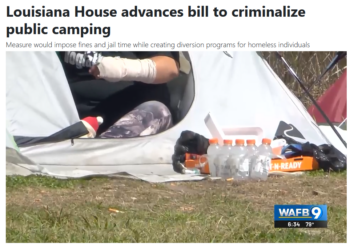
Janine Jackson: “Louisiana House Advances Bill to Criminalize Public Camping” is how many headlines have it, but the bill moving through the Louisiana legislature does more than make it a crime to sleep outside—creating a Dickensian alternate legal system to ensnare homeless people that one advocacy group describes as evoking “debtors’ prisons, convict leasing and the ugliest days of Jim Crow.”
What ideas and what people are driving cruelty like this, and how are people pushing back? Jesse Rabinowitz is the campaign and communications director at the National Homelessness Law Center, and leads the Housing Not Handcuffs campaign. He joins us now by phone from Washington, DC. Welcome to CounterSpin, Jesse Rabinowitz.
Jesse Rabinowitz: Thanks so much for having me.
JJ: It’s not law yet, I don’t think, but explain, if you would, what this Louisiana measure wants to do, what it would do if fully enacted.
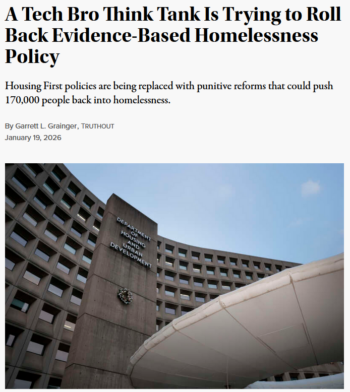
JR: Sure. This Louisiana bill takes a bad idea and makes it even worse. So we know that the far-right-wing billionaires at the Cicero Institute, which is a think tank founded by a former Palantir founder with close ties to the Trump administration, has been peddling these anti-homeless bills in states across the country for several years now.
And what Louisiana has done is taken their cookie-cutter bill, which makes it, in part, illegal to camp outside, and made it a whole lot worse by adding this provision that says that homeless people are subject to a different legal system than everybody else, and that homeless people could be sentenced to undefined “treatment” that they will then have to pay for out of pocket. And if they can’t afford to pay for it, that they can be sent to do labor for the government or a nonprofit organization.
This is bringing back debtors’ prisons, convict leasing, and creating a tiered country where people, by virtue of not being able to afford rent, are subject to a different set of justice. It’s just awful.
JJ: The idea that, like, “Well, you’re living on the street, so give us some money”—I mean, that doesn’t pass a sniff test. It doesn’t seem like it’s even trying to do what it’s saying it’s doing. It’s not that people are just sitting on hundreds of dollars and then choosing to camp out. It’s weird.
JR: You’re absolutely right. Yesterday was the two-year anniversary of the oral arguments in the Supreme Court case of Johnson v. Grants Pass, which shamefully ruled that cities can arrest or ticket people for sleeping outside, even when they have nowhere else to go. And in the past two years, over 300 cities have passed laws that make it a crime to be homeless. Many of them include things like a thousand dollars in fines. If folks had a thousand dollars, they wouldn’t be sleeping outside. If folks had the money to pay for treatment in Louisiana, they wouldn’t be sleeping outside.
But we know that their goal is not actually to help people, because if they were interested in helping people and solving homelessness, they would focus on the things that we know work, like housing and support. Their goal is to scapegoat and target homeless people, to push homeless people out of cities and into government-run detention camps. And that very thing has already happened in Louisiana, which is why this bill is so scary.
JJ: Just to take a beat for a second, these are coercive things that you would never wish on somebody you cared about, but they’re presented as appropriate or even necessary for “those people,” which is already part of a dehumanization that I think is key here. But I want to lift up how this masquerades, if you’re not paying attention, as concern, because “treatment,” after all, it sounds like, “Well, treatment, these people need help. Maybe they don’t know they need help.” But “treatment” sounds positive if you don’t know what’s actually being talked about.
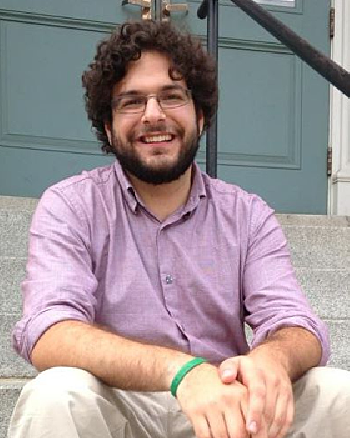
Jesse Rabinowitz: “We need to focus on the real cause of homelessness, which is the fact that rent in this country is just too damn high for more and more people to afford.”
JR: Absolutely. And I say this as a mental health professional; mental health treatment is amazing. It has impacted my life. It is a good thing. There’s not enough voluntary treatment and voluntary services to go around. I know of so many people, both people experiencing homelessness, but also people who have high-paying jobs, who would love to get into therapy or treatment, but can’t find an opening.
This bill doesn’t expand providers. It doesn’t expand services. It doesn’t expand care. All it does is expand this idea that people experiencing homelessness are different than everybody else. But the truth is, most people are just one missed paycheck away from losing their housing, and we need to focus on the real cause of homelessness, which is the fact that rent in this country is just too damn high for more and more people to afford.
JJ: Let’s talk a little bit more, because people say the cruelty is the point, not just because of the obvious lack of compassion that we see from some of these people, their evident despising of people without homes, and of poor people.
But it’s also because, and you’ve tipped this, if the goal were really to get folks off the street, it’s not a mystery how we would achieve that. We do have evidence. If that’s really the goal, we have evidence of what can work. Yep?
JR: Absolutely. I was a homeless outreach worker in DC, working with folks who lived outside with severe and persistent mental illness. None of those folks were living outside because they wanted to. They were all living outside because they had nowhere else to go.
But I saw with my own two eyes that when the client got matched to housing and supports that met their needs, they moved off the streets, they moved into housing, and they were able to get their lives back on track. Housing and services work; there’s just not nearly enough of it to go around. And the Trump administration is talking about cutting programs that we know work, which will make homelessness worse.
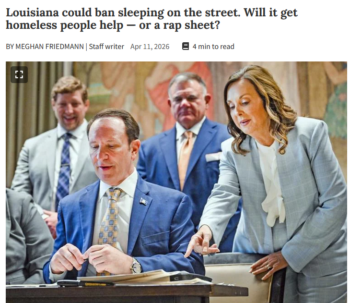
JJ: Well, they work because they help homeless people. And one gets the feeling that that’s not the kind of work that some folks want to be done. I hate to bring it back to cruelty, but it does seem as though there’s some weird—I mean, Louisiana Gov. [Jeff] Landry, for example, points to Donald Trump’s attacks on homeless people as his model and as justification. There’s a miasma of just cruelty. It seems to me that is what is driving this, and not an actual desire to get people off the street and into housing.
JR: I absolutely agree with you. Their desire is not to solve homelessness. Their desire is to use homelessness, and to target people experiencing homelessness, and make that a political football to enact an authoritarian regime, to stoke the flames of white supremacy and to deflect from this administration’s failures to actually help everyday people: Rent is more expensive, gas is more expensive, food is more expensive.
But people across the country actually agree with us. We have poll after poll that shows most people reject the idea of making it a crime to be homeless. And most people recognize the solution to homelessness is housing, not handcuffs.
We need our politicians to do their job and make sure that everybody, regardless of what they look like, where they come from, what they do, has a safe place to live. Louisiana is taking the backwards and easy way out, but it’s actually not going to solve homelessness. It’s going to make homelessness worse.
JJ: And I think some of us thought that maybe we’d got past the “individual moral failing” understanding of poverty, that we had advanced to a more structural understanding of how those conditions are created. As we know, we’ve been rocketing backwards into the past for some time now.
And just to say, this isn’t something to tweak. It’s not that these cut-and-paste anti-homeless laws that we’re seeing around the country need fixing. We need a whole different understanding, don’t we, of why things are as they are, and a different vision of how things can be?
JR: Absolutely. Consistent with their agenda, the Trump administration is trying to move us backwards. They are trying to move us backwards to a time of massive mental health institutions, of making homeless people jump through impossible hoops. And we used to do those things as a country, and we stopped doing them because they were both unjust and they simply didn’t work.
But we know that it doesn’t have to be this way. We have more than enough money in this country, more than enough brain power and expertise, to make sure that everybody has a safe place to live. And most people want everybody to have a safe place to live. And we have to build a housing system that works for people and not for profit.
JJ: Let me just ask you, finally, if you have any thoughts about reporting in this regard. Is there anything you’d like to see more of, or perhaps less of, when it comes to media talking about these issues?

JR: I really want the media and everyone to understand that the targeting of homelessness has, throughout history, been a tactic of authoritarian regimes. Just like people are rightfully outraged about the targeting of migrants, of queer folks, so too we have to understand that this purposeful targeting of homeless people is out of an authoritarian textbook.
But what starts with homeless folks isn’t going to stop there. They’re going to come for everyone that they don’t like, or they disagree with, which is why we all collectively have to stand up together and say, “No, we are not going to accept this. We are not going to accept a society where people that the administration doesn’t like are forced into detention camps or into jail.” Instead, we have to channel people’s rightful outrage to build a system that works for the many and not for the few.
JJ: We’ve been speaking with Jesse Rabinowitz from the National Homelessness Law Center. You can follow their work online at HomelessLaw.org. Jesse Rabinowitz, thank you so much for joining us this week on CounterSpin.
JR: Thanks for having me.




Funny how all this quite righteous condemnation of The Serial Killer Clown and cabal’s venom toward homeless folks brings up the image of Gavin Newsom tossing their belongings in my mind.
The bile crosses the aisle