

In an attempt to understand the coalition that gave Trump his narrow victory, for the past year and a half the press has spun a whole new subgenre of stilted, tautological feature reporting on how Trump supporters support Trump (FAIR.org, 2/15/17).
And in their opinion sections, corporate media have fared no better. They have routinely given platforms to those who claim, with little to no firm evidence, that Trump’s election and his steady (though historically low) popularity (as well as his predicted eventual reelection) are all partly if not wholly the fault of liberal smugness and left-wing political correctness run amok.
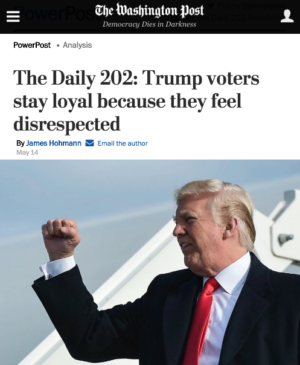
Just last week, the Washington Post (5/15/17) picked up the theme in a post with this matter-of-fact title: “Trump Voters Stay Loyal Because They Feel Disrespected.” Citing a small survey of voters in one county in Michigan by Democratic pollster Stan Greenberg, the Post simply repeats this conventional wisdom without skepticism. Of course, pollsters like Greenberg are in the business of getting more clients based on their purported insights into the electorate, no matter how tenuous or anecdotal their proclamations prove to be later. (Remember the pollster-cited “NASCAR Dads” and “Security Moms” in the 2004 election that nobody could actually find?)
But the proof presented in these arguments is routinely shot through with logical holes that go unaddressed. Neither Greenberg nor the Post seem to notice the massive lack of self-reflection, my-side bias, and obvious hypocrisy found in these anecdotal grievances. Consider this passage:
Trump voters complain that there is no respect for President Trump or for people like them who voted for him. One older white working class woman from Macomb recalled when she first started voting, “there was so much respect for the president. And I don’t care what he did, or what he said, there was always respect. It was always ‘Mr. President.’ And now, it disgusts me.”
Did Greenberg ask this woman her opinion of Trump’s years of Birther lies about President Obama? Who knows? Was there any specific inquiry as to what, if any, type of criticism of Trump from the left she or others like her would deem appropriate or respectful? Apparently not. Might “liberal condescension” just be a convenient fig leaf for hardened, motivated reasoning from an older, white demographic that is already heavily predisposed to like Trump, regardless of what liberals say? You won’t find any answers to legitimate questions like that here or elsewhere in these feckless claims. But that hasn’t stopped some of the most prestigious media outlets in the country from helping to perpetuate them.
The Washington Post is by no means alone. Politico (11/16) ran its own essay targeting liberal “smugness” and blaming “the left” for Donald Trump’s victory right after it happened. Among many other examples over the past 18 months are op-eds in the Guardian (“With Every Sneer, Liberals Just Make Trump Stronger,” 8/16/17), CNN (“Democrats: The Party Who Cried Racist,” 12/1/16), and the Post yet again, when the paper’s resident columnist-cum-fossil fuel lobbyist, Ed Rogers, conveniently blamed conservative voter alienation on an old standby in right-wing grievance-mongering: “The Democrats’ Use of the Race Card Does Real Harm” (11/1/17).
Former New York Times columnist Josh Barro, in a column for Business Insider, (7/17/17), zeroed in on the grave ills of left-wing cultural signaling with “Liberals Can Win if They Stop Being So Annoying and Fix Their ‘Hamburger Problem.’” (That problem is that they’re supposedly “too ready to bother too many ordinary people about too many of their personal choices.”)
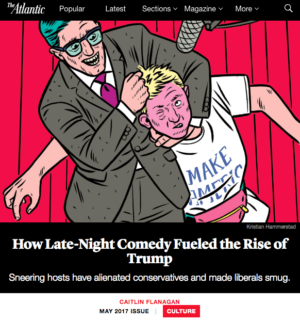
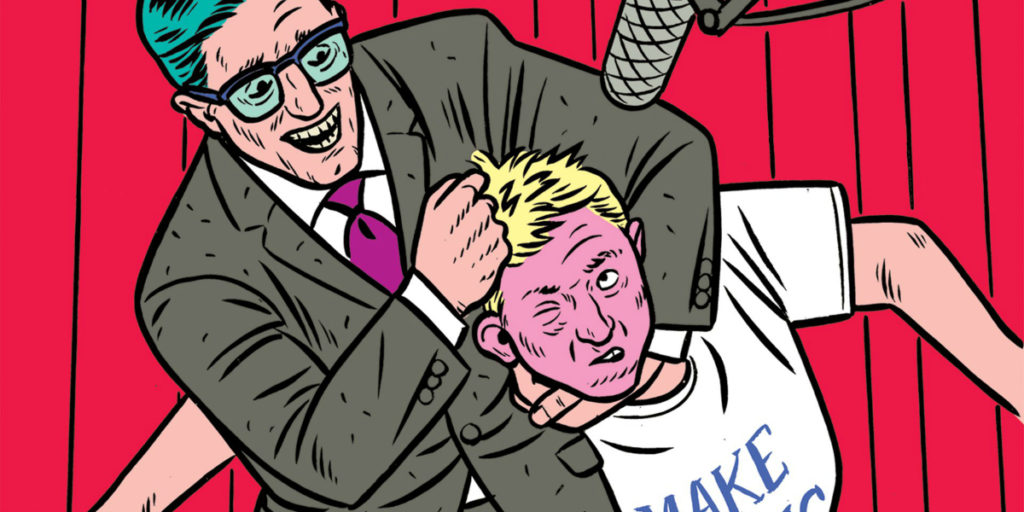
For her part, Caitlin Flanagan at The Atlantic (5/17) fingered the “sneering hosts” and “liberal smugness” of the likes of Seth Meyers, Samantha Bee and Saturday Night Live. All their sarcasm and jokes at the expense of the president and conservatives were proof of “How Late Night Comedy Fueled the Rise of Trump” as well.
But perhaps nowhere among the ranks of the establishment press will you find this “liberal smugness” argument more frequently than in the New York Times. The paper began indulging this op-ed narrative before the voting even began. Ross Douthat’s late-September column (9/21/16), “Clinton’s Samantha Bee Problem,” presaged Flanagan’s by a full eight months, calling out liberal comics as “propagandists” and “indoctrinators” whose “hectoring” was pushing more people to embrace Trump.
Right after the election, the Times ran “Stop Shaming Trump Supporters” (11/9/16). Just weeks later, the Times’ Maureen Dowd generously gave her Thanksgiving column over to Kevin, a conservative family member who, without any sense of irony, condemned liberal condescension with a heavy dose of his own (11/26/16):
Here is a short primer for the young protesters. If your preferred candidate loses, there is no need for mass hysteria, canceled midterms, safe spaces, crying rooms or group primal screams. You might understand this better if you had not received participation trophies, undeserved grades to protect your feelings or even if you had a proper understanding of civics.
Left unmentioned by Dowd’s relative: what a “proper understanding of civics” would say about the Republican congressional leadership planning from the very night of Obama’s first Inauguration to undertake unprecedented obstruction of his presidency, as well as eight straight years of likening him to everything from the “antichrist” to a “monkey” to an “Islamic terrorist.” But this kind of convenient historical omission is also typical fare for this flawed genre.
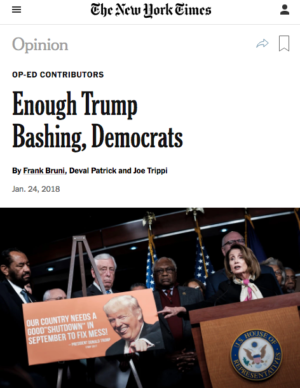
It didn’t stop there. A few months later, the Times re-framed this argument as a question, while ignoring the answer that Betteridge’s Law would offer for an op-ed with the loaded headline: “Are Liberals Helping Trump?” (2/18/17). Around the time of this year’s State of the Union, the paper published a conversation that included columnist Frank Bruni, headlined “Enough Trump Bashing, Democrats” (1/28/18).
This past March, Times readers were treated to “When Smug Liberals Met Conservative Trolls” (3/9/18), a classic both-sides op-ed from Reason’s editor-in-chief that employed reductive false equivalence about the failed DACA compromise: “The left labeled the right racist; the right accused the left of hating America. No substantive policy change resulted.” Of note: the op-ed writer didn’t feel it germane enough to mention that in a bipartisan meeting on DACA and immigration, the president apparently called Haiti and African nations “shithole” countries, or that two prominent Republican senators then used legalistic excuses to provide him with political cover for his xenophobic remarks, or that right-wing pundits and supporters online also closed ranks around, if not openly endorsed, Trump’s reported racism.
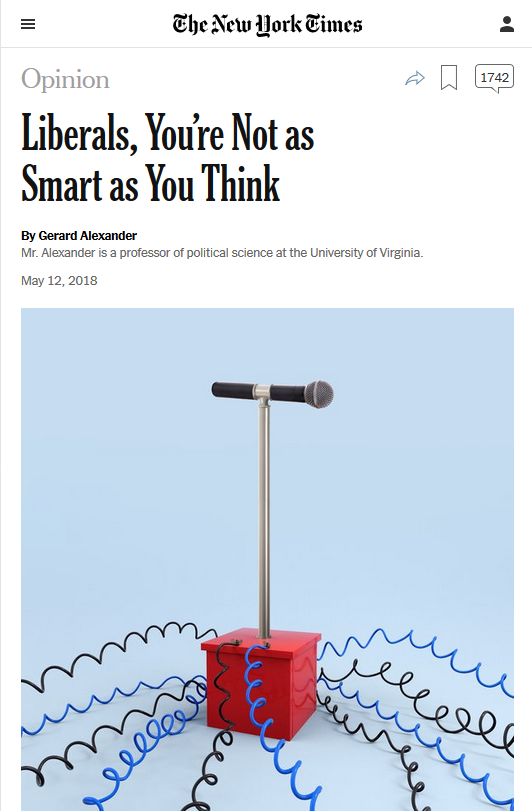
Then, this month, the paper ran its latest installment in this series: “Liberals, You’re Not as Smart as You Think” (5/12/18). Written by Gerard Alexander, a professor of political science at the University of Virginia, the op-ed traffics in the same old tired tropes and one-sided examples as its predecessors. In a stroke of self-parody, Alexander literally begins his essay with the lazy rhetorical defense mechanism of “Some of my best friends are (X),” that has long been the go-to excuse for people who have just made or are about to make a specious, if not discriminatory point about people who are (X). True to form, in the next paragraph he follows with wild, completely unprovable speculation: a “backlash that most liberals don’t seem to realize they’re causing—is going to get President Trump re-elected.”
Blame-the-liberal is a time-honored tradition among conservatives and predates Trump’s rise by years, decades even. It has been the ethos of Fox News since its first day on the air, reaching back through the presidencies of Obama (“Why Are Liberals So Rude to the Right?”: Guardian, 5/27/13) and Bush (Mona Charen’s 2004 book Do-Gooders: How Liberals Hurt Those They Claim to Help [and the Rest of Us]), all the way to the very origins of the modern conservative movement, when William F. Buckley expressed his infamous disgust with effete liberals by preferring governance by the first 2,000 names in the Boston phone book to the faculty of Harvard.
But Alexander’s shtick is literally repetitive. In fact, he made the exact same argument in the Washington Post (2/4/10) eight years ago, in “Why Are Liberals So Condescending?” And while his cherry-picked instances of left-wing insufferability have been updated, mostly—Alexander couldn’t resist playing at least one Golden Oldie in both pieces, the favorite right-wing taunt about Obama’s “they cling to guns and religion” remarks from the 2008 campaign—the beats are nonetheless the same throughout. As is his bad-faith characterization when contrasting liberal vs. conservative rhetoric. (The racist Birther conspiracy theory and unparalleled GOP obstruction is again completely overlooked.) Recall the tsunami of bile spewing forth from Fox News and right-wing radio during Obama’s first term, and then decide for yourself if his description below matches reality:
Of course, plenty of conservatives are hardly above feeling superior. But the closest they come to portraying liberals as systematically mistaken in their worldview is when they try to identify ideological dogmatism in a narrow slice of the left (say, among Ivy League faculty members), in a particular moment (during the health-care debate, for instance) or in specific individuals (such as Obama or House Speaker Nancy Pelosi, whom some conservatives accuse of being stealth ideologues). A few conservative voices may say that all liberals are always wrong, but these tend to be relatively marginal figures or media gadflies such as Glenn Beck.
This reading of history is patently preposterous to any sentient human. But even setting that aside, one might think that Alexander would feel compelled in his latest Times op-ed to acknowledge that in the age of Trump, right-wing invective against the left (and the media, a common stand-in for the left ) really has intensified. Instead, he shrinks down Trump’s vast compendium of discriminatory and bigoted remarks to a mere two passing incidents, minimizes them with murky language, and then helpfully distances his supporters from even that tiny sliver of intellectual honesty:
Admittedly, the president doesn’t make it easy. As a candidate, Mr. Trump made derogatory comments about Mexicans, and as president described some African countries with a vulgar epithet. But it is an unjustified leap to conclude that anyone who supports him in any way is racist.
This is a thinly veiled shot at Hillary Clinton’s “deplorable” comment about Trump supporters during the 2016 campaign. Which she apologized for, and which, if we’re being fair, was aimed at what she said were the “half” of Trump’s supporters that endorsed racism, sexism or other discriminatory policies.
Racism is obviously a bipartisan problem with deep, systemic roots and a long, toxic legacy in our country. But Alexander doesn’t even attempt to grapple with those broader issues, or deign to mention the racist “Southern strategy” that the Republican Party employed for decades—and that Republican National Committee chair Ken Mehlman apologized for. Rather than acknowledging that sexism and racism remain very real and pernicious phenomena in our society, these op-eds typically treat the words as mere insults that the left manipulatively and indiscriminately lobs at conservatives for almost every little thing they do.
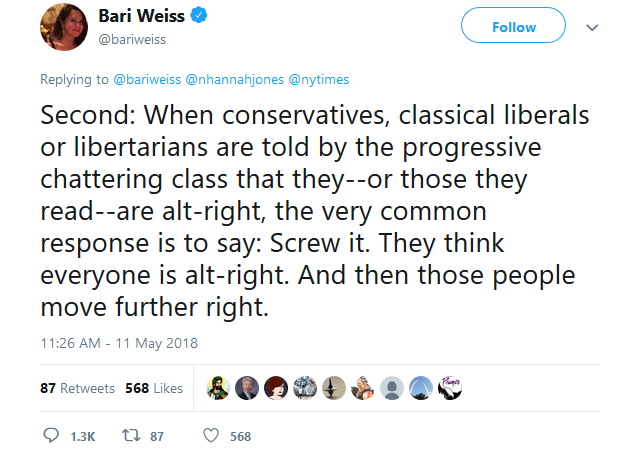
That is a key point: It is the intense reaction among conservatives to being labeled racist or bigoted that is a through-line in this liberal-smugness-only-makes-conservatives-more-reactionary argument. Time and again, any underlying racism or discriminatory policies cited by liberals are treated as mere pretense to stigmatize those on the right. This manifests itself in almost absurdly reductive ways. Consider New York Times editorial page columnist Bari Weiss’ comment on Twitter (5/11/18) this month:
When conservatives, classical liberals or libertarians are told by the progressive chattering class that they—or those they read—are alt-right, the very common response is to say: Screw it. They think everyone is alt-right. And then those people move further right.
There is a lot here to unpack. First off, how does this tetchy, spiteful backlash by conservatives that Weiss and others claim is a “common” phenomenon comport with the right-wing’s overwhelming disdain for thin-skinned “snowflakes,” or being “triggered,” in their sarcastic lexicon? (A Pew survey from July found that by a ratio of about five-to-one—83 percent to 16 percent—Trump supporters say too many people are easily offended.) And what does it say about the principles of conservatives if exposure to criticism by left-wing pundits makes them suddenly more sympathetic to rancid white nationalists or Nazi ideology?
Likewise, is there any reliable evidence that this widespread, liberal-triggered backlash behavior even exists? It is true, per a 2017 Cato survey, that
strong majorities of Republicans (73 percent) and independents (58 percent) say they keep some political beliefs to themselves…while a slim majority (53 percent) (of Democrats) do not feel the need to self-censor.
But being less likely to air one’s opinions—possibly out of shame or embarrassment—is not proof that conservatives are changing their opinions, or retrenching further to the right due to liberal hectoring (or, for that matter, that those opinions are worthy of sharing in the first place).
One might expect a political science professor like Alexander would be eager to cite professional research or an academic study or two to finally prove the liberal-smugness effect. Notably, neither he nor his fellow conservatives ever bother with this step—and the mainstream op-ed editors giving them a platform don’t seem to care. Instead, it is enough to simply state the claim as self-evident, or to quote a handful of random people who make sweeping claims about the abuse they face from unnamed liberals, as a way to justify what could just as easily be fairly predictable, baked-in support for Trump by Republicans.
Note this claim from the Times op-ed last February (2/18/17):
Conservatives have gotten vicious, too, sometimes with Mr. Trump’s encouragement. But if political action is meant to persuade people that Mr. Trump is bad for the country, then people on the fence would seem a logical place to start. Yet many seemingly persuadable conservatives say that liberals are burning bridges rather than building them.
The presence of a journalistic weasel word like “seemingly” should be a red flag for editors, a signal this “there, but for the disgrace of liberals, go I” premise is as ephemeral as the supposed snowflakes that conservatives claim liberals have become. Note how convenient it is that the conservatives in this formulation get to have it both ways: expressing personal remorse for some of Trump’s most egregious behavior, but then blaming their continuing support for his presidency on an external factor like culture war hectoring from liberal bullies. It’s easy to see why this idea has become almost an article of faith among some conservatives: It simultaneously offers self-righteousness and absolution.
In fact, however, a University of Maryland working paper that studied reactions to the 2016 election cast doubt on the premise of liberal shaming driving conservatives further toward the right. As it noted, there was no statistically significant evidence of a backlash by conservative voters when confronted with liberal critiques of Trump being racist. In fact, the paper found that conservative racial animus in response to liberal election messaging was rooted in pre-existing biases, which is why those same conservatives also rejected claims of Trump’s racism that came from Republicans. Or, as the paper concludes:
Racially conservative whites are resistant to a racialized counter-strategy. In other words, they are motivated to reject information critical of their preferred candidate because it is inconsistent with their existing racial attitudes and views about the candidate.
This study dovetails with an analysis done by The Nation (5/8/17) of pre- and post-election surveys which found that racial resentment, not economic anxiety, played an instrumental—and consistent—role in support for Trump during the last presidential campaign.
Both racial resentment and black influence animosity are significant predictors of Trump support among white respondents, independent of partisanship, ideology, education levels and the other factors included in the model. The results indicate a probability of Trump support higher than 60 percent for an otherwise typical white voter who scores at the highest levels on either anti-black racial resentment or anti-black influence animosity. This compares to less than 30 percent chance for a typical white voter with below average scores on either of the two measures anti-black attitudes.
These inconvenient facts simply don’t register to those seeking to pin the blame for Trump on those who oppose him. Instead, the only academic argument that regularly appears in “liberal smugness” canon comes via social psychologist Jonathan Haidt, who has become a popular figure within the establishment media thanks to his hand-wringing, pox-on-both-houses rhetoric, which lines up neatly with the faux-objectivity of much of the press.
Haidt’s role in “liberal smugness” op-eds is typically to bemoan partisan invective, while also subtly endorsing conservative victimization. In the February 2017 New York Times op-ed (2/18/17), Times correspondent Sabrina Tavernise also cites a Haidt research study that found “extreme political protest”—defined as “inflammatory rhetoric, blocking traffic, or damaging property”—by Black Lives Matter and anti-Trump supporters tended to result in lower public support. In that op-ed, his findings, along with a quote from a 72-year-old white female retiree who voted for Trump, is held up as de facto proof of the counterproductive nature of liberal scolding and political action.
But there’s a tell in that Trump voter’s quote about the 2017 Inauguration and Women’s March protests, which were overwhelmingly peaceful: “I don’t have a problem with protesting as long as it’s peaceful, but this is destroying the country.” So even when liberals meet the supposed criteria for acceptable dissent, they’re still doing it wrong.
We’ve seen this scenario play out many times before. Massive protests that criticize the status quo are routinely seen skeptically or even unfavorably by large portions of the public, regardless of party. And, as our history has shown, massive protests must often raise awareness of unpopular ideas in order for those ideas to become popular in the first place.
For example, a review of historical polling from the Civil Rights movement finds that strong majorities of the American public disapproved of both the Freedom Rides and lunch counter sit-ins in 1961. In 1963, 60 percent of Americans expressed unfavorable opinions about that year’s upcoming March on Washington. And just a month before the Civil Rights Act was signed in 1964, a Gallup poll found three out of four Americans thought “mass demonstrations” would hurt more than help the cause of racial equality.
Untold numbers of establishment politicians and pundits in that era likewise warned activists like Martin Luther King, Jr. and his liberal political allies that they too would face a backlash for daring to call out segregation and those who support it as favoring institutionalized racism. Refrains of those demands for patience from King and comity in his movement’s tactics echo through the op-eds that damn “liberal smugness” today.
The reality is that these op-eds are little more than fig leaves masking a concerted effort to delegitimize, neuter and stifle even measured, serious liberal criticism. While there are certainly extremists on the left who abuse loaded terms like “racist,” “sexist” and “Nazi,” the liberal-smugness-backlash argument uses these fringe examples to paint with the same broad brush that it accuses the left of using.
Most notably, these editorial arguments betray an intellectual dishonesty about trying to solve the problem they are supposedly diagnosing. Time and again, they expend almost all their energy gnashing their teeth at the alleged sins of liberal smugness and its supposed impact of the right. And yet there is never a corresponding effort to explain how, exactly, those on the left can engage conservatives on deep political differences without inadvertently alienating them.
Consider this Guardian op-ed’s—typically ambiguous—advice (8/16/17) for what liberals should do to express their displeasure or disagreement with Trump and those who enable his policies:
But Trump and his supporters thrive on the venom of their liberal tormentors. The old maxim should apply: Think what your enemy most wants you to do, and do the opposite. Tolerating Trump may stick in the craw, but it must be counter-productive to feed his paranoia, to behave exactly as his lieutenants want his critics to behave, like the liberal snobs that obsess him.
What does this “tolerating” entail, specifically? And how does it differ from a crude attempt at reverse psychology that is tantamount to getting liberals to voluntarily squelch their own dissent? You won’t find out from these supposed analyses of conservative feelings.
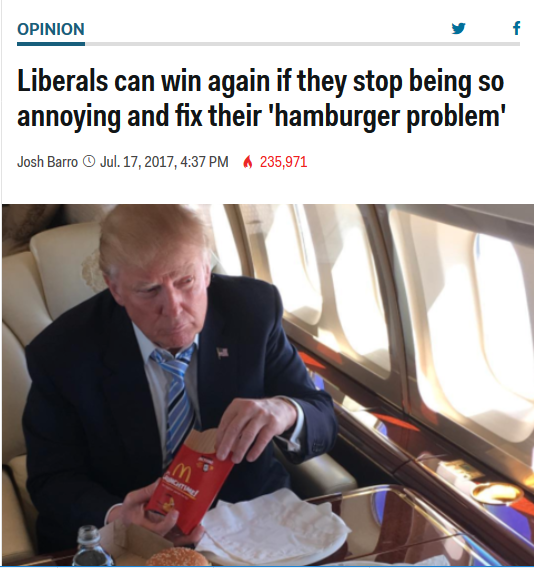
Former Times columnist Josh Barro did make more of an effort than most in his Business Insider column (7/17/17), but it still reeks of incredibly vague platitudes, ripe for easy manipulation and misinterpretation:
Don’t tell people they should feel guilty…. Say when you think the liberal commentariat has gone overboard…. Offer an agenda that provides benefits people can see as mattering in their daily lives…. Don’t get distracted by shiny objects.
As for Alexander’s Times piece, this is the extent of his advice for how liberals can break through and reach on-the-fence moderate conservatives in the marketplace of ideas:
Champions of inclusion can watch what they say and explain what they’re doing without presuming to regulate what words come out of other people’s mouths. Campus activists can allow invited visitors to speak and then, after that event, hold a teach-in discussing what they disagree with. After the Supreme Court ruled in 2015 that states had to allow same-sex marriage, the fight, in some quarters, turned to pizza places unwilling to cater such weddings. Maybe don’t pick that fight?
Boil it down, and you start to see the impossibly small needle liberal criticism and protest is being asked to thread by this argument: Carefully police your own rhetoric, but give those on the right the benefit of the doubt even when not policing theirs; assert your constitutional rights to free speech and against discrimination, but not in a disruptive way, and maybe not all the time.
This argument appeals to corporate media opinion editors because they almost universally fetishize calls for more respect and civility in politics, which have their own problematic history of abuse (FAIR.org, 11/17/16). But, in fact, this “liberal smugness” narrative is something much different and more insidious. It’s a zero-sum proposition that seeks to carve out special treatment for the beliefs of conservatives, while intentionally narrowing the acceptable tactics, voice and messaging of liberals. It’s a stealth closing of the Overton window from the left, positioned as an opening to give more fresh air to the right. It is not a new, insightful, or, at bottom, intellectually honest argument, and the op-ed editors who are willingly perpetuating it are doing both the public and the press a serious disservice.





Conservatives always win because what they have to do to stay on top is much easier than what liberals have to do just to get off the bottom.
A comment that provides yet more anecdotal evidence of that which has been empirically proven….that conservatives are far more self-righteous than, say, not only liberals, but of every sociopolitical subgroup tested.
The problem is that there’s a double standard here: For instance, another commonly used epithet for liberals is that they’re “sanctimonious.” Yet, who is more sanctimonious (and smug) than, say, Wayne LaPierre, or Bill O’Reilly, or any member of the Bundy clan, or any anti-abortion crusader on any given day? Somehow, smugness and sanctimony are supposed to be pathologies of people on the left but not on the right. I’d like to hear just one of these pundits parse that for me!
Exactly.
I remember Bob Altemeyer (author of The Authoritarians and The Authoritarian Spectre) chuckling over the irony of how self-described conservatives, prior to filling out a questionnaire that measures the level of self-righteousness of the one filling it out, were asked how they thought they would score on it compared to the other, more liberal and/or middle-of-the-toad politically, students who had also agreed to submit themselves to taking the Self-Righteousness Scale. Year after year the conservatives predicted they would score at the bottom of the scale – would be revealed as the least self-righteous people of them all. Year after year however the conservatives scored at the top of the S-R Scale, and usually by quite a margin. “Which” as Altemeyer chuckled, “is precisely what you’d expect the most self-righteous group to say of themselves, isn’t it?”
The Democratic party deserted the base a long time ago. It used to be they supported things like labor, civil rights, social safety net, etc. The neo-liberal Clinton Democratic party changed all that, went modern and corporate. And deserted the base, who were supposed to supplant issues of jobs and wages with issue of… wait… what issues did Mrs. Clinton run on? I can’t think of any. Can you think of any reason why we were supposed to vote “Clinton”? Other than to avoid “Trump”? I can’t, not specifically. She didn’t have a platform worth mentioning, other than “shared values with Israel” duties, and she lost me there.
If only the Democratic Party would read your post and take it to heart.
How they expected to win the rust belt states after they repeatedly betrayed the workers with trade deal after trade deal is beyond my understanding. I guess the two for one exchange that Schumer predicted didn’t come to fruition. Maybe if the DNC would more effectively betray the working class Schumer’s theory would come true.
The purpose of all there soft articles is to keep people from discussing real problems, which if changed might damage corporate profits and enrich the unwashed masses. People voted for Trump because they are desperate for change and will try anything. Neoliberal economic policies ruined the lives of millions of formerly middle class Americans and they resent it. They want it changed. The only places that voted strongly for Hillary were the financial and tech centers where those economies have benefited from the policies. My problem is how the voters think that changing the president without changing the congressmen and senators is going to change anything. If you keep electing the same senators and congressmen for 10, 20, 30 even 40 years in a row they are going to keep voting for the same budgets and things are never going to change.
The Democratic Party establishment serves the global establishment in the same fundamental and fraudulent ways as the Republican Party. I hope you accept the premise.
Corporate media is part of that transnational allience. Globalization should come to mind.
USA Dems having a roll in the theatre of USA Government, the elections and narrow script development is quite enough, and a full career task for the organization.
Apart from the monitorization and said or unsaid contractural agreements of the two party players, the nation, media and players themselves get very excited and wrapped up in the team game as if the show is real.
Certainly the Dems would prefer to be the protagonists but in actualizing their core values of staying in the series they are hardly going to confront the production sponsors; humanity’s colonizers.
Smug is the right word for both parties: looking back from a people’s revolt or national/economic or ecological collapse one would have no hesitation in acknowledging an arch of smugness across the board.
But in analyzing the daily show the players get so bound up in, better words to describe the Democrat brokers are billigerent, vindictive, fraudulent and duplicity – the same longterm currency as the GOP.
If you accept the first premise then you’re likely not to be surprised about the thickness of systemic despotism.
you’re way too longwinded. learn to edit yourself and you’ll have more impact.
I have to agree. This was twice as long as it should have been and was screaming for an editor. What’s “tired” is the reader, after slogging through it.
The smugness of people who think they’re liberal is noxious and has a real cost. Did it cost the Dems the election? The Queen of Smug and Presumptuousness was probably to blame there, but what it IS costing this country is a real dialogue between both sides. The smug are secure in their righteousness, and don’t feel they have to come to the table. In my experience, the other side is more open to discussion, which I’m sure the Smug Set would think is illusory. As long as this stalemate continues, we’ll suffer the kind of disunion that rewarded us with Trump.
you’re way too longwinded. learn to edit yourself and you’ll have more impact.
I have to agree. This was twice as long as it should have been and was screaming for an editor. What’s “tired” is the reader, after slogging through it.
The smugness of people who think they’re liberal is noxious and has a real cost. Did it cost the Dems the election? The Queen of Smug and Presumptuousness was probably to blame there, but what it IS costing this country is a real dialogue between both sides. The smug are secure in their righteousness, and don’t feel they have to come to the table. In my experience, the other side is more open to discussion, which I’m sure the Smug Set would think is illusory. As long as this stalemate continues, we’ll suffer the kind of disunion that rewarded us with Trump.
Neither Party has room to be smug.
In 2016 neither Hillary (48.2%) nor Trump (46.1%) received a majority of the popular vote.
Meaning that, in either case, more voters cast their ballots for “someone else.”
As the major parties become increasingly polarized, they create a growing vacuum in the Center — that will be filled, one way or another.
We The People are becoming more Centrist. …. when will the politicians see this?
Our author appears to suggest that “liberal smugness and left-wing political correctness run amok” are abstract concepts that may not be real.
But they do exist in my humble opinion.
But either way, and even if cause-and-effect is difficult to establish, the correlation between perceiving them and voting for Trump is strong.
The terms are being redefined. Liberals are now progressives. So called liberals are now neoliberals which are more aligned with conservatives. Conservatives like to try and maintain the old trope about liberals because they think it serves their interests.
The terms are being redefined. Liberals are now progressives. So called liberals are now neoliberals which are more aligned with conservatives. Conservatives like to try and maintain the old trope about liberals because they think it serves their interests.
Dems have been pandering to the Far-Left over the past 8 years or so.
That’s why they’ve been losing.
If you’re Democratic and want to win again, ditch the MoveOn/Alinsky tactics and get back to the real issues.
A great article on the topic (and not mentioned above) was written in January 2017 by Robert B. Reich. “The Life of the Party: “7 Truths for Democrats”
Look here: http://robertreich.org/post/156133931835
Hi Oddsox. and Thank you for the referral to read the above listed Reich article. That helps, but it still feels like dems and gopers are too much alike.
I was horrified in the last election, in how voters in Brooklyn were either dissed form the voting logs or disappeared into another party.
I was also horrified that the AP stated that Hillary had won and CA and 4 or 5 other states hadn’t voted yet!! The electoral college had already voted… oh swell so I guess one person one vote just disappeared. : 0
I really wanted Bernie for president and knocked on many neighborhood doors for him. I am one of those who thought that Hillary was smug, and people very much reacted to that I . I could not believe that in her final appearance she was dressed all in white and I thought, OMG, she’s channeling Amy Semple McPherson as she stood before the crowd and raise her arms in her all white outfit and there was smugness on her face…..scary it was.
I knew then that that she would lose. I would very much like a woman president, like Elizabeth Warren, because. she has a brain————-and to vote just because someone has a penis or a vagina is really stupid, and ultimately very costly—–that Citizens United debacle from the Supreme Court is killing the nation,. and so too when the Supremes also decided that money was free speech————America went down the rabbit hole with that one. : (
Absolutely correct! But it is even worse when you are a life long socialist and think our entire system of economy and politics require a complete do over.
fantastic article Rex! I was just listening to a conversation FAIR’s own Adam Johnson did on his Citations Needed podcast on soundcloud on this stupid argument that PC Liberals is what gave us Pumpkinhead and this continued pivot more to the right to try to appease right-wingers that we still don’t tolerate their inhumane views enough and haven’t normalized their cocktail of bigotry enough. I say to them: get over yourselves snowflakes and idlibs (idiot liberals) stop helping them out.