

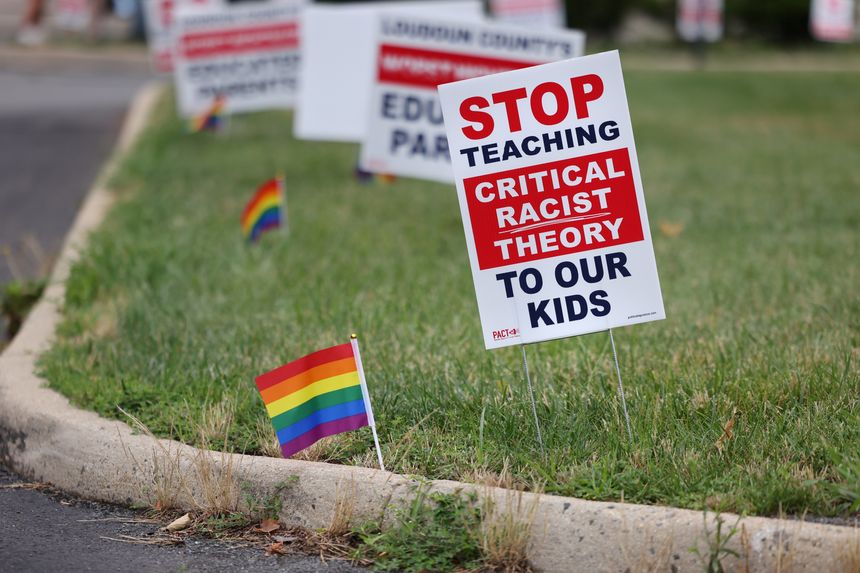
The Wall Street Journal (7/7/21) takes aim at critical race theory, which it describes as “a neo-Marxist ideology that…teaches that a person is defined above all else by race, gender and sexual orientation.”
The Wall Street Journal editorial board (7/7/21) recently condemned teachers’ support for anti-racist curricula and professional development. In a piece headlined “The Teachers Unions Go Woke”—because the right loves to use that term as a pejorative—the board wrote:
Believe it or not, union leaders claim that parents who oppose any of this are motivated by hate and are assaulting free speech….
But no one is opposed to teaching about America’s difficult racial history, including the evils of slavery and Jim Crow. What parents are awakening to is that their children are being told the lie that America has made little or no racial progress and therefore its legal, economic and political systems must be turned upside down.
While this may not be surprising coming from the notoriously right-wing Journal board, it’s worth unpacking as a window into the heart of the right’s anti–”critical race theory” campaign—what it’s trying to do, and how.
Opponents of teaching history
First, and crucially, the paper’s claim that “no one is opposed to teaching about America’s difficult racial history” is a flat-out lie, the one that is necessary to sustain the argument.
As much as the right whines about CRT supposedly calling people racists, the point of CRT is explicitly the opposite. CRT turns attention away from individual racist actions, instead highlighting the ways in which the history of racism in this country is embedded in present-day institutions. Right-wing movement leaders know this truth, and they are terrified of it. The evidence is clear as day in their messaging.
Take Texas. The state senate just passed a bill (SB3) that prohibits teaching that
with respect to their relationship to American values, slavery and racism are anything other than deviations from, betrayals of, or failures to live up to the authentic founding principles of the United States, which include liberty and equality.
Also on the Texas list of banned ideas: that “the advent of slavery in the territory that is now the United States constituted the true founding of the United States.”
Curriculum elimination

This is the 21st century, so instead of banning a book, Texas is banning a multimedia web project (New York Times Magazine, 8/19/19).
Texas had passed a bill just a month earlier (HB 3979) prohibiting the teaching of critical race theory and the New York Times Magazine‘s 1619 Project, which has an accompanying curriculum and “aims to reframe the country’s history by placing the consequences of slavery and the contributions of Black Americans at the very center of our national narrative.”
Texas Democrats managed to amend that bill to require that a number of historical texts and “historical documents related to the civic accomplishments of marginalized populations” be taught in the state’s social studies curriculum. SB3 would strip the vast majority of these, including:
- “The history of Native Americans”
- The Indian Removal Act
- MLK’s “Letter from a Birmingham Jail”
- Brown v. Board of Education
- The Emancipation Proclamation
- The 15th Amendment
- “The history of white supremacy, including but not limited to the institution of slavery, the eugenics movement, and the Ku Klux Klan, and the ways in which it is morally wrong.”
To top it off, Texas Lt. Gov. Dan Patrick, who is also a member of the board that oversees the state’s history museum, successfully pressed the museum to cancel a book event slated to talk about the role of racism and slavery in the Battle of the Alamo (Texas Tribune, 7/2/21).
‘Divisive concepts’
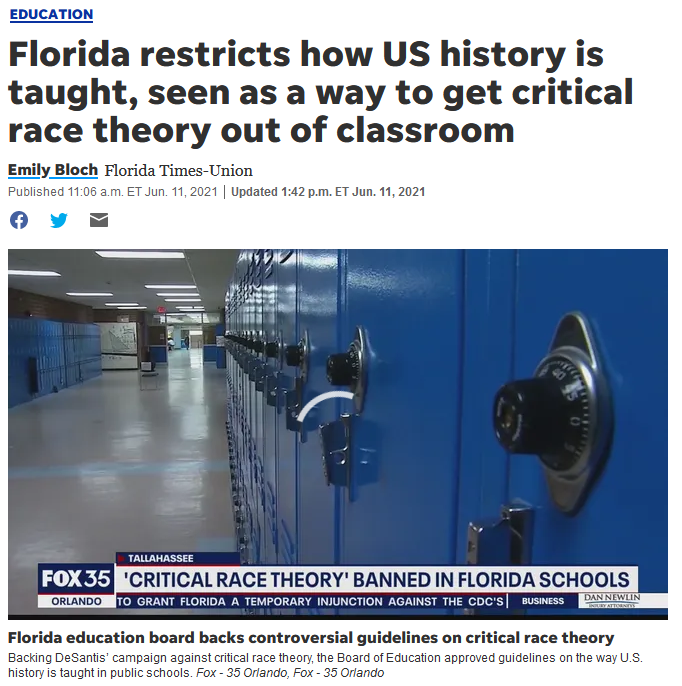
Under Florida’s new rules, teachers “may not define American history as something other than the creation of a new nation based largely on universal principles stated in the Declaration of Independence” (USA Today, 6/11/21).
Texas, of course, is not alone. In Florida, which has also banned the teaching of the 1619 Project, teachers “may not define American history as something other than the creation of a new nation based largely on universal principles stated in the Declaration of Independence” (USA Today, 6/11/21).
Twenty-seven states at this point have introduced restrictions on what can be taught in schools regarding race. Most use identical language (lifted wholesale from Trump’s executive order to prohibit federal agencies, contractors and grant recipients from conducting diversity trainings) that prohibits schools from teaching a list of “divisive concepts”:
- “the United States is fundamentally racist or sexist”
- “any individual should feel discomfort, guilt, anguish or any other form of psychological distress on account of his or her race or sex”
- “any other form of race or sex stereotyping or any other form of race or sex scapegoating.”
These further clarify that “race or sex stereotyping” means ascribing, among other things, “privileges, status or beliefs to a race or sex.” (Do you think white people or men have privileges in our society? Sorry, that idea is “divisive” and therefore banned.)
A threat to critical understanding
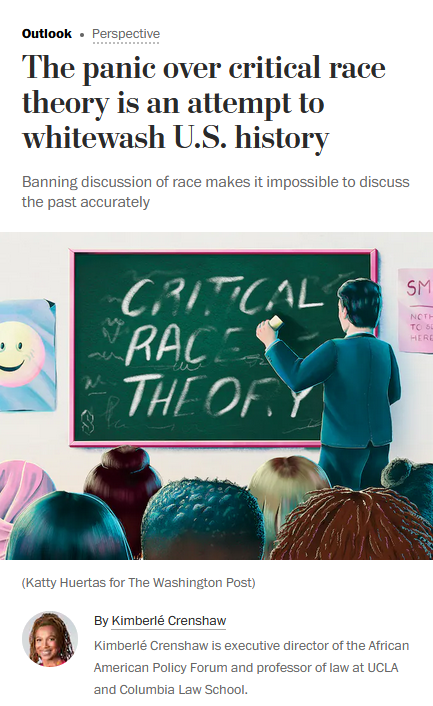
Kimberlé Crenshaw (Washington Post, 7/2/21): “Racism ended in the past, according to the developing backlash, and we would all be better off if we didn’t try to connect it to the present.”
As leading critical race theory proponent Kimberlé Crenshaw (Washington Post, 7/2/21) points out, while such language doesn’t technically ban teaching about historical racism, it
is even more insidious: It explicitly sets out to sanction certain feelings as part of a disingenuous crackdown on racial division. In closing off room to explore the impact of America’s racist history by citing “division”—a subjective condition that turns on any student’s (or parent’s) claim to feel resentment or guilt—the laws directly threaten any teacher who pursues a sustained, critical understanding of the deeper causes, legacies or contemporary implications of racism in fomenting uncivil discord.
Contrary to the Wall Street Journal‘s disingenuous protestations, the entire point of the current backlash campaign is precisely to arrest the recent movement toward teaching about the United States’ “difficult” racial history, because understanding the structural racism of the past reveals and gives context to its persistence.
A whitewashed history that erases the roots of structural racism is the linchpin to the right’s argument that America cannot be a racist or sexist country today. It follows that any inequalities that exist must be based on individual behavior, and racial (and gender) justice movements—against, say, police violence or attacks on voting rights—are misguided.
If they cannot teach about structural racism, then both the past and present of racial and gender inequality can only be attributed to a few bad apples.
The myth of ‘racial progress’
Which brings us to the second step in the argument, as presented by the Journal:
What parents are awakening to is that their children are being told the lie that America has made little or no racial progress and therefore its legal, economic and political systems must be turned upside down.
There’s no attempt at obfuscation here: They absolutely don’t want anyone talking about the fact that systemic racism continues to this day, and therefore needs to be addressed institutionally—which is exactly what the BLM protests of last summer made the country talk about.
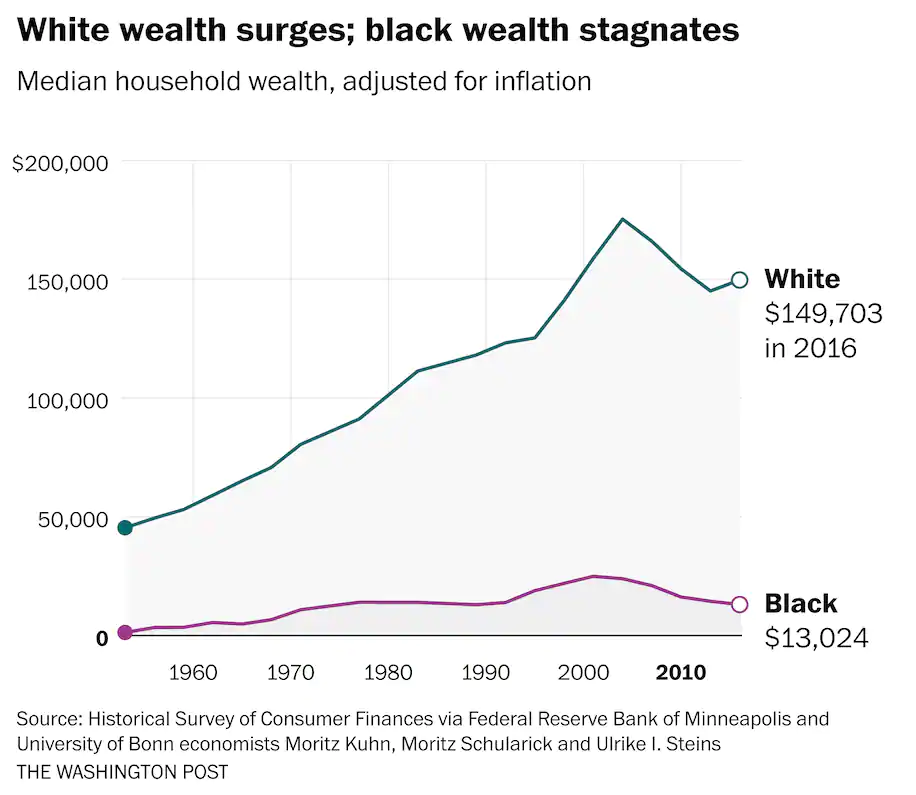
The Black/White Economic Divide Is as Wide as It Was in 1968, the Washington Post (6/4/20) reported.
They don’t want anyone talking about the fact that Black men are two and a half more times as likely as white men to be killed by police (PNAS, 8/20/19), but that those Black men killed are twice as likely to be unarmed (Nature, 5/26/21).
They don’t want anyone talking about the fact that the current life expectancy for a Black American is 73 years, versus 78 for white Americans—with Covid only expanding the discrepancy (PNAS, 2/21/21). This gap has not not narrowed appreciably since the Jim Crow era.
They don’t want anyone talking about the fact that Black people are uninsured at almost twice the rate of whites (Center for American Progress, 5/7/20), and that Black and Indigenous patients continue to receive poorer health care than white patients (New England Journal of Medicine, 2/25/21).
They don’t want anyone talking about the fact that race and ethnicity are better predictors of exposure to pollution than poverty is (Atlantic, 2/28/18).
They don’t want anyone talking about the fact that the median Black family has less than one-eighth the net wealth of the median white family, and that this number essentially hasn’t changed in 30 years.
After beginning by warning against “progressive political indoctrination,” the Journal concluded, “Parents have every right, even a duty, to fight back against this invasion of progressive politics in their schools.”
By “fight[ing] back” against an “invasion of progressive politics,” the Journal means cleansing the classroom of any serious discussion of racism—whether in the past or present.
ACTION ALERT: You can send a message to the Wall Street Journal at wsjcontact@wsj.com (or via Twitter: @WSJopinion) Please remember that respectful communication is the most effective. Feel free to leave a copy of your communication in the comments thread.
Research assistance: Elias Khoury




If the past is forgotten
The future is forfeit
Dear Wall St. Journal:
So—how many employees at the Wall St. Journal are African American? Just wondering.
Oh and hey, you might want to read this book: “The People’soHistory of the United States,” by Howard Zinn. This is a great starting place before moving in to Critical Race Theory.
Sincerely yours: a white person : )
How arrogant of you to assume that the only reason writers at the WSJ might disagree with Twitter politics is that they are ignorant and sheltered from black people.
Regarding this BS about teaching the children of white supremacists anything that might make them feel ‘discomfort’: anyone recall the good ol’ days when rightwingers ascribed hurt feelings to progressives as a way to insult and belittle them, and to dismiss their calls for social justice? Remember the sneering insult, “snowflakes”?
That was way back in 2016-17. One prominent rightwing a$$hole called snowflakes, “snivelling little weak-ass narcissists”. https://www.theguardian.com/science/2016/nov/28/snowflake-insult-disdain-young-people
This in turn reminds me of Nixon VP Spiro Agnew defining progressive “intellectuals” as “an effete corps of impudent snobs.” Agnew, corrupt to the core, later resigned in disgrace after pleading no contest to a single plea-deal felony count of tax evasion. (Attn: Donald Trump.)
Notice the language used by the right: snowflake, snivelling, little, weak-ass, effete — terms pertaining to physical size, strength, and vulnerability. This pattern fits with far-right and fascist hyper-masculinity and deriding any sign of ‘weakness’. (Again, attn: Donald Trump.)
But suddenly, voila! — so-called feelings of “discomfort” are sufficient pretext to hijack education, forcing educators to teach a vast skein of lies-by-omission regarding structural racism and the like. These draconian “memory laws” (as historian Tim Snyder calls them) in some cases may even criminalize teachers who violate these vague new standards.
I take this as a sign that the US could be plunging toward full-on authoritarian rule. For reference, see this Tim Snyder piece, published shortly before Trump was inaugurated: https://www.facebook.com/timothy.david.snyder/posts/1206636702716110.
Ahem!
As I understand it, “critical race theory” stems from an academic abstraction — a certain metaphorical lens or perspective by which to view historical contexts of the past and present.
CRT has now emerged from academia. As a label, the “theory” part persists in popular language and thinking. Given our bare-knuckle real-world context, I think that’s unfortunate.
Let’s unpack “theory.” It has two meanings: (a) an abstract lens or perspective, and more popularly (b) something unproven, debatable and (in the view of deniers) no more or less valid than any fact-free “theory.”
Consider, for instance, state laws forcing educators to teach alternative (read: Bible-based) “theories” alongside the “theory” of evolution — as if coequal. How fair! How open-minded! How politically corrupt.
With malice aforethought, rightwingers misuse the term “theory” to conflate any body of proven, well-established fact and an academic way of interpreting it. Think evolution, climate change, and now structural racism.
Academic abstractions are important. They play vital roles in scholarship and the advancement of human thought. One might even say, that’s what academia is for: in western culture, at least, it’s a sandbox in which people explore concepts and experiment with ideas.
Outside academia, on the other hand, us ordinary folks advocate for redress of blatant, baked-in, structural racism and the like. I see nothing “theoretical” about the harsh evidence of structural racism. (Thank you Julie Hollar for listing a few real-world examples.)
In our non-abstract, social justice context, I wish we could drop the word “theory.” Structural racism is fact. Reality, Lived experience — not “theory” as in popular parlance.
It’s unclear how it is this columnist feels qualified to speak for the “left”, but enthusiasm for this new doctrine — call it what you will — is far from universal. “Woke”, used with contempt, is not unique to the far right
Forget “CRT”, which isn’t a theory, since none of its claims can be proven true or false. There is, for example, no way to prove or disprove the claim that “race is a social construct”. Such assertions represent doctrine, not theory. So let’s put it in very simple terms: you either see everything in this life as an injustice based in the latest race/gender grievances — or you don’t. And you either think that pursuing this understanding of the world is productive in changing society for the better — or you don’t.
It’s easy enough to reject either the “woke” understanding of the world, or the “woke” prescription for change (the DEI grievance industry), without being a right-winger.
Of course, there’s always been a faction of the American left determined to dig its own grave and in “CRT”, it’s found the ideal shovel. You people — yes, “you people” — make the Democratic party mainstream look good by comparison. Venal though they are, at least they aren’t worried to death that someone, somewhere, may say something they find hurtful or in violation of current prohibitions.
Certainly true, Jake. You don’t have to be a right winger to be a racist.
Oh, wonderful! Anyone who takes exception to the current orthodoxy is a racist.
Impossible to provide a better example of the — speaking politely — intellectual shortcomings of the racial/gender grievance movement. A million thanks!
I agree with Jake here. The snobbish reply left on his above remark highlights a distinction between CRT’s written and oral traditions. On paper, CRT is purported to provide new structural framework for critiquing and understanding our social institutions. But in practice it rapidly devolves into “all white people are racist” or “anyone who disagrees with us is racist” hysteria.
Uh, sorry but no, it doesn’t. That’s just what you imagine will happen, likely due to some deep seated or long-held beliefs or neuropathy, possibly tied to some guilt over the feelings you might have had about race in your own youth or formative years.
Sorry, Evergreen State isn’t what will happen at every…nay….ANY school where curricula is influenced by CRT in the proper fields of study and context. I’d agree that CRT has little to no place in math, science or the like. But it’s not even controversial to argue that the right (and some members of the labor “left”) have long been afraid of teaching actual history to the point that slaves were called “guest laborers” in Texas schoolbooks – and Texas (and California) are the main textbook markets in the country, so they tend to drive the way other states’ books are written.
Again, not even remotely controversial – the right (and that includes the Democratic center and the corporations that control them) are fine to preach American exceptionalism, western chauvinism and even white superiority. If you see a corporation or Democrat pushing for anything “woke” looking – there’s a profit motive, but on the right it’s a matter of personal and party gut feelings.
No one has to “imagine” things seen every day on all media platforms. Fail.
And that may have been in Texas, so you say, but 25 years ago our textbooks used the word slavery and delved into chattel, etc etc. Now try the leading comments, well poisoning and other trite fallacies to someone who at the least is better at not being blatant about it.
Different disciplines can have different approaches to the racial and racist history of the United States. In literature or reading or writing classes, for instance, a study of Hamilton should include The Haunting of Liin-Manuel Miranda by Ishmael Reed. And for those in social studies or history classes, Richard Rothstein’s The Color of Law could be excerpted, if not assigned, to raise the question of how, for instance, Levittowns were segregated by law, with a covenant forbidding veterans to sell their homes to any but white people. Don’t call it racial theory, call it history.
Nobody can argue that economic disparities statistically correlative to race exist. The problem is to explain them—whether the disparities are the result of racism or racism is the result of ruling elites’ efforts to preserve the disparities, I.e. their hegemony. Did plantation owners enslave Africans because they were black, or because they wanted their labor, and rationalized slavery by racist myths?“Critical race theory” is a pompous misnomer for reducing all social phenomena to issues of skin color. It has nothing in common with “critical theory,” which was an intellectually credible method of Marxist analysis that the German Frankfürtschul developed after the Second World War.
Try again, John.
Critical Race Theory doesn’t try to reduce ALL social phenomena to race. It tries to separate the wheat from the chaff.
It tries to highlight the different actors in racial disparities: why most white students no nothing of the Tulsa massacre (hard to call a riot where +300 black people are slain, and another 1000 were injured, versus 2 or 3 white people killed), but hear a ton about the Watts riots.
Critical race theory is interrogative in nature: the laws being put in place are both subjective and vague, and are dictatorial in nature.
which one leads in a straight line away from the truth?
Sure looks like the laws, not CRT.
“which one leads in a straight line away from the truth?” Exactly, and who created and controls the lines? And, why did they create the lines? The man behind the curtain can no longer hide.
An excellent book that counters the myth that slaves were treated well is – American Slavery as It Is: Testimony of a Thousand Witnesses is a book written by the American abolitionist Theodore Dwight Weld, his wife Angelina Grimké, and her sister Sarah Grimké, which was published in 1839.
Over a period of time they collected newspaper articles where the slave owners own words were published which tell exactly how the slaves were treated.
Forgot to add – hate is taught and is passed down thru the generations. We still have people that are fighting the Civil War.
Nobody is mentioning … CRT is taught in college/universities … NOT grammar school or highschool where all the attention is going and parents are getting riled up.