


Janine Jackson interviewed TLDEF’s Ezra Young about trans rights law for the February 7, 2025, episode of CounterSpin. This is a lightly edited transcript.
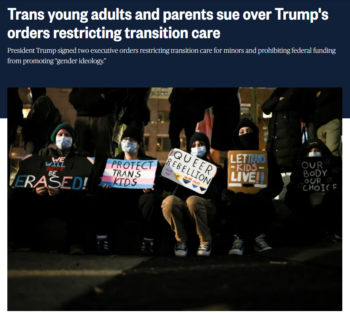
Janine Jackson: Transgender youth, families and advocates are filing lawsuits, pushing back on Trump executive orders that define sex as biological and “grounded in incontrovertible reality,” and that prohibit federal funding of transition-related healthcare for those under 19, including by medical schools and hospitals that receive federal research or education grants. According to a report by Jo Yurcaba at NBC Out, that latter order contained language claiming that “countless children soon regret that they have been mutilated,” and that they wind up “trapped with lifelong medical complications” and “a losing war with their own bodies.”
This accompanies orders prohibiting trans people from joining the military, and from receiving transition care while incarcerated, and then just yesterday, a move to ban trans women from women’s sports. It’s evident what Trump and his ilk want to do, but is it legal? And even if it’s not, what impacts could it still have?
Ezra Young is a civil rights attorney whose litigation and scholarship center on trans rights. He’s been visiting assistant law professor at Cornell Law School, director of impact litigation at the Transgender Legal Defense and Education Fund, and legal director at African American Policy Forum, among other things. He joins us now by phone from Charlottesville, Virginia. Welcome back to CounterSpin, Ezra Young.
Ezra Young: Thank you so much for the invitation.
JJ: Ground us, please, with some basic understanding. Discrimination based on gender identity is illegal. That’s established, isn’t it?
EY: Yes, it is. Gender identity is a newer term, but is essentially equivalent to sex. Federal law prohibits discrimination on the basis of sex, both under our Constitution, as well as under many statutes.
JJ: And it’s also established that the White House or Trump doesn’t have, really, the legal power or the authority to carry out these moves that these orders indicate, right?
EY: Correct. So this is just basic constitutional law, like I would teach my first-year law students; any one of them would be able to spot this. Under our Constitution, our government is one of limited powers. Those powers for the presidency are delineated in Article Two. The responsibility of the US president is to execute and enforce laws that are passed by Congress, not to make up new laws, and most definitely not to infringe upon the rights that are protected by the United States Constitution.
JJ: Right. Well, we know that the law saying they can’t do something doesn’t necessarily mean—we can already see that it hasn’t meant—that nothing happens, including things that can deeply affect people’s lives, even if they aren’t legal. So accepting that grayness, what should we be concerned about here?
EY: Well, first and foremost, I’d push back on the sense that there’s grayness. This is a situation where there’s black and white. Our Constitution, which I firmly believe in, enough so that I’m an expert in constitutional law and I teach it, limits what a president can do.
So let me contrast this with the president’s power when it comes to immigration. There’s a lot of power in the president when it comes to immigration, because that’s an issue over which our Constitution gives him power. But our Constitution is one of the government of limited powers, meaning if power isn’t expressly provided via the Constitution, the president can’t just make up that power. So for folks who think the president is doing something unconstitutional, or insists he has powers he doesn’t have, the best thing to do is to push back and say absolutely no.
Part of what we’re seeing right now, with some local hospitals in New York and elsewhere essentially trying to comply in advance, in the hope to appease Trump if one day he does have the power to do what he says he’s doing, that’s absolutely wrongheaded. We don’t, and no one should. That was why our country was founded. Despite all the sins on which it was founded, a good reason why we were founded was to make sure that the people retained the vast majority of the power. And when politicians, including the United States president, pretend they have more power than they do, it’s our responsibility as citizens and residents of this nation to push back and say no.
JJ: I appreciate that, and that the law is not itself vague, but that with folks complying in advance, as you say, and with this just sort of general confusion, we know that a law doesn’t have to actually pass in order for harms to happen, in order for the real world to respond to these calls, as we’re seeing now. So it’s important to distinguish the fact that the law is in opposition to all of this, and yet here we see people already acting as though somehow it were justified or authorized, which is frightening.
EY: It is frightening, and I think, again, that goes to our responsibility as Americans. Citizens or not, if you’re here, you’re an American, and you’re protected by the Constitution. It’s our responsibility to push back people who are all too ready to take steps against the trans community, against trans people, just like all of the other minority groups President Trump is trying to subjugate, and to insist: “Hey, stop. You’re not required to do this. If you’re choosing to do this, that’s a problem.”
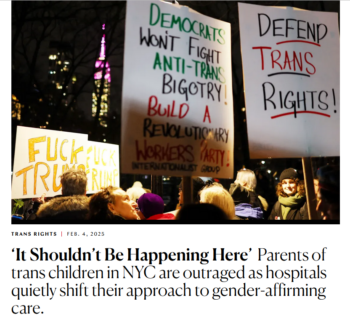
JJ: We are seeing resistance, both these lawsuits and protests in the street, I feel like more today than yesterday, and probably more tomorrow than today. Do you think that folks are activated enough, that they see things clearly? What other resistance would you like to see?

Ezra Young: “If Trump were to put out an executive order today declaring the sky is purple, that doesn’t change the reality that the sky is not purple.”
EY: I think protests are a great way for folks who might not know a lot of these issues, or might have limited capacities, so they’re not lawyers, they’re not educators, they’re not doctors, but they’re people who care. That’s a great way to push back, put your name and faith and body on the line, and to show you don’t agree with this.
In addition to that, I would suggest that people read these executive orders and know what they say and know what they don’t say. When I say, right now, for the trans community, complying in advance is one of the biggest problems we’re seeing, I mean it. I’ve been on dozens of calls with members of the trans community, including trans lawyers at large organizations and law firms, people who work for the federal government, who are not what my grandfather would call “using their thinking caps” right now. They’re thinking in a place of fear, and they’re not reading. They’re not thinking critically.
If Trump were to put out an executive order today declaring the sky is purple, that doesn’t change the reality that the sky is not purple. We don’t need to pretend that is the reality. We can just call it out for what it is, utter nonsense.
Beyond that, I would say people should not change anything about the way they live their life or go about the world, simply out of fear that something will be done to them that no one has the power to do.
I can say—it’s kind of funny—I was at a really conservative federal court last year, and I lost my passport. I thought I was going to find it again, but I didn’t, and then I got busy with work, and Trump came into office. So I finally got my stuff together, and applied for a new passport. A lot of people in my community were concerned that I wasn’t going to get a passport, and all I could think was: “I read all of the rules. I read all of the executive orders. There’s nothing that says I can’t get my passport.” I’m not home in Ithaca, New York, right now, but my understanding is my passport was delivered yesterday.
JJ: OK, so just going forward, people think media critics hate journalists, when really we just hate bad journalism, which there has been a fair amount of around trans issues; but there are also some brighter spots and some improvements, like one you saw out of what might seem an unlikely place. Would you tell us a little about that?
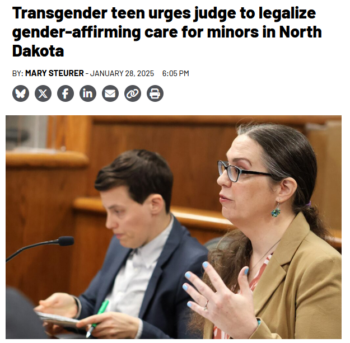
EY: One of my friends, Brittany Stewart, of an organization called Gender Justice, which is based in Minnesota, brought a lawsuit against the state of North Dakota, challenging a ban on minors accessing trans healthcare. This case was filed about two years ago, and it just went to a bench trial, meaning it was heard by only a judge in North Dakota last week.
Very lucky to the people of North Dakota, there’s a wonderful local journalist by the name of Mary Steurer who has been following the case for the last two years, and attended each and every day of the seven day bench trial. And each day after court, she submitted a story where there were photographs taken straight from the courtroom of the witnesses that were not anonymous, and describing what happened for the day.
And it’s not just passive recording that Mary did; it’s really critical reporting. She picked up on reporting in other states where the same witnesses testified. She shared long summaries of witness testimonies for the day. And my understanding is her reporting was so good that the two other major newspapers in North Dakota ran all of her daily reports on their front pages.
JJ: Yeah, Mary Steurer writes for the North Dakota Monitor. I looked through that reporting on your recommendation, and it really was straightforward, just being there in the room, bringing in relevant information. It just was strange, in a way, how refreshing it was to see such straightforward reporting. She would mention that a certain person made a statement about medical things, and she’d quote it, but then say, “Actually, this is an outlying view in the medical community,” which is relevant background information that another reporter might not have included. So I do want to say, just straightforward reporting can be such sunlight on a story like this.
EY: Yes, and especially I appreciate that Mary is local to North Dakota. She’s not an outsider parachuting in for a trial that might otherwise be overly sensationalized. This is a North Dakotan covering a North Dakota case in Bismarck, and she’s really speaking to the sensibilities of North Dakotans, and what they want to know about a case like this, not what outsiders like me from New York might think.
JJ: Let me just ask you, Ezra, while I have you, forward-looking thoughts. I’ve heard you say these moves are not legal, these executive orders are not legal, they can be stopped, people are engaged in stopping them. Are there things you’d look for journalists to be doing right now, or for other folks to be doing right now, that can make sure that goes forward in the way that we want it to?
EY: For journalists, I’d recommend that you cast a wide net to understand all of the actions that are happening, and all of the lawsuits that are happening. A lot of journalists at the national level, at the very least, do really reactive reporting. So within a few minutes of an executive order coming out, they’ll talk to the same activists that they always talk to on both sides. They’ll talk to a lawyer who has no idea what this area of law is, just to get a quote in, and then they move on.
I think it would be helpful for Americans, and trans Americans especially, to know there’s more going on in our fight than being reactive to nonsense executive orders.
As one example, I filed suit against the US Office of Personnel Management yesterday, on behalf of my client Manning, a former federal employee challenging the federal government’s health benefits plans’ decades-long trans exclusions in healthcare. This is a case that captures the long arc of the struggle for trans rights. It started 10 years ago, and ironically enough, the only administration that was supportive of Mr. Manning’s bid was Mr. Trump.
JJ: That is odd.
EY: But here we are in court again.
JJ: All right then, so cast a wide net, and don’t just look at the most recent thing that’s come down the pike, because that will just have all of our heads spinning, and take our eyes off the prize.
EY: And talk to different voices, not just the same activists, not just the same lawyers, not just the same parents, not just the same kids. There are a lot of trans people. We’re not a monolith. We have different views and interests, and different experiences, and you won’t capture that if you just talk to the same talking heads.
JJ: All right, then. We’ve been speaking with civil rights attorney Ezra Young. You can follow his work at EzraYoung.com. Thank you so much for joining us this week on CounterSpin.
EY: Thank you so much, Janine.


This is an excellent summation of the delusional idealism of liberalism: “Well, first and foremost, I’d push back on the sense that there’s grayness. This is a situation where there’s black and white. Our Constitution, which I firmly believe in, enough so that I’m an expert in constitutional law and I teach it, limits what a president can do.”
Wow, what are even worried about?!? The system works!
I think the fundamental assumption Ezra Young is making is false. Essentially, he’s assuming a level of institutional functionality that is obsolete, and so are a lot of other people. I am a whistleblower with an MA of Public Policy from Central European University with a BA of International Affairs, and a lot of background in genocide psychology and authoritarianism. I was absolutely telling people to get passports urgently, and look at how transpeople’s passports are now being “corrected” to reflect their birth sex and make their passports worthless. I have spent the last few years observing, fighting, and trying to warn people about the functional nullification of civil rights laws due to spectacular, awe-inspiring corruption (a prerequisite for Fascism), among other causes, and the media is not doing enough to give marginalized people informed consent about this reality and what it means.
It is negligent to focus on “well, this is illegal,” as though the law will protect people from Trump’s executive orders when it will not. Back in 2016, I was like 20 feet away from Newt Gingrich who was making gross comparisons between Trump and Andrew Jackson. The Supreme Court ruled against Jackson’s Trail of Tears, and Jackson did it anyway because he knew the Supreme Court couldn’t enforce their rulings. Don’t think for a moment that Trump intends to respect Rule of Law, and he’s already captured the Supreme Court, so he doesn’t have to. If the law functioned, Trump would be in jail. If our institutions functioned to protect us, we would never have gotten to this point.
I have seen a 180 degree disconnect between the de jure and the de facto when it comes to protective laws, and that’s what people need to know about. Perpetrators already know they can expect impunity, yet victims are being told to “know their rights” as if that will protect them when they will not. Journalists often cannot tell the stories of corruption that corroborate what I am telling you, and an investigative reporter I just worked with had his two year investigation undermined after one highly-censored and sanitized piece (out of perhaps six planned articles), and he was at one of the biggest and most important publications in the nation.
Down-playing the threats and telling people to focus on what Trump “can do” given “legal authority” creates a dangerous lack of informed consent and false sense of security, and it is negligent. Here’s one of my favorite examples: Maps that show best states for LGBTQ+ people are based on laws and policies in those states. They do not consider whether or not those laws and policies are enforced or upheld at all. Someone might move to one of those states from a more dangerous (on paper) state looking for safety, only to find out they’ve walked into a trap…
Please take this seriously. I’m happy to explain the many mechanisms through which civil rights have been nullified for the majority of people if you contact me.