

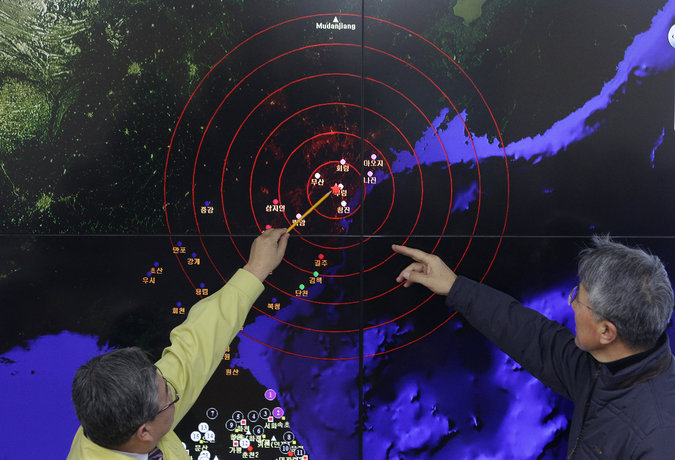

The New York Times ran this photo under the dramatic headline “North Korea Says It Has Detonated Its First Hydrogen Bomb.” But is there any reason to believe that the North Korean claim might be true? (photo: Chung Sung-Jun/Getty Images)
The New York Times‘ David Sanger and Choe Sang-Hun (1/5/16) say that if North Korea’s claim to have successfully tested a hydrogen bomb is true, that would “dramatically escalate the nuclear challenge from one of the world’s most isolated and dangerous states.” But they don’t say why.
Fusion-based hydrogen bombs have more explosive power than nuclear fission bombs that rely on uranium or plutonium. “If the North Korean claim about a hydrogen bomb is true, this test was of a different, and significantly more threatening, nature,” the Times reports. It’s not made clear, though, what if anything North Korea could achieve by having a bomb that could destroy a city and its suburbs rather than just a city, or how the response by the US and its allies to such a threat would be in any way different.
Nor does the Times‘ front-page story point out how unlikely it is that North Korea has, in fact, detonated a hydrogen bomb. “Detection devices around the world had picked up a 5.1 seismic event along the country’s northeast coast,” the Sanger/Sang-Hun article reported–using a number that is unlikely to mean much to many readers. A Q&A on the Times‘ website (1/6/16) does more to put the story in context:
The United States Geological Survey reported that it detected a magnitude 5.1 seismic event in the northeastern part of North Korea, where the test is said to have occurred — roughly similar to what happened in 2013, when North Korea tested an atomic bomb. But a South Korean lawmaker, Lee Cheol-woo, said that his country’s intelligence service estimated the event triggered an explosive yield of six kilotons and a magnitude 4.8 event — smaller than the 7.9 kilotons and magnitude 4.9 reported after the 2013 test.
A successful hydrogen bomb test would typically have an explosive yield of hundreds of kilotons — or tens of kilotons, for a failed test — Mr. Lee said.
So whatever it was that North Korea exploded, the US and South Korea agree that it wasn’t much different in power than the bomb North Korea tested in 2013. It’s really difficult to say how this would “dramatically escalate the nuclear challenge” posed by North Korea. But it might sell some papers if you put it on the front page.
Jim Naureckas is the editor of FAIR.org. Follow him on Twitter at @JNaureckas.
You can send a message to the New York Times at letters@nytimes.com, or write to public editor Margaret Sullivan at public@nytimes.com (Twitter:@NYTimes or @Sulliview). Please remember that respectful communication is the most effective.






“It’s really difficult to say how this would ‘dramatically escalate the nuclear challenge’ posed by North Korea.”
A thermonuclear (“H-bomb”) explosion would be a step toward miniaturization without sacrificing explosive power, allowing the DPRK to put their nukes on the missiles they are also improving, making them deliverable throughout the region, or beyond, thus strengthening their deterrent (or threat, if you want to think in those terms).
Although the level of analysis in the media is dismal, North Korean claims of progress are worth taking seriously, based on recent history. Condescending, knee-jerk skepticism has been proven wrong several times in the past, going back to their first fission-bomb test. I would look for a more authoritative source about what occurred than a South Korean member of Congress.
I agree with David G. There is no credible evidence that North Korea didn’t test an H-bomb, either. Especially since it was first reported in the Chinese media, which would indicate that the DPRK first notified the Chinese government.
“Knee-jerk skepticism,” David G? In today’s media misinformation/manipulation world, that’s what EVERYONE should be exercising.
I think you missed Jim’s point. He’s not trying to debunk the event itself; rather just pointing out how the NYT is (yet again) fearmongering without all the facts.
TeeJae –
I should have said “knee-jerk disbelief”. Skepticism is good. North Korea may be trying to make a dud test sound like a success, but if so, their thinking is still worth looking at closely. DPRK officials are equally horrid, and a lot more competent, than their U.S. counterparts.
My basic point was that FAIR’s take was as confused as the Times’s.
FAIR’s take is perfectly logical. With or with out ‘evidence’ which seems to be scant anyway, what difference does it make if they have even Ten nuclear weapons, as compared to say the 200+ nuclear weapons that Israeli not only has, but has an effective deliver system if they need it. Or the several thousand we have, along with China, France, Russia, The U.K., India, Pakistan, Belgium, Germany, Italy, Netherlands, and Turkey.
The Article from the Times reminds me of the scene from the lion in Winter, where Prince John is getting mouthy with Prince Richard, and Richard pulls a knife. John runs around the bedroom yelling he’s got a knife. Queen Elenore of Aquitaine fire back “Of course he has knife. We all have knives! It’s 1183 and we are Barbarians! We, are the origins of war! Not the History’s forces, Nor the Times, nor Justice, nor the lack of it, not causes, not religions, or any kinds of government, or any other thing, we are the killers!
The NYT would be Prince John, sniveling and acting the fool, while screaming about the fact one of the siblings ‘has a knife’.
If this were 1940, and North Korea had a bomb and delivery System, then it would ‘Dramatically escalate’ things, as it did when Hitler was trying to make the bomb. Now days, everyone and his brother has one, and the only thing it is good for, is putting up on the mantle piece like an old musket, to glorify in. Or to use a suicide device, if we suddenly try and take over the place. They can sit in peace, and contemplate all they want. The are still an island with no where to go.