


Dahr Jamail is a staff reporter at Truthout and the author of The End of Ice: Bearing Witness and Finding Meaning in the Path of Climate Disruption. This is an edited transcript of Janine Jackson’s interview with him for the April 27, 2018, episode of CounterSpin.
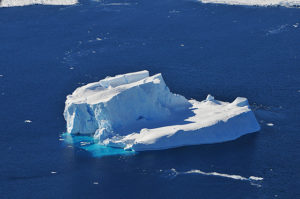
Dahr Jamail: Bottom water is stopping being formed, because of the melting of these coastal glaciers in two places of Antarctica: off the Western Antarctic coast, as well as the Totten Glacier, which is in Eastern Antarctica. And so these are the two fastest-melting regions of the ice continent.
So what this is causing, according to this study, is the cold surface water is no longer making its way all the way down into the depths, so it’s not forming that deeper layer of water that can travel across areas where it normally would. And so what this essentially means is that these two regions of Antarctica’s glaciers are now in a feedback loop where they are melting, it’s causing this effect on the oceans, and then that’s causing even more melting.
And so this is worrisome for numerous reasons. For a long time, scientists believed that Antarctica, being the ice continent, would either not be dramatically impacted by human-caused climate disruption, or at least minimally. But now what this means is that at least 10 percent of Antarctica’s coastal glaciers are now in full retreat, and because of this feedback loop, that retreat’s only going to speed up, and ultimately this feedback loop will start happening on other glaciers in Antarctica as well.
And so for sea level rise, we already know that the Arctic sea ice is dramatically melting, which is going to only intensify the melt rate in the Arctic. Of course, Greenland, we know, is melting at record rates as well. And so now with Antarctica—save dramatic, dramatic changes in mitigation, in fossil fuel CO2 emissions across the planet, on a very, very abrupt timescale—right now, at current trajectories, we are on course, at a minimum, to hit the worst-case projections of sea level rise, which, according to the National Oceanic and Atmospheric Administration, is 8.5 feet by 2100. But these worst-case projections, unfortunately, keep being upgraded every time more and more reports, like the one we’re discussing today, are being released.
(photo: NASA)
Janine Jackson: In terms of attention to what is obviously an almost staggeringly important development, the New York Times had a big three-part photo piece last May, with really spectacular images of Antarctica, and a kind of virtual reality thing. At one point the piece said, if the sea level rise turns out to be as rapid as the worst-case projections, it could lead to “a catastrophe without parallel in the history of civilization.”
And then, since then, and that’s May of 2017, well, the Times hasn’t really gone back to the story. Their recent Antarctica stories have been about penguins, you know. I just don’t know that the attention is commensurate.
And then I want to say a little thing about the tone of coverage, because within that same New York Times piece, in the Part One of it (it was three parts), it noted that US and British scientists were working to get better measurements in the main trouble spots, and then it added, “The effort could cost more than $25 million, and might not produce clearer answers about the fate of the ice until the early 2020s.” And the next sentence is, “For scientists working in Antarctica, the situation has become a race against time.”
Well, surely part of the reason we aren’t running as fast as we might is the amount of coverage, or lack of it, and then this tone that, “Oh, it’s expensive.”
DJ: It is really shocking to me, and I think you really hit the nail on the head when you discussed the fact of the gravity of this crisis and the implications of this on the entirety of human civilization on the planet, not even to talk about other species. And one would think that that would demand a level of coverage that would be path-breaking, urgent and backed up by citing all of the scientific data that’s being released at a fairly rapid pace right now, whether it’s sea level rise, temperature-increase projections, what’s happening to methane in the Arctic, etc., etc.
For example, I would add another quote by Dr. Eric Rignot, a glaciologist with UC Irvine and NASA’s Jet Propulsion Lab, back in 2014, who said, “Today we present observational evidence”—we’re not talking about projections—“observational evidence that a large sector of the West Antarctic Ice Sheet has gone into irreversible retreat…. It has passed the point of no return.” That was four years ago.
So the urgency is clear. Sea level–rise projections are being increased dramatically. We are talking, in the longer run, billions of people being displaced by sea level rise. Entire megacities on the coast, like New York and Tokyo, that are going to have to be relocated entirely, or completely abandoned to the sea.
And so with that being the context, the reportage of, “Oh, OK, well at least we’re not giving the denialists coverage….” We need to be reporting on specifically what is happening, what the projections are, and what this means, because pretending, “Oh, it’s not that bad,” or “We’re still going to be able to mitigate it to the point where we’re not going to have to relocate much of New York City,” for example, it’s just not honest coverage.


