


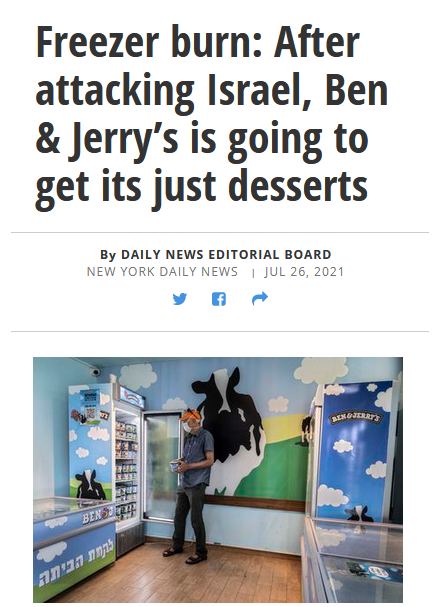
Daily News (7/26/21) on Ben & Jerry’s withdrawal from the Occupied Territories: “Very pleased are the BDS crowd, Israel-haters and assorted antisemites, but it’s an ice-cream headache for Unilever.”
Ben & Jerry’s decision to halt its operations in the Israeli-occupied West Bank and in Jerusalem has pro-Israel editors working overtime.
The New York Daily News (7/26/21) celebrated counter-boycotts of the ice cream brand, including the state’s pension system considering cutting ties with the brand’s parent company, Unilever, because of a 2016 executive order against the Boycott, Divestment and Sanctions movement. The tabloid’s editorial board, sounding like a sidekick standing behind a gang enforcer, said, “No firm should want to be on that very naughty list.”
The New York Post found a brand worker who quit over the West Bank pull out (7/22/21), and a grocery store that is taking the ice cream off its shelves (7/19/21). New York Gov. Andrew Cuomo made waves as the first US governor to take executive action against the BDS movement, but the Post (7/24/21) complained that he’s not attacking Ben & Jerry’s swiftly enough.
In the Wall Street Journal (7/21/21), Scalia Law School professor Eugene Kontorovich gloated that several state pension funds could retaliate against Unilever, because Israel considers parts of the areas Ben & Jerry’s is boycotting to be its sovereign territory.
The Boston Herald (7/21/21) went a step further, denouncing Ben & Jerry’s decision to boycott the occupation as a part of a longer list of unacceptably progressive causes adopted by the brand, like opposing the Trump administration and celebrating racial justice advocate Colin Kaepernick. “If Alexandria Ocasio-Cortez ran an ice cream company, this is what it would look like,” the Herald fumed.
Who’s got a double standard?
An op-ed in Newsweek (7/22/21), written by associates of the Foundation for Defense of Democracies, invoked a double standard in regards to human rights concerns, saying, “Unilever is reportedly a major purchaser of tomato paste from state-owned factories in China’s Xinjiang region, where the US State Department says China is engaged in ‘horrific abuses.’”
Newsweek‘s supposed “gotcha” provides insight into the imbalance we’re seeing in the press. China, like Israel, retaliates against brands that participate in boycotts against it—H&M, Nike and other brands were targeted for declining to buy cotton from Xinjiang (BBC, 3/26/21)—but the response from the US press is very different. Fortune (7/26/21) runs advice on “How US CEOs Can Stand Up to China,” not calls for states to join China in punishing those CEOs.
While Israel’s retaliation against Ben & Jerry’s is framed as defending its sovereignty, the China situation is framed in Cold War language: The “latest China-versus-the-West dispute is getting ugly,” because the Chinese state was offering “threat[s] to the likes of Adidas and Nike” (Deutsche Welle, 4/9/21).
Time-honored nonviolent tactic
What’s striking about the editorial reaction to the Ben & Jerry’s news isn’t that it supports Israel, but that it insinuates that the tactic of boycotting Israel is extreme and illegitimate when, in fact, boycotts have long been considered one of the most effective nonviolent ways people and groups can have political agency beyond the ballot box.
LGBTQ activists famously led a boycott of Russian products because of the Russian government’s treatment of sexual minorities (Guardian, 7/26/13). Civil rights activists in the state of Georgia threatened boycotts of the state’s biggest companies unless they opposed that state’s voter suppression moves (CBS, 3/29/21). Cuomo even barred state workers from nonessential travel to states that passed anti-LGBTQ laws (Vanity Fair, 3/29/16). When Hugo Chávez was still alive and leading the socialist government of Venezuela, anti-socialists called for a boycott of the Venezuela-owned oil giant Citgo (Pittsburgh Post-Gazette, 10/21/06).
The idea that Israel is being “singled out,” as opponents of BDS often say, just doesn’t stand up to scrutiny. The Delano grape boycott and the Montgomery bus boycott are celebrated in American history as examples of how nonviolent action has been used to address injustice. And the press has repeatedly called for a “Palestinian Gandhi” to emerge who can bring the movement for Palestinian rights away from suicide bombs and rocket attacks (FAIR.org, 4/7/10, 4/1/11, 7/18/12; Bloomberg, 12/27/21).
The move by Ben & Jerry’s is part of that movement to use nonviolent measures to pressure the Israeli government to recognize democratic rights. To dub boycotts of the occupation as antisemitic (as some Jewish organizations have) or, in the case of Ben & Jerry’s, terroristic (according to the Israeli government—New York Post, 7/21/21) shows that calls for Palestinians to protest nonviolently (FAIR.org, 3/29/19) were never made in good faith.
Absent Palestinian voices

AP (7/19/21) was unusual in quoting a Palestinian perspective on Ben & Jerry’s decision—that it was “an important step to help pressure the Israeli government to end the occupation.”
Michael Brown, associate editor of Electronic Intifada, told FAIR:
Palestinian voices in mainstream US media reporting on Ben & Jerry’s have been largely absent. Background on efforts from Vermont activists have received scant attention. There’s been coverage of aggressive quotes from Israeli officials, particularly [Prime Minister Naftali] Bennett and [Foreign Minister Yair] Lapid, but very little on what BDS actually is…. Additionally, I would like to see more legal analysis with journalists reaching out to Palestine Legal to find out about the efforts to suppress First Amendment-protected speech on Palestinian rights.
As Brown pointed out, the initial coverage of the issue in the New York Times (7/19/21) didn’t feature Palestinian voices or the greater perspective of BDS activists. Coverage at NPR (7/19/21), while featuring the company’s reasoning for pulling out of the West Bank, similarly doesn’t augment the news with voices from Palestinians or the BDS movement. AP (7/19/21), by contrast, offered a statement from an Arab Joint List lawmaker in Israel and from Palestine activists.
End of a taboo?
Israeli government supporters in the press fear that if Ben & Jerry’s and its parent company don’t suffer economically for their decision on the Occupied Territories, then support for this kind of political pressure will become less taboo, and other groups could follow suit. And those editorialists have reason to worry. Democratic voters are becoming more sympathetic to supporting Palestinians, an AP poll (6/23/21) suggests, while another poll indicates that a quarter of US Jews are willing to call Israel an “apartheid” state (Jewish Telegraphic Agency, 7/13/21).
Given that Ben & Jerry’s choice could be a sign of a shifting narrative, perhaps it’s not so surprising that editors are having a meltdown over ice cream.
Featured Image: Ben & Jerry’s outlet in Hollywood Beach, Florida (cc photo: Rob Olivera)



Israel: gotta force Ben and Jerry’s to sell ice cream where we want them to.
Also Israel: wants to be a member of the UN but doesn’t want to abide by the UN or international law concerning the 1967 borders.
Also: all for liberty unless it goes against them, and no government interference unless it’s an interference on something they want, and then support for individual liberty and free market capitalism goes out the window.
If people are anti-Israeli Zionist policy on Israel being in occupied territories (Israel is against international law and the UN that Israel is a member of) then those people are somehow antisemitic, but if people are anti-Neturei Karta, or anti-T’Bselem, etc, then magically they’re somehow not antisemitic.
“It used to be that an antisemite was someone that hated Jews. Nowadays it is someone Jews hate.” ~ Hejo Meyer, holocaust survivor
“Antisemitic? It’s a trick. We always use it to stifle legitimate criticism of Zionist Israel.” ~ Shulamit Aloni, former Israeli cabinet member and winner of 2000 Israel Prize, exposing this tactic.
“It’s a trick we always use: when somebody from Europe or US is criticising Israel we bring up the Holocaust or call them antisemitic. It’s very easy to blame critics of Israel as antisemitic” ~ Also Shulamit Aloni
I fully support BDS and boycotting companies doing business with Israel insofar as I am able. On the other hand, I will now also start buying Ben and Jerry’s ice cream.
% CORRECT in your decision
Absolutely agree with you. My freezer is now stocked with several of Ben and Jerry’s!
Ben and Jerry are not ant-Semitic or terrorists. They make and sell ice cream. I can’t imagine many ice cream lovers taking Israel seriously. Should Israel be attacked by real anti-Semites or real terrorists, they would know the difference. A business can retain the right to refuse to sell to anyone. Israel seems determined to make itself a laughing stock. When you call wolf too many times and there is no wolf, don’t expect help if a real wolf arrives.
This is the Adalah Project’s Discriminatory Laws database, describing the 65 laws that comprise the legal basis of Israeli Apartheid, if not the whole of it in terms of land theft, killings, occupation etc. – https://www.adalah.org/en/content/view/7771
Therefore, it is not just that ‘a quarter of the Jewish population THINK Israel is Apartheid’, factually it is, as the internationally renowned Israeli NGO B’Tselem points out in its 2018 document ‘A regime of Jewish supremacy from the Jordan River to the Mediterranean Sea: This is apartheid.’
Funnily enough, the US used to have a fierce record of attacking Apartheid in South Africa and is at this very moment undergoing a fierce revision of historical and current prejudice against black communities inside the US itself.
Which tempts me to ask, why is it that you find bias and Apartheid against the black community unacceptable but you’re quite happy for Apartheid Israel to visit it on Palestinians? Are they not black enough for you?
Thank you Ben and Jerry’s Ice cream. We all scream for your ice cream.
And Israel, seeing that NAKBA began in 1948—and that the Zionists in Israel have been stealing Palestinian land since then———GROW UP! And NO Ben and Jerry’s for you!
,
If you do anything today, support BDS and buy some ice cream too—Ben and Jerry’s the best in Ice Cream and the best in standing up for HUMANITY’S rights!
The hypocrisy of the US government and their media stenographers is astounding. They push murderous sanctions during a pandemic on countries with much better human rights records than Israel, like Venezuela and Cuba, and act like there is no problem with such outrageous double standards. But you can’t expect corporations masquerading as news outlets to be honest about much of anything.
I know this is a huge PR victory in another tortuous step in achieving human rights for Palestinians. I’m as gratified as the next person. But I think its announcement should be qualified by an allusion to Ben & Jerry’s making their fortune in the torture of sentient animals on an industrial scale. Mark Ethan Smith says businesses “retain the right to refuse to sell to anyone.” This is certainly not absolutely true today when there are many restrictions on whom a business can choose to serve or not serve. A motel for example, cannot refuse to provide a room to a black person. And shouldn’t be true in a wider sovereign sense. For pursued to its inevitable conclusion you get private billionaires in control of the mass media. I’m not sure where Jon Cloke finds the US’s “fierce record of attacking Apartheid in South Africa.” US intelligence provided Mandela’s location to the apartheid government to capture and imprison him for 26 years. The State Department listed the African National Congress as a state sponsor of terrorism for as long.
Why make the discussion on B&J’s action as part of the BDS movement? It is not. B&J says that they still intend to sell in Israel and that they are not boycotting Israel, They just won’t sell in the illegal settlements in the West Bank.
First Israel is being singled out the current head of the board on record supporting the terrorist group Hamas and Hezbollah
there is no apartheid in Israel
Unileaver can and hsould fire the board, there is nothing that pertain to social justice in doing a modern era Kristalchaleent
And you write for pro terrorist racist publications like the Guardian