


Bill Gates’ influence is so ubiquitous it’s invisible. (photo: Sebastian Derungs/WEF)
The Guardian (8/31/16) published a broadly positive report on Liberian education, which is handing over the reins of 120 primary schools to a consortium of private education companies and NGOs in a pilot program exploring privatization of the West African nation’s schools. One passage in particular was especially glowing:
The deputy minister [of Education], Aagon Tingba, is reading The Bee Eater, a biography of Michele Rhee, a polarizing educational reformist and former chancellor of Washington, DC, public schools. “She changed the lives of children in Washington, but people complained her methods were controversial. But she made a difference. So why can’t we do that here?
What the piece failed to note—other than the fact that Rhee’s tenure left DC’s schools “worse by almost every conceivable measure” (Truthout, 10/23/13)—is that multi-billionaire Bill Gates is both the major investor of the company administering the Liberian education overhaul and the principal of the Gates Foundation, sponsor of the Guardian’s Global Development vertical, where the story appeared.
The story clearly labels the Gates Foundation as its sponsor. What it never mentioned is that Bill Gates is a major investor of the firm at the heart of the story, Bridge Academies International, having pitched in, along with Facebook co-founder Mark Zuckerberg and eBay co-founder Pierre Omidyar, $100 million for the “education startup.”
Making the conflict more glaring is the fact that this is a personal, for-profit investment for Gates, not a charitable donation.
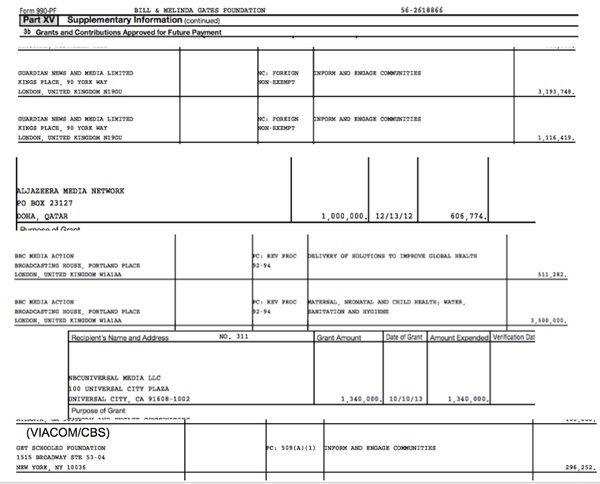
The Guardian claims its Global Development vertical, launched in 2011, is “editorially independent of any sponsorship.” According to its most recent tax filings in 2014, the Gates Foundation has an on-going $5.69 million grant to Guardian News Media Limited.
The Guardian has run other puff pieces on the Gates Foundation in this vertical, such as “Gates Foundation Annual Letter: What Do You Think of Their Vision?” (1/22/15), which is basically an investment letter, along with “Melinda Gates Hits Out at ‘War on Women’ on Eve of Summit” (7/7/12) and “Bill Gates: Digital Learning Will Revolutionize Education in Global South” (1/22/15).
FAIR has written for years about how Gates’ investment tentacles influence the media. He’s done softball interviews pushing common core with ABC (3/18/14), helped bankroll charter school reporting at the LA Times (8/24/15), funded the talking heads behind Race to the Top (9/1/10).
The Gates Foundation gives grants in the hundreds of thousands and often millions to such media organizations as NBCUniversal, Al Jazeera, BBC, Viacom (CBS) and Participant Media (the producer of pro-charter school documentary Waiting for Superman). Both Gates and the Gates Foundation are sizable shareholders in Comcast, which is the primary investor in Buzzfeed and Vox, as well the parent corporation of MSNBC and NBC News–the latter of which teamed up with Gates and other noted education experts like Exxon and University of Phoenix Online for the week-long charter school commercial “Education Week”.
In 2009, the New York Times reported that the Gates Foundation was partnering with media companies to write and shape stories to “embed” messages in primetime dramas:
It is less well known as a behind-the-scenes influencer of public attitudes toward these issues by helping to shape story lines and insert messages into popular entertainment like the television shows ER, Law & Order: SVU and Private Practice. The foundation’s messages on HIV prevention, surgical safety and the spread of infectious diseases have found their way into these shows.
The Times report was solely in the context of Gates’ health initiatives; it’s not clear if the foundation also co-produced TV shows to advance its school privatization agenda.
FAIR reached out to the writer of the piece, Nadene Ghouri, asking why she did not disclose the glaring conflict of interest. At the time of publication, Ghouri has not returned our request for comment.
His enormous wealth and the reach of media parent corporations seem to exempt Gates from routine disclosure requirements. He was offered up as an education expert in the pro-charter Waiting for Superman, without any mention of the fact that he donated at least $2 million to the film and had a media partnership with its distributor, Viacom. He is given softball interviews in Comcast-backed Vox without disclosure that he’s a major Comcast investor. Because his stake in media companies is laundered enough times, it’s assumed not to merit mention.
In the case of the Guardian, Gates effectively owns an entire vertical, so when one of his investments is written up, one doesn’t notice the conflict of interest—like a fish doesn’t notice water. Because his influence is everywhere, it appears to be nowhere.
h/t Mark Ames
Adam Johnson is a contributing analyst for FAIR.org. Follow him on Twitter at @AdamJohnsonNYC.



What the hell is a vertical? Jargon is unhelpful, other than to demonstrate the author’s total immersion in his subject. Please come up for air rather than dragging your readers down under the surface. Good article otherwise. Great. The 1% – in this case the 0.1% – are so utterly vile. They remind me of the slavers and slave traders of last century in their utter contempt for mankind – other than as an instrument of personal enrichment.
Yes, what is a “vertical”? and exactly how does it differ from an horizontal? a parallel? or an orthogonal? Inquiring minds . . .
A “vertical” is like a website within a website that focuses on a particular topic–analogous to a section in a print newspaper.
Think about it — “Education” financed/pushed by Gates, the guy who turned a 3rd rate OS into a monopoly…
Good article. It’s important that we keep an eye on the oligarchy’s ‘philanthropic’ foundations and consider how their financial influence effects the news media that they support.
Now I’m curious about which foundations fund FAIR and CounterSpin and how much money they’re paying.
FAIR’s Financial Overview
https://fair.org/about-fair/financial-report/
The following article mentions ‘liberal foundations’ some examples of ‘liberal foundations’ would be Rockefeller Foundation, The Rockefeller Brothers Fund, Soros’ Open Society, Ford Foundation etc.
HOW FOUNDATIONS HARM JOURNALISM AND POLITICS
http://prorev.com/2010/01/foundations-and-investigative-reporting.html
A “newsmaker” by another meaning
I agree with the query of the vertical. And that otherwise fine reporting. Bertrand Russell wrote in Why I Am Not a Christian that innocent until proven guilty was a fine concept and he supported it. In the case of saints, however, it should be just the opposite: guilty until proven innocent. Bill Gates has done nothing in my eyes to exonerate his ill-gotten windfall. Achievements such as his happen because of the support of the hidden collective.
Meant to mention I like to extrapolate that concept to rich people: Bill Gates: guilty. Don Trump: guilty. John Mellencamp: innocent.
So, Gates unilaterally defines the problem, uses the media to declare his assumptions as fact, prescribes his own solution, and then clears a profit from it. Sounds like an education monopoly to me.
And Gates is a just new comer to the scene, the of the oligarchs have been controlling the narrative through education (and so-called alternative media) from public elementary school up to the most prestigious universities in the world through their ‘philanthropic’ foundations.
Foundations: Their Power and Influence
http://www.earthemperor.com/2009/06/14/foundations-their-power-and-influence-by-rene-a-wormser/
About the book:
This book grew out of my conviction that some of the materials examined by the Reece Committee, for which I [, René A. Wormser,] acted as general counsel, deserve broader circulation. [1]
Why it’s called the “Reece Committee”:
It is not easy to investigate foundations, not even for Congress to attempt it: the giant foundations are powerful and have powerful friends. A special committee was created by the House of Representatives of the 83rd Congress to investigate tax-exempt organizations. It is generally referred to as the “Reece Committee” after its chairman, Congressman B. Carroll Reece of Tennessee. [2]
.
Re Michele Rhee, “a polarizing educational reformist and former chancellor of Washington, DC, public schools. ‘She changed the lives of children in Washington, but people complained her methods were controversial. But she made a difference.”
Indeed, apparently: “… Rhee’s tenure left DC’s schools ‘worse by almost every conceivable measure’”
So she did make a difference. What’s to complain about?
It’s a bit overwhelming for me to get the full impact because I’m not bright enough (complete disclosure there) to understand a lot of jargon, and understand a lot of the complexities of the relationships between Gates as individual, Gates as the Foundation, Gates the investor and the intricacies of relationship to overlapping parent companies. I thought (I assume like the majority of people?) that everything done by Bill & Melinda Gates was philanthropic. Also I always assume that when someone like Gates backs a documentary or film, let’s say, and has ownership of some part of the company that might market it, it wasn’t a bad thing, it was a good thing because without the money to get all this off the ground, a film or documentary or charity wouldn’t be made. I think for someone like me, the biggest confusion when talking about the mega-rich like Gates, is – why is it a bad thing for him to be part of a for-profit company, if the majority of that income is donated everywhere? Also I think the one thing that bothers me in any piece like this, is that it’s important to keep the facts factual, and not build a tiny fire in the hopes of adding to the bigger flames. I’m specifically talking about the paragraph talking about the behind-the-scenes influencing by the Foundation to the public in popular TV shows. It states “The foundation’s messages on HIV prevention, surgical safety and the spread of infectious diseases have found their way into these shows.” Well, that’s a good thing, right? But then the author goes on to say “The Times report was solely in the context of Gates’ health initiatives; IT’S NOT CLEAR IF THE FOUNDATION ALSO CO-PRODUCED TV SHOWS TO ADVANCE ITS SCHOOL PRIVATIZATION AGENDA.” [my caps] Well, it certainly sounds like the author has done exhaustive research to prove everything else in the article; why is it “not clear” if the school privatization agenda has also been embedded within entertainment, to the public? It seems to me that the author loses credibility in his zeal to smear the Foundation by asserting that, even though there is all this good, timely, educational information brought to the public, it’s JUST possible that there’s also some nasty controversial alternative propaganda that’s lurking. Anyway, my takeaway is – Gates ‘appears’ to be doing great things but it’s all somehow murky, self-serving, and financially suspect, and I need to investigate further before I assume all people who look like they’re doing great things have no ulterior motives. :/
All well and good to give your local billionaire the benefit of the doubt, but I’d much prefer to have educational agendas overseen by educators, thanks very much, and if it isn’t too much to ask, I’d also prefer that the media not be bought and paid for either. If destroying public education in this country so a load of “reformer” grifters can cash in is your idea of doing great things, we just might have some differences in our sets of values. Bill Gates can take his billions and gtf out of education. He’s broken enough crockery already.
For those who are interested, I wrote to the Guardian’s reader’s editor when this was posted and pointed this information out to them. This is the response I got from them today:
——BEGIN E-MAIL———–
Thank you for your email. The Bill and Melinda Gates Foundation, although it provides funding for the Guardian’s global development site, has no editorial control at all. It does not know what articles will be published on the site, so it was unaware that this story had been commissioned, and our editors were unaware that Bill Gates was an investor in the company mentioned in the article.
Now that we have been made aware of the connection, a note has been added to the foot of the article.
Best wishes
Barbara Harper
Guardian Readers’ editor’s office
Guardian News & Media
—–
+44 (0)20 3353 4736
guardian.readers@theguardian.com
—–
@GdnReadersEd
—–
——–END E-MAIL—————–