


On October 10, a ceasefire was declared in the Gaza Strip, where more than 67,000 Palestinians were officially killed in just over two years of Israel’s United States-backed genocide. With an estimated 10,000 bodies still buried under the all-consuming rubble, and indirect deaths unaccounted for, this number is almost certainly a drastic underestimate. Shortly after the ceasefire took effect, US President Donald Trump pronounced the war in Gaza “over,” proclaiming that “at long last we have peace in the Middle East.”
In the ten days following the implementation of the ostensible truce, the Israeli military reportedly killed at least 97 Palestinians in Gaza and wounded 230, violating the ceasefire agreement no fewer than 80 times. One might have expected, then, to see a headline or two along the lines of, I dunno, “Israel Violates Ceasefire”—or maybe “So Much for ‘Peace’ in Gaza.”
No such headlines turned up in the Western corporate media—not that there weren’t some pretty spectacular violations to choose from. On October 17, for example, 11 members of the Abu Shaaban family, including seven children and three women, were blasted to bits in Gaza City’s Zeitoun neighborhood while attempting to reach their home. According to the Israelis, the family’s vehicle had trespassed over the so-called “yellow line,” the invisible boundary arbitrarily demarcating the more than 50% of Gazan territory still occupied by the genocidal army.
Then on October 19, Israel bombed the living daylights out of central and southern Gaza and killed dozens after alleging a ceasefire violation by Hamas—an allegation that not even Trump found convincing, but that enabled such impressively passive headlines as “Strikes Hit Gaza After Truce Violations Alleged” (Guardian, 10/19/25). Once the carnage was complete, the BBC (10/19/25) assured readers that “Israel Says It Will Return to Ceasefire After Gaza Strikes.” For his part, Israeli Prime Minister Benjamin Netanyahu informed the Knesset that the Israeli military had dropped 153 tons of bombs on Gaza during this particular, um, pause in the ceasefire.
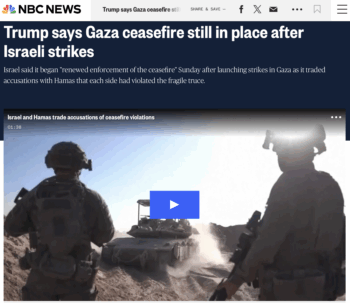
NBC (10/20/2025) and others persist in describing the ceasefire as “in place” or “holding” despite Israel clearly not ceasing to fire.
While most media outlets consistently describe the ceasefire as “fragile” (NBC News, 10/20/25) and “delicate” (ABC News, 10/20/25), they somehow can’t bring themselves to state the obvious: If you don’t cease firing, it’s not a ceasefire. Of course, the refusal to call a spade a spade should perhaps come as no surprise from an industry that continues to peddle the narrative of a “ceasefire” in Lebanon despite acknowledging “near-daily strikes” (New York Times, 7/9/25) on the country by Israel and the killing of some 250 people in the first seven months following the truce declaration last November.
‘Both sides have accused the other’
There is also the pernicious media tendency of allowing equal weight to ceasefire breach allegations by Israel and Hamas given the former’s mendacious—not to mention genocidal—track record. This mendaciousness has been on display for decades, most prominently in Israel’s eternal claim to be fighting “terrorists”—a fight that somehow never fails to kill thousands upon thousands of civilians; at least 20,000 of those killed in the latest two-year showdown were children, with a whole lot more presumed to be buried beneath the rubble. In the episode involving the Abu Shaaban family, the Israelis invoked a typical lie from their vast arsenal: a “suspicious vehicle” had approached Israeli troops “in a way that caused an imminent threat to them”—so they killed the family, and that was that.
And yet the media unceasingly grant Israel space to present deceitful arguments as credible, without ever emphasizing that Hamas is not the one that is dropping 153 tons of bombs in one day during a supposed “ceasefire.”
Case in point: an NBC News dispatch (10/19/25) titled “Israel and Hamas trade accusations of ceasefire violations,” in which we are told that “both sides have accused the other of violating the terms of the deal.” The next sentence outlines Israel’s primary ongoing gripe regarding Hamas’s alleged ceasefire transgressions: “Israel says Hamas is delaying the release of the bodies of hostages held inside Gaza, while Hamas says it will take time to search for and recover remains.”
In accordance with the ceasefire agreement, Hamas promptly returned all living hostages in its possession to Israel, and it has returned the remains of several more. But the group has said it is unable to recover the remaining bodies because they lie under formidable quantities of rubble, thanks to Israel’s recent pulverization of the enclave. Rather than allowing the necessary machinery into Gaza to assist with excavating the remains that Israel so urgently demands, Netanyahu has instead announced that the Rafah border crossing between Gaza and Egypt will remain closed until Hamas “fulfills” its part of the deal.
Any logical observer might conclude that Israel is actively endeavoring to sabotage the “ceasefire.” But the corporate media are not in the business of logical observation. In its writeup, titled “Hamas Returns Bodies as Fragile Gaza Ceasefire Holds,” the Financial Times presents as entirely legitimate an arrangement in which “Israeli officials have accused Hamas of returning the bodies too slowly, and threatened to limit the amount of humanitarian aid allowed into Gaza in an effort to pressure the militant group to accelerate the returns” (10/19/25).
Anyway, nothing to see here: just some more casual enforced starvation and illegal aid deprivation in an already famine-stricken territory. It’s all in a day’s work during a “fragile ceasefire.”
Ceasefire ‘holding’?
In the aftermath of the Abu Shaaban family massacre, CNN reported (10/17/25) that the ceasefire was “holding”—albeit not without “coming under strain,” naming as the first culprit the “failure of Hamas to return all the bodies.” The question of the return of the bodies occupied the first 10 paragraphs of the piece, so that when CNN also named “the initially slow entry of aid” into Gaza and the “continued, if isolated, incidents of killings of Palestinians in Israeli strikes” as contributing to the “strain,” it had already been made clear to the reader which facet of the alleged violations was the most important.
The next day, NBC News employed a similarly diplomatic approach to Israel’s ongoing lethal operations, noting that “even as the ceasefire between Hamas and Israel holds, Palestinians have been killed by Israeli forces” (10/18/25). Again, the media are apparently incapable of coming right out and stating that Israel has unequivocally violated the ceasefire, or that a ceasefire is not a ceasefire if one side is permitted to engage in continued slaughter.
According to the delusions of the Washington Post (10/15/25), meanwhile, Israel is “largely restrained from attacking Hamas under the ceasefire sponsored by Trump,” resulting in a situation in which “Hamas’s enduring grip has significant implications for the future of Gaza and President Donald Trump’s peace plan.” As usual, Israel is let off the hook for its campaign to literally annihilate Gaza’s future.
And yet this particular intervention by the Post is at least less batshit crazy than another one courtesy of columnist George F. Will (10/13/25), who has determined that “primary credit for the Gaza ceasefire” goes to the Israeli army and Netanyahu.
I would advise anyone with blood pressure problems to avoid so much as glancing at the column in question, but the gist of his argument is basically that genocide was a “necessary precondition for the cessation of warfare.” (Secondary credit goes to the US for “enabl[ing] Israel’s victory by not restraining its self-defense.”) It would seem, of course, that not launching a genocide in the first place might be an easier way to avoid warfare—a “cessation” of which has not been achieved in Gaza anyway.
“Greatest threat” to peace?
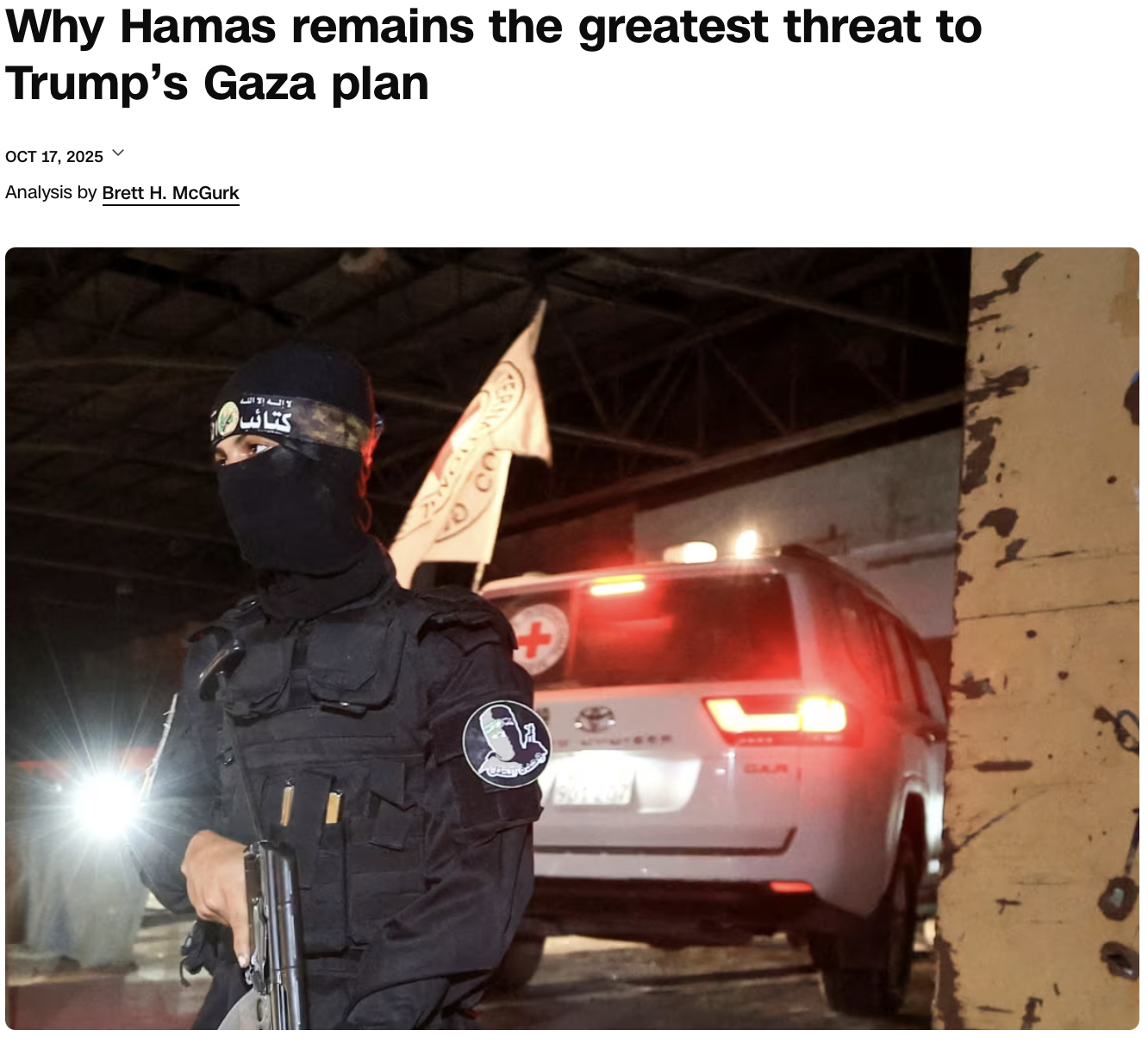
CNN (10/17/25) names Hamas as the “greatest threat” to Trump’s Gaza plan—a claim supported by a broader media environment that won’t acknowledge Israel’s genocide.
Indeed, while most corporate media commentary is not as transparently deranged as Will’s, there persists the notion that it is Hamas, not Israel, that is the greatest obstacle to peace—see, for instance, CNN‘s (10/17/25) “Why Hamas Remains the Greatest Threat to Trump’s Gaza Plan.” When Reuters (10/19/25) listed the “formidable obstacles to Trump’s plan to end the war,” it named “Hamas disarming, the governance of Gaza, the make-up of an international ‘stabilization force,’ and moves towards the creation of a Palestinian state” that have yet to be resolved. Notice which actor is missing.
A typical Associated Press dispatch (10/13/25) headlined “Despite Momentous Ceasefire, the Path for Lasting Peace and Rebuilding in Gaza Is Precipitous” explains that “how and when Hamas is to disarm, and where its arms will go, are unclear, as are plans for Israel’s withdrawal from Gaza.” Never do such articles find the need to point out that Israel is a state whose very existence is predicated on ethnic cleansing and perpetual war—or to cite such relevant findings as the determination by a United Nations commission of inquiry that Israel has committed genocide in Gaza.
The Genocide Convention defines the phenomenon as “acts committed with intent to destroy, in whole or in part, a national, ethnical, racial or religious group.” Such acts include “killing members of the group,” “causing serious bodily or mental harm to members of the group,” and “deliberately inflicting on the group conditions of life calculated to bring about its physical destruction in whole or in part.”
The inconceivable bodily and mental devastation that Israel has deliberately inflicted on the people of Gaza clearly continues despite Trump’s announcement that the war in Gaza is “over.” And as Israel continues to violate the so-called “ceasefire” while attempting to redirect blame to justify its own unceasing aggression, the media’s lack of scrutiny only abets those violations.




It’s prudent to scrutinise the numbers and ensure we know how they were arrived at, even when Francesca Albanese cites them. Polya and Hil (https://arena.org.au/politics-of-counting-gazas-dead/), in particular, start from Jamaluddine et al.‘s estimate (https://www.thelancet.com/journals/lancet/article/PIIS0140-6736(24)02678-3/fulltext), assume that the rate of fatalities up to 30 June 2024 has remained constant ever since, and then assume, following Khatib et al. (https://www.thelancet.com/journals/lancet/article/PIIS0140-6736(24)01169-3/fulltext), that the number of ‘indirect fatalities’ will be four times as many as direct fatalities from Israeli violence. Khatib selected the factor of four from the 2008 Global Burden of Armed Violence (https://www.refworld.org/reference/research/gds/2008/en/64390), which is also problematical, including misrepresenting some of its own data. Many of the indirect fatalities are yet to occur, so Polya’s assertion of ‘a staggering total of 680,000 deaths by 25 April 2025’ [my emphasis], is simply false. (See Spagat‘s detailed critique of Khatib (https://aoav.org.uk/2024/a-critical-analysis-of-the-lancets-letter-counting-the-dead-in-gaza-difficult-but-essential-professor-mike-spagat-reviews-the-claim-the-total-gaza-death-toll-may-reach-upwards-of-186000/), and mine (https://bureauofcounterpropaganda.substack.com/p/counting-the-dead)).
We also need to remember the lifelong crippling disabilities that will burden not only the direct victim, but those who need to care for them, and the orphaned children, who will endure psychological trauma for the rest of their lives.
The point is not to glorify the MoH or its statistics nor to mitigate Israel’s culpability. As far as I’m concerned, whatever Hamas may have done, nothing can justify harming even one uninvolved person, much less the myriads Israel has already slaughtered. It’s to reject sensationalism and the bodgy arithmetic that I hesitate to dignify with the label ‘methodology’, including the outright fiction that all indirect fatalities have already occurred.
Applying bogus ‘methodologies’ to questionable assumptions and misinterpreting the nature of ‘indirect fatalities’ to arrive at the largest, most sensational projections does not strengthen the arguments against Israel’s dramatically accelerated genocide over the last two years. On the contrary, it invites doubt.
Sensationalising body counts, moreover, seems to imply that:
– fatalities are the only costs to the victims of Israeli aggression
– 70,000 dead are not bad enough
– bogus assumptions and ‘methods’, aka Alternative Facts™, are better than old fashioned evidence.
A ceasefire ends when Israel declares that Hamas – always untrustworthy, “what else do you expect from Arabs?”, dangerous, violent – has breached it. The Zionist corporate media will go along with that. There can be no peace so long as an armed Zionist State of Israel exists.