

Venezuela’s Bolivarian Revolution, which took off with the election of President Hugo Chávez in December 1998, frequently and even quite recently received praise for its social gains from the United Nations, international humanitarian organizations and economists. This aspect of the country’s story has been almost entirely written out of media coverage of the effort to overthrow the Venezuelan government by the US, Canada and their right-wing partners in Venezuela and the region.
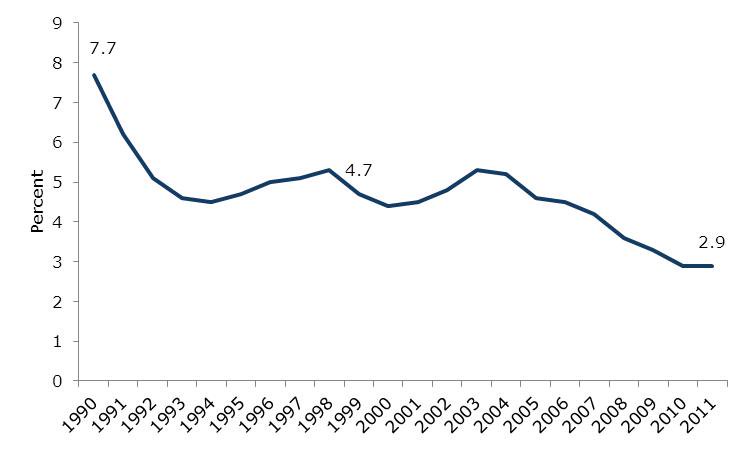
Malnutrition in children under five was one of several social indicators that improved dramatically in Venezuela following the election of Hugo Chávez in 1999. (Source: Instituto Nacional de Nutrición/CEPR)
Under Chávez, poverty in Venezuela was cut by more than a third, and extreme poverty by 57 percent (CEPR, 3/7/13). (These declines were even steeper if measured from the depths of the opposition-led oil strike, designed to force Chávez out by wrecking the economy.)
In June 2013, the UN’s Food and Agriculture Organization (FAO) included Venezuela in a group of 18 nations that that had cut their number of hungry people by half in the preceding 20 years, 14 of which were governed by Chavismo: The FAO said that Venezuela reduced the number of people suffering from malnutrition from 13.5 percent of the population in 1990–92 to less than 5 percent of the population in 2010–12; the FAO credited government-run supermarket networks and nutrition programs created by Chávez.
Three months later, the UN Committee on the Elimination of Racial Discrimination said that it “welcomes the social development measures, programs and plans that include indigenous peoples and people of African descent, which have helped to combat structural racial discrimination” in the country. The committee also noted that it
welcomes the progress made by the [Venezuelan government] in the area of education and its efforts to reduce illiteracy, as a result of which it was declared an “illiteracy-free territory” by the United Nations Educational, Scientific and Cultural Organization (UNESCO) in October 2005.
In 2014, Niky Fabiancic, resident UN coordinator for Venezuela, called the country “one of the leading countries in Latin America and the Caribbean in reducing inequality,” according to Venezuelanalysis (5/9/14). The website also quoted UNICEF representative Kiyomi Kawaguchi as saying that from 2009–10, 7.7 million students attended school, an increase of 24 percent over ten years previously.
Thus, in the Bolivarian Revolution’s 14th and 15th year, multiple UN organs highlighted how Chavismo had improved the lives of Venezuela’s poor majority.
Similarly, the UN’s Economic and Social Council published a report in 2015, two years into the presidency of Nicolas Maduro, that said the council
takes note with satisfaction of the progress made by [the Venezuelan government] in combating poverty and reducing inequality. The Committee also welcomes the huge progress made by the [Venezuelan government] in the fight against malnutrition through the expansion of the school meals program and the food allowance for low-income families.
One widely used measure of a country or territory’s overall well-being is the UN’s Human Development Index (HDI), a statistical composite index of life expectancy, education and per capita income indicators. The most recent HDI report is the one that was published in 2018, based on 2017 data.
The 2018 report put Venezuela in the category of countries or territories that have “High Human Development,” the second best of the HDI’s four rankings, and 78th of the 189 countries and territories examined. On that list, Venezuela outranks the majority of the states in the 14-country Lima Group currently trying to overthrow its government, including Brazil, Colombia, Guatemala, Guyana, Honduras, Paraguay, Peru and Saint Lucia. Guatemala, Guyana and Honduras are categorized as “Medium Human Development,” the group below the one to which Venezuela belongs and the second lowest HDI category.
The HDI does not provide a perfect picture of present conditions in Venezuela, since the situation in the country has evolved and appears to have worsened since 2017, in large part because of the sharp escalation of the economic war on the country by the Trump administration in August 2017. The HDI does, however, indicate that by this metric, in 2017 Venezuela was doing reasonably well by regional and global standards even in the face of harsh sanctions.
While the progress made by the Bolivarian Revolution has eroded—in larger measure due to US, Canadian and European sanctions undercutting Venezuela’s economy and its people’s access to food and medicine—a mere six months ago, Alfred de Zayas, the first UN special rapporteur to visit Venezuela in 21 years, issued a report based on his late 2017 visit to the country, four years into the Maduro era. The report says:
In the Bolivarian Republic of Venezuela, the Gran Misión Vivienda low-cost housing program has contributed to saving millions of persons from homelessness. Over 2 million housing units have been delivered to persons who would otherwise live in shanty towns. In order to address hunger, the Local Supply and Production Committees provide needy Venezuelans with 16kg packages containing sugar, flour, dried milk, oil etc., as the independent expert was able to verify at the Urbanización Nelson Mandela. Another social acquis, El Sistema, established by the late José Antonio Abreu, has offered free musical education to over 1 million youngsters, contributing to a reduction in juvenile delinquency.
Each of these pieces of information constitutes evidence about life in Venezuela in the Chavismo period, which the US and its partners are attempting to end. As such, this data should at least be part of the current conversation about Venezuela, especially inside of states that are trying to illegally oust the Venezuelan movement that not long ago was being praised for its successes by the UN, international humanitarian groups, and economists, and drawing favourable comparisons to the social order that had previously prevailed in the country.

To assess whether US media have noted this crucial part of the story of the Bolivarian Revolution, I used the media aggregator Factiva to search the databases of three of the country’s major newspapers: the New York Times, Wall Street Journal and Washington Post. I examined the period since the US government and its allies have asserted that Juan Guaidó is the president of Venezuela, not the elected Nicolás Maduro. According to Factiva, the three outlets have run a combined 800 pieces in the intervening period, and I was able to find four that make reference to Chavismo social programs and even these are done in a vague, dismissive fashion. None discuss in any detail the accomplishments that won the Bolivarian Revolution international acclaim.
The Wall Street Journal (2/7/19) gave a timeline of Venezuelan history that, in a section labelled “2003–12,” asserts:
Mr. Chávez expropriates farms and businesses, and uses oil revenue to build homes, distribute food and upgrade healthcare. The programs reduce poverty and make him popular. But he also saddles Venezuela with high inflation, billions in foreign debt and makes the country even more oil dependent.
This piece’s mention of Chavismo’s achievements subsumes them into an overarching narrative that is overwhelmingly focused on the many failures the authors attribute to the Bolivarian Revolution.

The New York Times‘ “short, simple primer” (1/24/19) on “how did things in Venezuela get so bad?” never mentions the word “sanctions.”
Max Fisher of the New York Times (1/24/19) noted that “Mr. Chávez was a dedicated leftist who spent heavily on social programs,” but failed to mention that these programs benefited Venezuelans for a very long time, especially the poorest in the country. In a common trope that’s typically used against leftist governments, especially those in the Global South with non-white majorities, Fisher denigrates the use of Venezuela’s resources to aid its people as a kind of bribery: “handouts to maintain support among his supporters.”
Also in the Times, Virginia Lopez Glass (1/25/19) made a brief, hand-waving reference to the long period of successes of the Bolivarian Revolution, writing that “perhaps Venezuela is finally at the end of a political cycle that, despite some years of social gains, ultimately impoverished what was once the richest nation in the region.”
Times columnist Bret Stephens (1/28/19) mentioned Chavismo’s social programs, but only to blame government spending on these for the country’s ailments.
The Post seems not to have made any mention at all of the improvements the Bolivarian Revolution brought to the poor and working class who make up most of Venezuela’s population.
When the gains that Chavismo made are erased from the story being told about the country, a distorted version of events is presented. This accounting carries the incorrect message that the Bolivarian Revolution has been an abject failure from start to finish, and that every aspect of the project must therefore be abandoned in order to improve Venezuelans’ conditions. Such a misleading narrative further suggests that, since the Venezuelan government has allegedly brought only harm to the country’s people, the states involved in the effort to remove the Venezuelan government are justified in so doing, and their citizens should support rather than try to stop these efforts.
The starting point for discussions about Venezuela involving anyone who purports to care about the welfare of the people of the country ought to be the question, “What steps can be taken for Venezuela to resume making the impressive strides that it made for the majority of the time that Chavismo has held power?” as opposed to, “How can we disempower the social forces that gave birth to those gains, namely Venezuela’s poor and disproportionately mestizo, indigenous and black populations?” To their discredit, corporate media have framed their coverage around the latter rather than the former–a question whose answer necessarily involves lifting the draconian sanctions.




Thanks again to FAIR for carrying articles like the above, which are the proverbial ‘breath of fresh air’ in the non-stop MSM railing against Venezuela. Even as I reach my 7th decade, it STILL staggers me politically that domestic conservatives can almost always be against any DOMESTIC social-welfare government spending (unless their immediate family is in-need of it) in this country, and always advocating ‘tough-love’ for the poor, and then yet feign outrage and cry crocodile tears about poor people in foreign countries when those countries’ leaders supposedly maltreat their citizens, AND then these same conservatives advocate economic and military aggression against that country which in no way threatens us and which often makes things HORRIBLE for those poor foreign citizens. Chomsky cites instances where private meeting notes of political leaders often reveal one of the things they fear is a ‘good example’ that will spread to other countries, which I’m sure drives a lot of this interventionism, synched-up with armament spending.
Unfortunately, Venezuela was never a good example. It is sad that detractors of socialism are pointing to it as an example. Chavismo’s initial success was propped up on $100+ oil. That simply wasn’t sustainable. It started caving long before any interventionism took place. The fatal mix of poor policy (price controls, currency controls, expropriations) and corruption put them on a declining trajectory even prior to sanctions. Until the recent sanctions in 2017, I’d say that corruption was the primary deterrent to a successful socialist experiment in Venezuela. Now with sanctions it is just end-game for Maduro. The empire will not back down. Perhaps the PSUV can regroup and purge the corrupt bad-actors from its ranks in whatever happens after Maduro.
The one flight they couldn’t control was the true capital of a nation — human capital. All the technocrats are gone. The future doesn’t look bright unless Russia, China, and Cuba send in their advisors to help out their colony. It doesn’t seem like they are committed to the socialist cause. I’m sure they are committed to getting their loans paid back.
Your report don’t show the real situation of Venezuela. I am from Colombia and my partner is venezuelan. You data was manipulate and don’t have the real comparation with the current numbers. If you check just the USCIS entrance you can the HIGH number of asilums and refugee petitions. Please weak up and talk with venezuelan in USA if you don’t believe me.
OK, so the Bolivarian Revolution may have made gains in some measures of equality, but at what cost? Having lived in Venezuela, I doubt Bolivarian leaders have ever been interested in economic freedom, freedom of the press, public dialogue, freedom to assemble and many other measures of democracy. Blaming Venezuela’s 20-year-old inflation avalanche on any other country ignores the fact that Bolivarian leaders failed economically from the start of the revolution. They had to amend the constitution in order to extend their rule rather than trust the democratic voting process. Bolivarian leaders had to drown out opposing views with daily 3-hour-long speaches, 24/7 TV/radio programs and shutting down alternative media sources within Venezuela. Chavista thugs have threatened opposition efforts to assemble from the beginning of the Bolivarian Revolution. Of WHAT is the Bolivarian Revolution a good example??
Chavismo’s gains were being erased a long time before sanctions ever happened. They were being erased in 2013 when Maduro was narrowly re-elected. The gains were definitely being erased in 2014 when there were massive protests and in 2015 when the opposition trounced the PSUV coalition. This was all before there were sanctions.
It’s nice and convenient that the author’s chart stops at 2011. He seems like a professor of propaganda. Just insert enough truth to make it seem plausible. It makes Venezuela seem like the now down-and-out sports star that talks about it like it was the “good old days.” Well, $100+ oil is not in the picture for a long while.
Why? It’s all very explainable. The obvious reasons (no conspiracy necessary) is that the oil price tanked, price controls distorted the market creating shortages, and corruption made things worse. Claims of economic warfare between 2013 and 2015 by the opposition are silly. If anything, it was economic suicide by PSUV-connected actors like the Chavez clan. Who was buying up the available price-controlled basics and CLAP boxes? Who was expropriating farms, dairies, newsprint manufacturers (!), and food factories and then mismanaging them to oblivion? PSUV-connected actors that made profits through their vulture activity. If it was anyone else other than PSUV-connected actors, they would have been dealt with a long time ago. Maduro should have grown a pair and cracked down on his own party. Just search for “rich kids of venezuela.” You’ll see a lot of PSUV big-wig connected kids flaunting money. I didn’t realize that their parents’ government salaries were that generous. A true rags to riches story of hard work and perseverance. No. They just stole it.
The most unfortunate thing is that the PSUV has given socialism a bad name. Because, what’s going on in Venezuela may have started out with good intentions (and been a true revolution for the people), but it devolved into a system where all the connected skimmed and sold their country for pennies on the dollar. The new vultures that have bought up and are trying to sap Venezuela’s resources are Russia, China, and Cuba. It’s like they traded one devil — Haliburton, CONOCO, Total, etc. — for another dark lord — Gazprom, CNOOC, etc.
Sanctions have made everything worse. But, that was their design. Everything looks end-game now for Maduro. It is fair to criticize the interventionism. Hopefully it doesn’t turn more violent than it already has. I guess we’ll see next week.
If you are a lazy contrarian that hasn’t really read up on Venezuela. Take time to read all sides. Talk to a Venezuelan. If you don’t know any, you aren’t looking hard enough. They are everywhere now.
Well, we flooded the oil market with the middle east interventions since 2001. The economic and intelligence effort against Venezuela started as soon as Chavez took power. 100+$ a barrel oil was a reasonable price, considering the global utility and scarcity of the resource. We squeezed OPEC out like a sponge, one of the reasons for invading Iraq, and artificially put the price of oil through the floor for decades in order to nip the Venezuelan example in the butt.
https://www.youtube.com/watch?v=fWAP8a7R5Uo http://cepr.net/blogs/the-americas-blog/venezuelan-economic-and-social-performance-under-hugo-chavez-in-graphs https://fair.org/home/wapo-trump-needs-to-destroy-venezuela-to-save-it/?awt_l=Evp1G&awt_m=j4ewtSb_ooR._TQ Trump also prohibited the Venezuelan government–owned CITGO corporation, based in Texas, from sending any profits or dividends back to Venezuela. In fact, basic democratic freedoms in Venezuela remain at a level the US government would never tolerate were it faced with similar circumstances: a major economic crisis deliberatelyworsened by a foreign power that openly backs the most violent elements of the opposition. Just consider that, in far less dire circumstances, the liberal end of US opinion is either ignoring or viciously applauding the likelihood of Julian Assange being imprisoned in the United States for publishing government secrets. https://www.usnews.com/news/world/articles/2018-09-25/us-puts-sanctions-on-venezuela-first-lady-other-officials https://www.globalresearch.ca/whats-really-happening-in-venezuela-from-someone-who-knows/5604010?utm_campaign=magnet&utm_source=article_page&utm_medium=related_articles http://www.informationclearinghouse.info/50792.htm many of the Venezuelans who fled the monetary crisis believing that they would easily find work in another Latin-American country are today trying to return home. But the Lima Group prevents them from doing so, forbidding Venezuelan planes who are attempting to repatriate them to use their air space, as well as interdicting the buses which have come to help them cross the borders. https://www.globalresearch.ca/international-book-fair-venezuela-being-educated-only-way-free/5660516?utm_campaign=magnet&utm_source=article_page&utm_medium=related_articles I would be lying if I said that I saw a single person sleeping in the streets of Caracas like what I see every single day a few blocks from where I live in the city of Oakland, California. Here there are thousands living under the bridges of the great highways in the richest country in the world. On the contrary, on my way from the Maiquetía Simón Bolívar International Airport to the city I was able to see with my own eyes the big housing projects which are part of the Misión Vivienda. Called repressive by the US media, Venezuela began to emphasize housing of the people with the Hugo Chávez government and continues to do so under President Maduro, with another two million housing units created for low-income people. Venezuela gets the label “repressive” because it is guilty of being a good example.
https://russia-insider.com/en/venezuela-festers-russians-wake-americas-blind-hate/ri26679
Despite sanctions, Venezuela lives better than its neighbors Colombia, Guatemala, Honduras. There are six million Colombian economic and political refugees in Venezuela; and they do not want to go back to their country. They prefer to suffer in socialist Venezuela. Now, when thousands of Central Americans are trekking to Rio Grande, the US should take care of them instead of worrying about Venezuela. The current exodus occurs in the most obliging client-states of Washington. We also learned that the US stole $31 billion of Venezuelan assets and gave 1 (one) billion to the Random Guy they appointed as Venezuelan President.
Eight Venezuela Lies the US Government and the Mainstream Media Want You to Believe
https://www.globalresearch.ca/8-venezuela-lies/5670534?utm_campaign=magnet&utm_source=article_page&utm_medium=related_articles
Maduro: US Withholding $5bn of Medical Supplies in ‘Criminal’ Measure
https://www.globalresearch.ca/maduro-us-withholding-5bn-medical-supplies/5672330?utm_campaign=magnet&utm_source=article_page&utm_medium=related_articles
. https://www.globalresearch.ca/whats-really-happening-in-venezuela-from-someone-who-knows/5604010?utm_campaign=magnet&utm_source=article_page&utm_medium=related_articles Trump also prohibited the Venezuelan government–owned CITGO corporation, based in Texas, from sending any profits or dividends back to Venezuela. https://fair.org/home/wapo-trump-needs-to-destroy-venezuela-to-save-it/?awt_l=Evp1G&awt_m=j4ewtSb_ooR._TQ Presstitutes Turn Blind Eye to UN Report on Venezuela – PaulCraigRoberts.org https://www.paulcraigroberts.org/2019/03/08/presstitutes-turn-blind-eye-to-un-report-on-venezuela/?mc_cid=caacd83069&mc_eid=c2a947a216
LOL and outside of Eddie’s great comment , who are those other people posting? Is that you Mr. Guaido and some bored CIA trained friends trying to arrange the universe—again? Thanks Mr, Shupak, it’s nice to get some actual news and FAIR never lets me down.
By all means, visit Venezuela. Maybe befriend some Venezuelans. The truth is far more complex than what is presented by Mr. Shupak’s slight of hand. Have you talked to a Venezuelan today? I have.
The Venezuelans who left before the sanctions regime went into effect were the beneficiaries of a brutal society that cared nothing for the desperately poor dark-skinned people living in shacks In horrifying conditions near or even on garbage dumps. Since the sanctions regime went into effect, the picture is probably more complicated, but the utterly absurd declaration by Obama that Venezuela is a threat to US national security is at least as outrageous as Trump’s declaration of a national emergency at the Mexican border. And $100 a barrel oil is a bargain if the externalized costs of its use are figured in. The people upset about this article remind me of the Tea Partiers who “want their country back.” White Venezuela living in paradise; dark Venezuela in abject poverty and hopelessness.
Thank you Mr Shupak for writing this article! There are always at least 2 sides to a story and our MSM is amazingly one sided in bring us the news. Even if people don’t agree with Maduro and how he governs that is no excuse for USA to declare another person as Venezuela’s new leader. Why don’t people see how UNdemocratic this is??? It is clear that a handful of billionaires (6) own all media outlets and control the messages. They are also ruling the USA and other countries with hostel takeovers for personal gains, using our military while we the taxpayers are paying for it at the expense of our own lack of healthcare, education, infrastructure, the arts, etc. Such a deal!!
Gregory: Thanks for your excellent report and important insights. Thanks FAIR.
It’s funny how the ”critical” commentors went out of their way to comment on something they claim is so bias -if you truly believed that why would you bother saying anything? -if it’s really so bias then anything you say won’t change any minds right? Hmmm
99.99999979% loss of value in the Venezuelan currency since Chavez took office
1.7 million percent inflation (2018)
Daily minimum wage of 18 cents per day
Great economic WINS for Chavismo.
No running water. Always blamed on sabotage, never neglect after 20 years
Frequent blackouts. (including blackouts during a Maduro presser!)
Roads that look like minefields.
Collapsing bridges.
More wins for the Chavismo infrastructure.
Teachers and professors
Doctors and nurses
Technicians, (electrical, oil and civil service)
Abandoning Bolivarian Socialism. (Thank Chavez/God for the fake Cuban doctors)
No affordable food. No food sovereignty. Nearly everything imported
Antibiotics? Anti-malarials? Insulin? Retrovirals for HIV? Dialysis supplies? Non existent, or unaffordable
Hospitals are a shambles. Women give birth on donkey carts, or filthy floors. Patients are asked to provide their own supplies.
More wins for Marx!
Hey Gregory!
As someone that has been directly affected by the humanitarian crisis in Venezuela for almost 20 years, I think I am in the position to highlight the fact that this article is based in very old statistics (not to say false) and probably not looking in the right places to sustain this argument.
It is extremely irresponsible to write an article like this with the ongoing situation in Venezuela, more since it is under a site that claims to “challenge media bias”.
Not here to defend any political parties since I too do not agree with the current right-wing government in the US. Just letting you know that this is extremely insensitive since I have and seen close people to me dying from malnutrition, crime, medicine scarcities. As well, even my own family has lowered the amount of food that is consumed since it simply cannot be afforded nor found.
The levels of corruption and negligence coming from the current narco-communist regime of Nicolas Maduro is damaging the country’s democracy and killing thousands of innocent people.
Just a suggestion, since this misinforms people that do not have idea what is happening, and takes out credibility from this source.
LRM.