

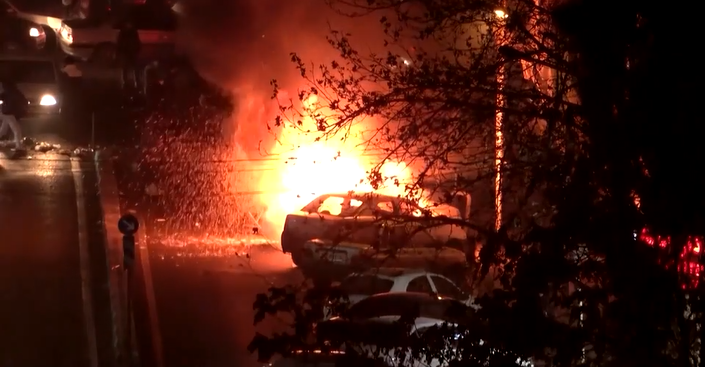
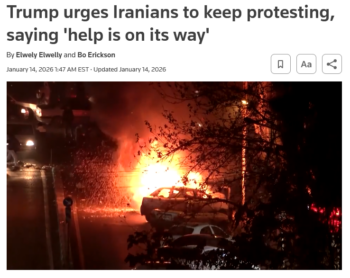
Reuters (1/14/26): “Asked what he meant by ‘help is on its way,’ Trump told reporters they would have to figure that out.”
When protests against high inflation swept Iran in late December, the usual international suspects wasted little time in endeavoring to hijack the unrest—which prompted a violent government crackdown—for their own purposes.
On January 10, Donald Trump—fresh off his abduction of Venezuelan President Nicolás Maduro—took to his preferred social media platform to showcase his signature manic reliance on random capitalization and exclamation points: “Iran is looking at FREEDOM, perhaps like never before. The USA stands ready to help!!! President DONALD J. TRUMP.” A few days later, another encouraging message: “Iranian Patriots, KEEP PROTESTING—TAKE OVER YOUR INSTITUTIONS!!!… HELP IS ON ITS WAY.”
The protests have since dissipated, without any successful “help” thus far in the form of regime change or US/Israeli military attack, although Trump has dispatched a “massive fleet” to the Middle East “just in case.” The Iranian government, which blames the US and Israel for fueling the bloody upheaval, has put the death toll at 3,117 (Al Jazeera, 1/21/26), including state security personnel. The Canada-based International Centre for Human Rights—aptly described by prominent Mideast analyst Mouin Rabbani as a “faux human rights organization”—claims that no fewer than 43,000 Iranians were killed by government agents. In between those two extremes, all manner of other numbers have also been flung about.
The US establishment media, ever on hand to assist with the vilification of Iran and pave the way for imperial aggression, have jumped at the chance to expose alleged government savagery. This diligence hasn’t generally been deemed necessary in the case of, for example, the US-backed Israeli genocide in the Gaza Strip—which most media can’t even bring themselves to call a genocide. The mass slaughter in Gaza, which proceeds apace under the guise of a “ceasefire,” has officially killed over 70,000 Palestinians since October 2023, although last year UN special rapporteur Francesca Albanese warned that the “real death toll” might already have reached 680,000.
‘Sparked by economic grievances’
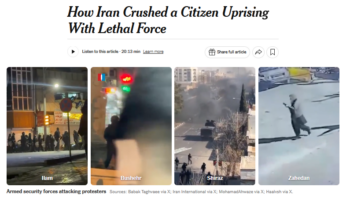
It’s unlikely that the New York Times (6/25/26), reporting on a pro-US country, would use the expression “citizen uprising” to describe a situation where “government buildings, commercial properties, mosques and police stations were set on fire.”
In the realm of politically motivated reporting, however, Iranians are far worthier victims, and in its January 25 requiem, “How Iran Crushed a Citizen Uprising With Lethal Force,” the New York Times grieved:
Across Iran, funerals are taking place. Parents are burying children. Children are burying parents. Siblings, friends, neighbors, colleagues, classmates and teammates are attending burial processions.
The country’s “plunging economy” made an appearance in the second paragraph of the article as the initial catalyst for the protests. No further relevant economic or historical context was provided in the ensuing 69 paragraphs.
The Wall Street Journal’s January 26 condemnation, “Iran’s Protest Crackdown Looks Deadlier by the Day,” only offered a vague reference to “economic grievances” as the instigator of the protests, citing “rights groups” as the source of the estimate that “10,000 or more” people were killed in the crackdown. A CNN dispatch (1/17/26) headlined “Blood on the Streets” ended with the following reflection on Iran’s dire financial predicament: “The harsh reality of life today in Iran guarantees that the protests will soon reignite.” NBC News (1/25/26) noted that “the demonstrations were sparked by economic grievances as the rial currency crashed and inflation soared.”
‘Economic statecraft’
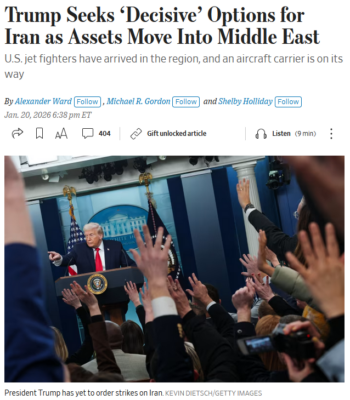
The Wall Street Journal (1/20/26) touted “US financial pressure” as a “nonmilitary means of reprimanding Iran,” because, according to Treasury Secretary Scott Bessent, it already “worked” in Iran: “Their economy collapsed…. This is why the people took to the street.”
But the US corporate media by and large fail to consider why, exactly, it is that Iran is in such economic disarray—an arrangement that happens to have more than a little to do with US “help.” As Al Jazeera (1/13/26) has pointed out, decades of US sanctions against Iran have “crippled” the lives of Iranians, and “played a central role in the country’s economic crises that were the primary trigger for the current spate of protests” in the first place.
Funnily enough, US officials have even admitted as much. And yet the Wall Street Journal (1/20/26) was perhaps the only major US media outlet to publish US Treasury Secretary Scott Bessent’s recent comments, at the World Economic Forum in Davos, that sanctions on Iran had
worked because in December, their economy collapsed…. This is why the people took to the street. This is economic statecraft, no shots fired, and things are moving in a very positive way here.
Britain’s Guardian (1/23/26) newspaper managed to print a few additional lines from Bessent’s remarks: “We saw a major bank go under. The central bank has started to print money. There is a dollar shortage. They are not able to get imports.”
It’s reminiscent of a scene from the first Trump administration in 2019, when then–Secretary of State Mike Pompeo boasted to the press of the charming effects of coercive economic measures against Venezuela: “The circle is tightening. The humanitarian crisis is increasing by the hour…. You can see the increasing pain and suffering that the Venezuelan people are suffering from.”
‘Still squeezed’
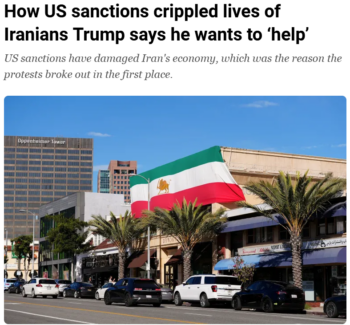
Al Jazeera (1/13/26): Iran’s middle class is “now 28 percentage points smaller than it would have been in the absence of sanctions.”
Meanwhile, anyone needing a reminder of the inherent lethality of such forms of “economic statecraft” need only recall the 1996 assessment by then–US Ambassador to the UN Madeleine Albright of the estimate that US sanctions had thus far killed half a million Iraqi children: “We think the price is worth it.”
Al Jazeera (1/13/26) reviewed some of the effects of sanctions on Iran over the decades, from a spike in plane crashes due to the government’s inability to import new aircraft, to skyrocketing prices for essential medications, to the collapse of the rial and a diminishing GDP. Incidentally, sanctions have also created “opportunities for corruption, forcing trade and finance into grey and black channels,” and lining the pockets of an elite minority.
(It’s perhaps worth mentioning that, back in 2014, the New York Times—1/22/14—deigned to feature the opinion of Iranian-American filmmaker and writer Beheshteh Farshneshani that the impact of sanctions on Iran had been “devastating,” resulting in soaring poverty levels and widespread hardship.)
In a January 26 writeup, the Associated Press devoted a smidgen of space to the understatement that the Iranian economy is “still squeezed by international sanctions,” preferring to focus on the calculation by “activists” that at least 6,126 people were killed in the crackdown on protesters.
Mossad ‘with them in the streets’
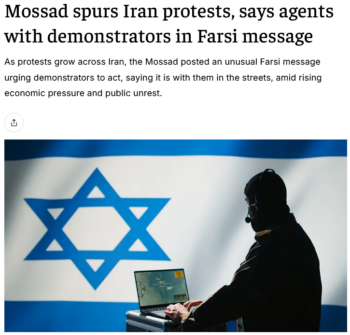
The Jerusalem Post (12/29/25) quoted Mossad’s message to Iranians: “We are with you. Not only from a distance and verbally. We are with you in the field.”
The AP report also sought to discredit Iranian allegations of US and Israeli intervention in the demonstrations, specifying that Iran’s UN ambassador had given “no evidence to support his claims” to that effect.
Were the US media in the business of habitually placing the news in proper political context, of course, claims of US/Israeli intervention in Iran would hardly be regarded as dubious. But the establishment press is not fond of reflecting on the fact that the Islamic theocracy came to power as a result of the overthrow in 1979 of the Shah of Iran, an obsessive purchaser of US weaponry, whose torture-happy reign had been enabled by the 1953 CIA-orchestrated coup against the democratically elected Iranian leader Mohammad Mossadegh. Israel’s track record in the country includes killing Iranian scientists and lots of other people.
Those skeptical of current Iranian government “claims” might take a moment to glance at English-language Israeli media such as the Jerusalem Post, which on December 29 reported that Israel’s Mossad intelligence agency had “posted an unusual Farsi message urging demonstrators to act, saying it is with them in the streets.” On January 8, the Israel Hayom website quoted Israeli minister Amichai Eliyahu on current covert operations in Iran: “I can assure you that we have some of our people operating there right now.”
And on January 16, the Times of Israel conveyed comments by Tamir Morag, political correspondent for the right-wing television station Channel 14, according to which “foreign actors” were arming the Iranian protesters. The Times observed that Morag had been “careful in his report not to explicitly implicate Israel in the alleged weapons transfer,” but had been “more flippant” on social media:
We reported tonight on Channel 14: Foreign actors are arming the protesters in Iran with live firearms, which is the reason for the hundreds of regime personnel killed. Everyone is free to guess who is behind it.
The US media, on the other hand, have steered clear of even reporting what the Israelis themselves are saying. Ditto for what Mike Pompeo (proponent of Venezuelan “suffering”) said on January 2, when he took to X to wish a “Happy New Year to every Iranian in the streets,” and went on to add: “Also to every Mossad agent walking beside them.”
‘A pared-down Iran’
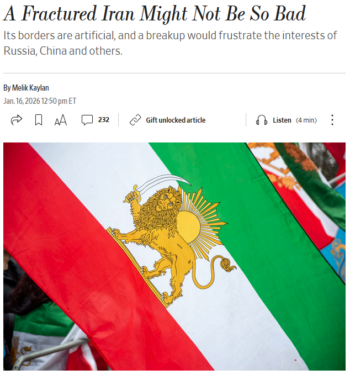
The Wall Street Journal‘s Melik Kaylan (1/16/26) wrote that “there’s a distinct possibility of civil war after regime change” in Iran; for him, that’s a feature, not a bug.
As for what the corporate press is saying, the Wall Street Journal (1/16/26) went so far as to run an opinion piece titled “A Fractured Iran Might Not Be So Bad.” Melik Kaylan, whose bio lists his beat as “culture and the arts,” argued that various ethnic groups should secede from the country because “a pared-down Iran would pose a diminished risk to Israel,” among other perks.
In Kaylan’s cultured view, “for the sake of regional and world peace, the best option may be to help secession happen and thereby take a downsized Iran…off the geopolitical chessboard entirely.” Why stop at regime change when you can just remake the entire regional map?
Trump, for his part, has not only deployed a “big armada” (Axios, 1/26/26) to the Middle East, but also imposed—what else?—new sanctions on Iran following the crackdown on protests. The president has furthermore announced 25% import tariffs on products from any country that persists in doing business with the Islamic Republic. And as the US doubles down on economic warfare, with the tacit assistance of a media establishment that can’t be bothered to say too much about it, don’t expect regional or world peace anytime soon.



Sanctions sing along
Cruel to be kind
In the right measure
Cruel to be kind
It’s a very good sign
Cruel to be kind
Means that I love you
Baby
You gotta be cruel to be kind
I’m a long time subscriber of FAIR and I am disappointed by the tone of this article, to say the least. I’m a leftist progressive Iraninan. I am against military intervention. I am against reestablishment of the monarchy. I vehemently oppose the regime. Wanted to let you know I’m not here trolling.
I don’t appreciate how this article is trying to deminish and devalue the lives lost in Iran by undermining the death tolls provided by anyone other than the Iranian government, which the article admits is a theocracy (I hope I don’t have to explain why that’s bad). The article only provides two links: one that references the government’s stats, and one that is claims is from a questionable human rights organization. Which leaves the reader taking the lower number as genuine and feeling better. However, there are more reports that support a toll much higher than the regime provided number. Time magazine referencing a source in the Iranian health ministry, puts the death toll at 30,000 people (https://time.com/7357635/more-than-30000-killed-in-iran-say-senior-officials/) Another Iraninan human rights organization (hopefully they hold up to your high standards: https://www.en-hrana.org/day-35-of-the-protests-pressure-on-medical-staff-and-lawyers-continued-arrests/) has CONFIRMED 6713 deaths (6305 protester)
So it was a choice on your side to cast doubt on the higher numbers. Especially with the link to Mr Rabbani’s article casting even more shadow over the cherry picked “bad” number. FAIR frequently criticizes the media when they echo official government-approved “facts”, but here you see FAIR doing exactly that.
Believe me, as an Iraninan I WISH this was not true, I want to believe otherwise, but seeing videos and pictures coming out of the country, unfortunately the higher numbers seem plausible.
Another note is the emphasis on the “economic” root cause, as if the dictatorship in Iran with ZERO free press, ZERO domestic opposition, ZERO labor unions, LOTS of codified misogyny, 2nd HIGHEST executions in the world, etc. is a nice place to live, just the economy is the problem.
Why would people rise against the regime if not for US or Israel’s role? amirite?
I recommend everyone who reads this to read this article: Open Letter to the Anti Imperialist Left (https://tripleampersand.org/open-letter-to-the-anti-imperialist-left/)
I quote:
..when these uprisings occur, many of you respond with suspicion rather than solidarity. The agency of Iranian women, workers, and students is immediately interrogated. Their rebellions are reframed as covert NATO, U.S., and Israeli operations. Their dead are mourned conditionally, if at all.
…
A critique of imperialism that refuses to analyze non-Western authoritarianism becomes analytically incoherent. It reproduces the state-centric logic it claims to oppose, mistaking opposition to U.S. power for emancipation itself.
I recommend readers watch the undeniable atrocities committed by the US and Israeli-backed terorists in multiple cities in Iran on the Press TV and Khabar, and other reliable sources, most supported by solid evidence, including eye witnesses.
continued from my previous message
Regarding the recurring themes dealing with Iran in the mainstream and social media, I urge to highlight a couple of points.
1. The root cause of the current problems in Iran is foreign interference.
I am not trying to underestimate the domestic shortcomings, but the root cause of the current situation (corruption, inflation and other issues) in Iran is certainly foreign interference. Readers can refer to the articles and books detailing the vast and prolonged interference and paralyzing actions (from industrial sabotage to different riots or terrorist activities to inhumane sanctions, to name a few) of the US and allies against Iran.
The US and allies have also constantly tried to influence and direct national elections in Iran and exploit the results.
Their hostility towards Iran is mainly due to the fact that Iran is the only state standing on the way of the realization of the inhumane goals of the elites, super-rich, and multi-national corporates ruling the world, most notably the US.
2. The ruling system in Iran has no resemblance to a dictatorship
As to calling the Islamic Republic a dictatorship, I emphasize that the ruling system in Iran has no resemblance to a dictatorship as all high ranking officials, including the leader, are directly or indirectly elected by people.
Another fact ruling out the dictatorship narrative is that, all people are allowed to freely express their views. Every day, I see some dissidents criticizing the government’s policies or insulting the top authorities, even the leader, loudly in the street with no limitation or personal consequences. Only those spreading lies and rumors may be somehow advised or occasionally legally followed.
I challenge the readers to repeatedly visit certain streets or parks and listen to the dissidents and see how freely they express their political views and feelings about the rulers, sometimes using extremely insulting language.
I have submitted a comment three times in the past three days an none have been published. it’s unfortunate how a media watchdog doesn’t understand the importance of free speech.
so you publish this, but the points I try to make get stuck in moderation?? smh