Janine Jackson interviewed James Loewen about misreported history for the July 3, 2015, episode of CounterSpin; selections from that interview were reaired on the November 25, 2016, show. This is a lightly edited transcript of the rebroadcast.
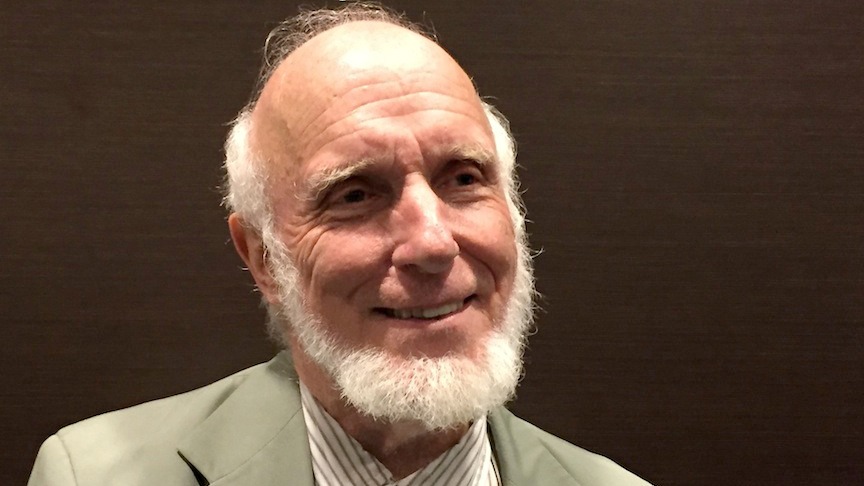
James Loewen: “It is all about states’ rights, except the South is against states’ rights.” (Photo: SpeakOut)
[mp3-jplayer tracks=”CounterSpin James Loewen Interview @https://eadn-wc04-3257648.nxedge.io/audio/counterspin/CounterSpin161125Loewen.mp3″]
Janine Jackson: Thanksgiving is one of the times US media feature a view of history that is, to be generous, hazy. Much of the talk of Native and settler bread-breaking will reflect not the actual events, but the story that powerful people have chosen to tell.

Confederate battle flag flying in front of the South Carolina statehouse, 2015 (cc photo: Sally Tudor)
Last year, CounterSpin spoke with James Loewen, author of the classic book Lies My Teacher Told Me, who explained how Americans are mistaught some of the most fundamental events in US history. And this misunderstanding of history very much affects present-day politics, including race relations. Loewen started by talking about the then-pending removal of the Confederate flag from the statehouse in South Carolina.
James Loewen: Well, let me say, first of all, that I think it is very important that Governor Haley came out against the flag, and that it looks like it’s going to succeed, that the flag will come down from this place of honor right in front of the state capitol. Of course, a while back, it did come down from on top of the state capitol, which was just an astounding placement, if you think about it, because it implies—you know, the flag flying right over the place where the laws are made certainly implies that the laws are made in obedience to what that flag means.
So let’s look for just a minute at what that flag means, because, unfortunately, most of the people who are right now flip-flopping on the flag—and, again, it’s wonderful that they are reversing themselves—but most of them still don’t have, well, either the knowledge, perhaps, or certainly the guts to actually say that they’ve been getting it wrong all these years. They need to say what the flag stands for.
The Confederacy seceded, many people think, for states’ rights, and I know they think this because for the last, oh, at least seven years, and certainly for the last five years, while we’ve been in the sesquicentennial of the Civil War, I’ve been going around the country asking them, why did the South secede?
Now, this is the most important thing that ever happened in the history of this country, because, of course, the secession of the South and its firing on various forts, particularly Fort Sumter, led immediately to the Civil War, which is far and away the most important thing that ever happened after we organized as a country.
So this is very important, why did they do it? And you always get four answers. You get the South seceded for slavery; it seceded for states’ rights; it seceded because of the election of Lincoln; and it seceded over tariffs and taxes, or issues about tariffs and taxes.
JJ: Uh-huh.
JL: And then I ask people to vote, and what’s interesting is it doesn’t make any difference whether I’m asking them in Columbia, South Carolina, where I have, or Greensboro, North Carolina, where I have, or North Dakota, where I have, or an overwhelmingly black audience in Memphis, where I have, or in Southern California, the answer comes out, almost always, the same, and here’s how it comes out: About 15 percent, sometimes 20 percent, say the South seceded over slavery. Sixty percent say, sometimes 65, say the South seceded for states’ rights. About 2 percent say the South seceded because of the election of Lincoln. And about 10 to 30 percent—this is the one that varies the most—say that it was all about issues about tariffs and taxes.
 So then we look at the facts, and it’s very interesting, the facts are perfectly easy to find. The most important single statement is by South Carolina, because it seceded first, but every single state makes a similar statement when it leaves the United States. Here’s what South Carolina called its statement: “Declaration of the Immediate Causes Which Induce and Justify the Secession of South Carolina from the Federal Union.” That kind of sounds right on point, doesn’t it?
JJ: Yes.
JL: And here’s what they say. They actually say, “We assert that 14 of the states have deliberately refused for years past to fulfill their constitutional obligations, and we refer to their own statutes for the proof.” Now, “constitutional obligations” sounds kind of vague, but they go right on to tell us exactly what they mean:
The Constitution of the United States, in its fourth Article, provides as follows: “No person held to service or labor in one State, under the laws thereof, escaping into another, shall, in consequence of any law or regulation therein, be discharged from such service or labor, but shall be delivered up, on claim of the party to whom such service or labor may be due.”
Well, that’s, of course, the Fugitive Slave Clause, and they then go on to tell us which states are exercising their states’ rights in various little ways and making various little interferences. They say, “The states of Maine, New Hampshire, Vermont,” blah blah blah—they name 16 of them in all, ending up in the West with Wisconsin and Iowa—“have enacted laws which either nullify the acts of Congress or render useless any attempt to execute them. In many of these states, the fugitive is discharged from the service or labor claimed”—so, in other words, it is all about states rights, except the South is against states rights, and what it’s really all about is, of course, slavery.
So we completely misunderstand the most important thing that ever happened in the country. Now, why do we misunderstand it? Well, I’m going to give you two reasons. The first thing we need to do, any historian will tell you, we need to look at when we started to misunderstand it. We didn’t misunderstand it at the time; how could we? Mississippi, Texas, every single state says, “it’s slavery, that’s why we’re leaving,” so we didn’t misunderstand it then.
We started misunderstanding it mostly between 1890 and 1940, and this is the era that historians call the nadir of race relations. “Nadir” is, of course, an English-language word meaning “low point.” So during this era, 1890 to 1940, the United States goes more racist in its thinking, in its ideology, than at any other point.
This is when lynchings reached an all-time high, this is when so many towns across the North go sundown—that is, they throw out their black populations, or if they don’t have any, they make a decision, formally or informally, that they’re never going to have any. And they post, some of them post, infamous signs at their city limits, like Manitowoc, Wisconsin, saying, “Nigger, don’t let the sun go down on you in Manitowoc.”
JJ: Uh-huh.
JL: So at this point, when the neo-Confederates start saying, no, no, no, it wasn’t about slavery, it was all about states’; rights, the white North really doesn’t have the gumption to argue with them, because they’re participating in racism so heavily themselves. So that’s one explanation.
 But the other explanation is to look at today’s textbooks. And one I like to pick on is the largest textbook ever invented for middle school in this country, it’s called The American Journey. It’s a history of the United States. It’s allegedly by three famous historians: Joyce Appleby, Alan Brinkley and James McPherson. And so you would think that the stuff on the Civil War would be by McPherson, because he wrote what I think is the best single-volume history of the Civil War. But when you read it, it turns out it completely mystifies what secession was all about.
Now, McPherson knows; so what we know from this is, it turns out that these people who allegedly write the history textbooks don’t write them. The publishers write them, and then they rent their names and stick them on them. But they don’t even read them!
Now, when I’m lecturing about this kind of thing to college students, I say, now, look, if you are such an idiot that you actually buy your term paper for $9.95 from the web, I hope you at least have the brains to read the darn thing before you hand it in to your teacher. So I know that James McPherson never even read what he says about secession in this book, because he’d never put up with it.
JJ: He knows better.
JL: Yes.
JJ: That was James Loewen, author of the classic Lies My Teacher Told Me.