


Janine Jackson interviewed Vera Eidelman about Fourth of July freedoms for the July 2, 2021, episode of CounterSpin. This is a lightly edited transcript.

Janine Jackson: As US citizens celebrate the Fourth of July, many will be thinking about the best way to grill a vegan hot dog. But many will also be thinking about what the “freedoms” we tell ourselves define this country and its project actually mean in 2021.
If you think the answers are to be found in history, you might be missing the point. The US is engaged in radical (“to the root”) debate right now about what democracy means, what civil liberties mean, and what kind of society we want to live in. We’re in history right now; this is what it looks like.
So what are the front-burner issues in terms of free speech, rights of assembly, the right to protest—to disrupt business as usual, which we know is central to making actual change?
Our next guest thinks about these questions every day. Vera Eidelman is staff attorney with the ACLU’s Speech, Privacy and Technology Project. She joins us now by phone. Welcome to CounterSpin, Vera Eidelman.
Vera Eidelman: Thank you so much for having me.
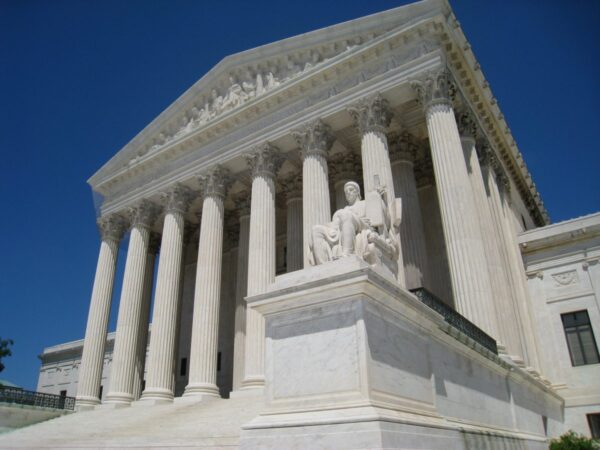
Supreme Court Building (photo: Daderot/Wikimedia)
JJ: I wanted to talk, first, about B.L. v. Mahanoy Area School District. I know that many listeners haven’t heard anything about this case, but it really gets at: When do you lose your right to free speech or free expression? Can you talk a little bit about what was at stake in that case, and your response to the Court’s ruling?
VE: Absolutely. So Mahanoy Area School District v. B.L. was the most important case about young people’s free speech rights in the last 50 or so years. The issue at stake in that case was a school’s authority to discipline a student for what they said or expressed outside of school hours, off of school property, that was not harassing or threatening in any way.
Our client in that case, “B.L.,” was, when the case began, a 14-year-old who had tried out for the varsity cheerleading team at her public school. She unfortunately didn’t make it onto varsity, and was very upset. And she took to Snapchat, on a weekend, at a local convenience store, with her friends, not wearing anything that reflected the school, not mentioning the school or anyone at the school by name; instead typing, “f school, f softball, f cheer, f everything” on top of a photograph of her and her friend raising their middle fingers. (They did not say “f”; they used the actual word, just for clarity.)
JJ: Right.
VE: And the school suspended her from the cheerleading squad for the entire year.
And the ACLU of Pennsylvania took up her case, arguing that the school could not discipline her under the diminished rules that attach to student speech rights inside of the school environment, given that she was out of school, speaking her mind on the weekend, online.
And the Supreme Court ultimately agreed with us, holding that the school cannot apply the same diminished rule that attaches inside of school outside of school. Because otherwise, students would be carrying the schoolhouse on their back 24 hours a day, seven days a week, unable to ever fully explore their views, unable to fully express themselves, for fear of always worrying that they might be deemed “disruptive,” which is the standard that typically applies in schools.
And the court also recognized that the school itself actually has an interest in enabling students to engage in dissenting and unpopular speech—recognizing, of course, that what that means in any particular school district will vary by the reality of that school district—because the school really is, in the words of Justice Breyer, a “nursery for democracy,” and one of the goals of the school should be to teach kids what it means to have free speech rights.
JJ: And as a parent with an activist child, I hear that word “disruptive,” and it just sets something off, because obviously that is a contextual term, as you’ve just described. But that sounds a little worrisome, just on its face, at the level of language, to make that the standard.
VE: Absolutely. That was the main thing that we were very worried about in this case, that the school might win in arguing that it can apply that very subjective viewpoint-based standard outside of the school.
JJ: So, OK: Schools are nurseries to help kids develop their voice, and to learn that they are allowed to use their voice, and in terms of using it meaningfully, in terms of changing things. So then those young people become adults, and they want to go out in the street to use their voice. So now we’re at my second question, which is: This spate, not new but increasing, of anti-protest legislation. Can you just talk about the range of laws that we’re seeing spring up, and what they are doing or trying to do?

Vera Eidelman: “Some of these laws seek to really punish, not unlawful conduct, but association: the fact that people are in the same place at the same time.”
VE: Yes, unfortunately, we have, as you mentioned, seen the continuation and deepening of the anti-democratic, anti-protest legislative trend around the country. For at least the last five years now, we have seen legislators respond to vocal, powerful, full-throated advocacy, not by listening to what their constituents are saying, but instead by seeking to create new laws that would silence them.
Examples of the types of laws range from increasing penalties on laws that already make something criminal —so, for example, laws that already criminalize trespass, or refusal to disperse, or failure to obey an officer; all of those things are already illegal, and these laws would seek to increase the penalties that attach. In some cases, the bills seek to increase the penalties, not just in terms of criminal time, which of course is incredibly impactful, but also in terms of restricting people’s access to public employment, to public office and even to public benefits; things like access to scholarships for school, food stamps and the like.
In addition, some of these laws seek to really punish, not unlawful conduct, but association: the fact that people are in the same place at the same time. A number of the bills that have been proposed—including some even that have passed, for example, in Florida—are incredibly ambiguous as to whether they punish an individual who has themselves engaged in violence or property destruction, for example, or every other person around when that occurs, regardless of whether they were involved, regardless of what they themselves think of that conduct. So we’re really seeing a lot of bills, and even a few bills that have become law, that seek to criminalize association, criminalize the act of gathering together to make our voices heard.
JJ: I think if I could pick out one thing, the idea of laws that say it’s OK to hit protesters with your car. I just think that even for folks who, you know, may have complicated feelings, that’s just mind-blowing. What’s going on with that?
VE: I completely agree. And I think it’s particularly mind-blowing, given that these aren’t just hypotheticals. We know that Heather Heyer died in Charlottesville as a result of someone hitting her with his car; we’ve also seen many other protesters injured at protests by cars. And so I think it is a particularly perverse legislative trend that we are seeing. And a clear message that it sends to people who are thinking of joining with others and going out onto the streets is, “You better think twice, because you might get hit by a car—and if you are, you might have no recourse.”
JJ: Exactly, exactly.

Let me ask you, finally, about media, because I often have noticed that, broadly speaking, corporate media love people speaking up, until they’re an organized group and they’re speaking up in the street, and then somehow they move from being individuals with a voice, to “interested” activists, and it’s somehow different. It’s like, “Protest is great, but keep it quiet.”
And I see NPR, which has done all kinds of favorable coverage, but then I see this headline, “Wave of ‘Anti-Protest’ Bills…”—and “anti-protest” is in quotes, like maybe it’s not true—”Wave of ‘Anti-Protest’ Bills Could Threaten First Amendment.” Well, could and threaten; now we’re at two degrees of separation. And I just wonder if media are bringing home the threat that’s happening here.
So that’s just me, but I would like to ask you: What would you like to see more of, maybe, from reporters, or maybe less of, in terms of coverage of this legislation, coverage of the protests, and coverage of the real fight that we’re in right now?
VE: That’s an interesting question. I do think that one thing to keep in mind is that this really is an anti-democratic trend.
JJ: Right.
VE: I think there are ways in which it will not be surprising to see who these laws get applied against. But at the same time, at their core, they are taking aim at, where you started, one of our fundamental American rights: the right to protest. And that applies regardless of the message that is being expressed.
And I think it’s important to keep in mind that this is legislation that will impact people, regardless of what they’re expressing, simply because they are seeking to do what is so deeply American: to join together, and speak out together, and be in the same place with other people who they want to associate with. And I think that that is the thing that legislators should really be ashamed for doing: the idea that they are trying to stop people from exercising one of their fundamental rights.
JJ: We’ve been speaking with Vera Eidelman, she’s staff attorney with the ACLU’s Speech, Privacy and Technology Project. They are online at ACLU.org. Vera Eidelman, thank you so much for joining us this week on CounterSpin.
VE: Thank you very much for having me.


I have seen protesters drag people out of their cars and beat the tar out of them. It is a complex issue as to what a person should do who ends up at the wrong place and the wrong time. Purposely running over somebody because you don’t like them is murder. Being afraid and trying to escape is a different matter.
I’m certain Janine finds hate crime penalties wrong since all they do is add more time to existing laws.
I’m also certain Janine is fine with FIRE and their want to bring back free speech for conservatives on college campuses..
Most of us don’t mind peaceful protests. We do mind it when those protests disrupt others from their normal activities (block roads) or when they set buildings on fire, loot or murder.
Sadly, many times it is the local police who began attacking peaceful protestors. In Buffalo, the elderly man walked toward the police , and by the video it was apparent that he wanted to speak with them. he was pushed down, his head hit the cement and the rest of the police just walked on by as blood ran out on the pavement from the head injury.
I am glad that San Francisco has begun a non -police team who goes out to interact and speak with people who are having mental health issues. But more needs to be done in so many American cities. What a horror, when police knock at a door and then shoot into a home ( the wrong home ) and a woman is murdered in her own bed.
Conservatives have the same free speech on campuses as all the other students, so I am amazed that you think conservatives have no free speech on campuses.
Wonder, you are naive if you think that conservative speech isn’t under attack at colleges. Check out FIRE.
One woman being shot is a tragedy. It is not a trend.
Police do not attack peaceful protesters. You may find an occurrence or two. You won’t find a trend
Police are specifically trained, sent out to and rewarded FOR attacking peaceful protestors. It’s become a large part of our autocratic dupoloy’s dopplegangster yuppie protection scam & upwards-redistribution of property, equity & labor. Israeli trained NYPD agents provacateurs during Occupy, BLM or Obama’s Frackistan G20, the cops stomp down 1st Amendment while welcoming 2nd Amendment racist terror (setting servile White “working class” Sturmabteilung on ANY dissent, strike or gathering by any-some-body NOT sucking-up to boss, landlord, FIRE Sector, AIPAC or brainwashed by silly-ass media cage-rattlin echo-chamber lies they’re told they believe? OathKeeper, III% cranked-up cops & Boogaloo Boi agents provacateurs frequently outnumber actual protesters, now. And viral video demonstrate WHO sets fires, assults innocents, stomps down citizen’s constitutional free speech, right of assembly (or herds crazed inbred nazis about the Capital. The cops only EXIST to subjugate indentured serfs; beat, incarcerate slave labor, murder to terrorize “examples.” We’re surely not unique in this; but the Nazis, Stalinists, Mao, Pol Pot, Fascist and Communist totalitarians ALL copy our dead-eyed substance abusing murderers, kneeling on ALL our throats?
LOL. What loon site did you read that on?
You are FAR out there. Take off that tin foil hat.
Shicks, Bubba; I was THERE for three of those NYPD attacks on 22K PEACEFUL Occupy types (among about 5-7K tourists & theater-goers in Times Square) being repeatedly charged by 36 big dudes on horses, scores of cop Goldwings, jumping from scooters onto EVERYBODY!) SAW an eighty year old lady get her hand nearly torn off. TV didn’t cover ANY of this, THOUSANDS being led out onto the Brooklyn Bridge by scary-looking plainclothes “agents” with 700 PEACEFUL protesters arrested FOR TV. This AND the LRAD, Microwave cannon, agents provacateurs and huge plainclothes THUGS grabbing folks off the street, protesting Obama in Pittsburgh was ALL viral ALL OVER the internet, foe over a decade. As were Boogaloo Bois, Militia & rifle totting OathKeeper nazis setting fires and bashing out windows KNOWINGLY being recorded. What planet is this troll on?
22k people were attacked and somehow it was kept quiet? LMAO.
FWIW, protesting is one thing, occupying land that isn’t yours is entirely different. Protesting is not looting, rioting, setting fires, murder, or camping.
NOBODY minds a peaceful protest. What you loons do is not protesting.
Yeah. You’d have to be completely severed from reality to continuously repeat BLATANT lies on here. When it was NYPD who recorded the 22K & 700+ arrests on a famous bridge, packed with folks uploading video. Just making shit up and CONSTANTLY being debunked has to get old, eventually? The protesters and police got along just fine, until the “white shirts” commanded NYPD viciously & sadistically attack, as MILLIONS have seen. BAD troll!
https://www.theguardian.com/world/blog/2011/oct/03/occupy-wall-street-brooklyn-bridge-arrests
https://www.google.com/search?q=occupy+times+square&client=firefox-b-1-m&prmd=nimv&sxsrf=ALeKk02BSgkh4OCocTcFbzxJYH5JVB0HdA:1626109824180&source=lnms&tbm=vid&sa=X&ved=2ahUKEwih6r2Tg97xAhXWMlkFHYlWDLQQ_AUoBHoECAIQBA&biw=396&bih=736
700 is not 22k. 700 were arrested for walking across a bridge meant for cars. Yes, they should have been arrested. How many people couldn’t get to work? How many people needed to travel across that bridge for an emergency? Protesting is one thing, disrupting traffic is narcissistic.
Defending narcissists must get old.
Show me where police have been trained and rewarded for attacking people. I want evidence that they have been trained to attack peaceful people. I want evidence that they have been paid above their normal salary to attack peaceful protestors.