


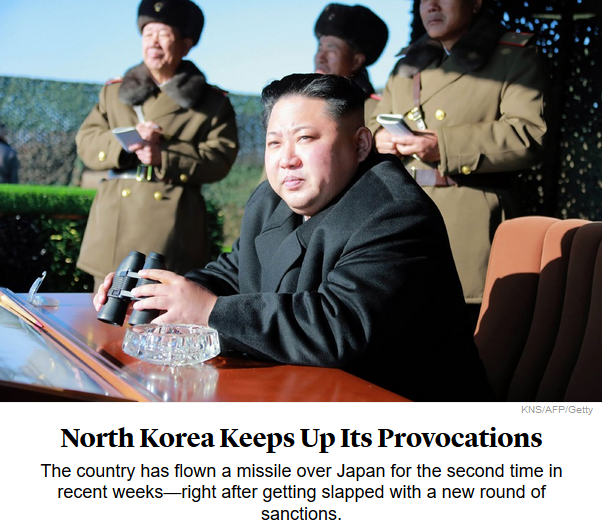
The Atlantic (9/14/17) warned that North Korea could ” put the entire United States in its nuclear crosshairs.”
For the consumer of US corporate media, the idea of a nuclear armed North Korea is a terrifying threat. Almost every day for the last two weeks, print and television media have amped up the potential danger of a devastating military strike from the isolated peninsular nation.
“North Korea Keeps Up Its Provocations,” read a headline at The Atlantic (9/14/17). “North Korea Threatens to ‘Sink’ Japan, Reduce US to ‘Ashes and Darkness,’” reported CNBC (9/14/17). Vox (9/22/17) told readers “Why North Korea’s Latest Threats Are Far More Serious Than Its Typical Bluster.”
The North Korean government is not operating in a vacuum. Yet the reasons for North Korea’s militarization—the country has the fourth largest army in the world—and the historical context for its conflict with the United States are seldom honestly discussed in corporate media.
The Korean War, in which the United States invaded the North on behalf of South Korea, claimed the lives of over 2 million North Koreans. The US dropped as many munitions as it had dropped on the entire Pacific Theater in World War II—a four-year conflict ranging over tens of millions of square miles, as opposed to the 46,541 square miles of North Korea—and the war has never been officially ended.
After citing a source who says North Korea is “paranoid that the United States is going to eliminate them,” Wired‘s Brian Barrett (9/19/17) wrote, “One can trace that paranoia back to the Korean War”—followed by a reasonable description of why the fear of attack was justified. “In 1950, then–US President Harry Truman said that he was prepared to authorize the use of nuclear weapons to end the conflict.” The millions of actual deaths North Korea had suffered during the war—out of a population at the time of less than 10 million—were not noted as contributing to the country’s “paranoia.”
As Hyun Lee put it to FAIR’s CounterSpin (4/7/17), the circumstances surrounding US/North Korea relations make the latter’s desire for powerful weapons understandable—even rational:
We’ve become very confused in the United States, because the mainstream media like to exaggerate the North Korean nuclear threat, but we never get news of what the US has been doing over the past decades. And we should be very clear that what this is all about is actually US nuclear first-strike advantage against North Korea, and North Korea reacting to that by developing its deterrence capability.
The US and South Korea hold annual joint military exercises on the North Korean border—exercises that are explicitly rehearsals for an eventual invasion of the North. As recently as September 23, the US sent a bomber off the North Korean coast—a show of force designed to ratchet up tensions. It would be good if the corporate media used some of their much touted but little practiced objectivity to make this context clear to audiences.
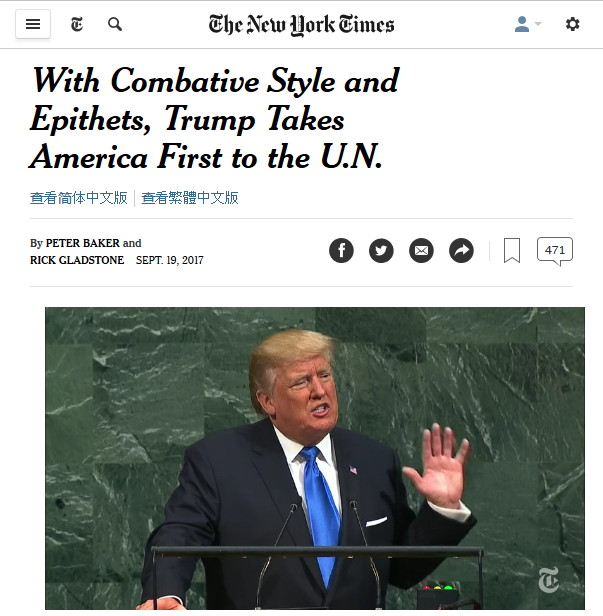
“President Trump brought the same confrontational style of leadership he has used at home to the world’s most prominent stage,” the New York Times (9/19/17) reported.
President Donald Trump’s September 19 speech at the United Nations, in which he threatened to “totally destroy” North Korea, fueled the conflict between the two nations. The president’s statement was criticized in the corporate media for its bellicose and aggressive nature—but as with many of the president’s actions, it was the tone and not the substance that was so offensive to the nation’s news providers.
The New York Times (9/19/17) called that a “confrontational style of leadership.” Vox‘s Alex Ward (9/20/17) described Trump’s remarks as “belligerent rhetoric.” “Trump’s perhaps oddly chosen colloquialisms masked what was a pretty astounding escalation of his rhetoric when it comes to North Korea,” said the Washington Post‘s Aaron Blake (9/19/19).
Yet even with the acknowledgement that Trump had gone farther in his language than his predecessors, corporate media ignore the context in which these threats are made. US news reports don’t reflect the history between the two countries when they write headlines like New York magazine’s “Wait, Are We at War With North Korea Now?” (9/25/17). And that lack of historical context can lead to the San Diego Union-Tribune (9/22/17) publishing an opinion piece on “North Korea’s Weird History of Insulting US Officials” without confronting the history of the two nations that might have led to that language.
Though North Korea surely provides excuses for bombastic rhetoric and threats from America, the power differential is obvious to anyone who is paying attention to the tensions between the two countries. The US controls the majority of the earth’s oceans, has military bases in over 70 countries, and possesses enough firepower to destroy the world many times over. By contrast, North Korea has an antiquated military (regardless of its large number of soldiers) and essentially one powerful ally in China—a country that just this week joined the US in imposing economic sanctions on North Korea.
Lee again:
Since [2006], what the United States has tried to do is stall North Korea’s nuclear development, tying it up through negotiations that basically went nowhere, at the same time constantly threatening to bring about North Korea’s collapse, through sanctions that were crippling its economy, and also military exercises that were very provocative. They simulate war plans that now include the decapitation of the North Korean leadership, and include nuclear first strike.
In short, North Korea is isolated and on edge. The insular regime faces a major threat to its south and an over six-decade faceoff with the world’s most powerful country. That doesn’t excuse North Korea’s actions — firing missiles over Japan isn’t a productive move — but it does provide context for decisions made by North Korea. As long as US corporate media ignore that history and the power differential, the “threat” to the US from North Korea will be overhyped, while the actual military might of the US is downplayed.





How could FAIR destroy the credibility of this otherwise important article by beginning its case with this statement: “The Korean War, in which the United States invaded the North on behalf of South Korea, claimed the lives of over 2 million….” You give your critics the chance to ignore everything else by your inexcusable failure to state that ON JUNE 25th, 1950 NORTH KOREA INVADED SOUTH KOREA – and almost succeeded in conquering the whole country. The U.S. and South Korea “invaded” North Korea the same way the Allies in WWII “invaded” Germany to win that war. How could your writer be so stupid?
Here’s the quick version: In 1945, the northern part of the peninsula was the more educated and industrialized half of the country with an estimated 15% of the northern population self-identifying as Christians. The south was backward farmlands, heavily infiltrated by communist guerrillas. In the years following the 1945 split, on both sides there were terrible purges and other violence, resulting in mass migrations north and south. In 1950 North Korea invaded the South in a daring sneak attack. North Korea nearly succeeded – ultimately, the fighting ended close to the original separation line. During the decades after the war, North Korea sent spies, assassins, and saboteurs into the South. One band attacked the presidential offices. One assassin killed the wife of the South Korean president. In 1983, North Korea killed twenty-one South Koreans including several of the nation’s top officials. (China was at the time trying to bring the two sides together). NK kidnapped Japanese citizens, including children, for use as language instructors, wives for Japanese terrorists, or to steal their identities for use by NK spies, killing a number of the victims. (NK has admitted to the practice and apologized to Japan). Most recently, KJU killed his uncle and his half brother (among others) with sadistic cruelty, also using a banned and extremely dangerous bio warfare agent on the half brother. But if authentic history isn’t your thing, look at the outcomes. Same Korean gene pool, north and south. The North had the economic patronage and military support of two of the world’s superpowers, access to most of the world’s markets, but never progressed. In contrast, despite its 1945 beginnings as the impoverished and under-educated half of the peninsula, South Korea now flourishes and and is the go-to source for high quality, complex ships; arguably the world’s best smart phones and television screens; well built automobiles; etc, etc. South Korea enjoys a high standard of living, the world’s best internet delivery system, and contributes musicians, visual artists, doctors and scientists to the world. The North, after decades of handouts and help from Russia and China, is still a struggling third world society where the leadership energies drain into myth making and the elimination of dissent. Only the elite get fat. Now that tens of thousands of North Koreans have escaped but continue, in many cases, to maintain contact with family through smugglers and other means, the jig is up for the Kim clan – North Koreans know they are sucking hind titty. As more and more understand why, the apparent survival gambit for Kimunism is an extreme conflict that unites the grumblers. You may hate Trump, but don’t be stupid about North Korea.
I can’t say I am entirely well informed on this, but i can tell you left out the role of the Americans, fairly sure they did put and supported a dictator in the South, and the South regained control largely due to American support. Even after the Korean war(technically still at war) it took a long time for a semblance of democracy to be won.
It is not like the US created the conditions for good outcomes much at all. Planet Oaf never has any good factions.
Hey Jaser.
I’d like you to compare the current NORTH Korean household GDP to the SOUTH Korean household GDP. I’d also like you to look at their economy national GDP and their exports. You might find the differences extremely staggering.
If the South had fallen to the invading North, it would have plunged all of Korea into a communist / socialist nightmare. At the time, hundreds of thousands of “communists” and “socialists” DIED from starvation and forced labor – all across Soviet Russia, Communist China, and many other revolutionary societies.
Hate Trump. Mutilate history to fit your warped views of how much you apparently -loath- you own country. But the United States -saved- South Korea.
President Donald Trump’s September 19 speech at the United Nations, in which he threatened to “totally destroy” North Korea, fueled the conflict between the two nations. The president’s statement was criticized in the corporate media for its bellicose and aggressive nature—but as with many of the president’s actions, it was the tone and not the substance that was so offensive to the nation’s news providers.
Does US have a right to do so
When the Japanese invaded the Korean peninsula 300,000-400,000 Korean fled north and successfully fought off the Japanese. When the Japanese were defeated some gunless Koreans in the north tried to return to the houses they had built with their own hands in the south- 20,000 to 30,000 of them were slaughtered by American soldiers- that is when the Chinese stepped in to protect those in the north from American soldiers. No slaughtering of those 20,000 to 30,000 gunless men and women and children would have meant no Korean War. Kim Jung-un remembers- him and I talked about it. Kim Jung-un said to me that he would like to go to the south to build a house near where his father and his father’s father built a house. Never happen with Bully South Korea and Bully Japan and Bully America.
America needs to go away now aand leave the Koreas alone. The only good thing about this 67 years ( assunming that 1950 began all this) is that the DMZ has become a wonderful conservation zone of what the Koreas used to be like. I read about one scientist who has seen existnce of the Siberian tiger and is hopeful, some still survive. This would be wonderful because that tiger was once the unifying symbol of a united Korea. Since America has dissed any sort of peace accord then after all this time, it should be enough of an abandonment to have the UN do somenthing positive, and have all nations vote for America to go home. America, you are putting so much money into killing and destruction, that it would be nice if the Koreas work on their problems. America seems to do well in blowing things up and killing civilians, and Israel, England, and France are emeshed in that too.The citiznes of all these war invested nations need help, ——–not more body bags.
The NORTH KOREANS … INVADED … THE SOUTH, you God-damn hack of a “journalist.” You have just invalidated your entire freaking article.
“At dawn on Sunday, 25 June 1950, the Korean People’s Army crossed the 38th parallel behind artillery fire.[114] The KPA justified its assault with the claim that ROK troops attacked first and that the KPA were aiming to arrest and execute the “bandit traitor Syngman Rhee”.[115] Fighting began on the strategic Ongjin peninsula in the west.[116][117] There were initial South Korean claims that they captured the city of Haeju, and this sequence of events has led some scholars to argue that the South Koreans fired first.”
“Whoever fired the first shots in Ongjin, within an hour, North Korean forces attacked all along the 38th parallel. The North Koreans had a combined arms force including tanks supported by heavy artillery. The South Koreans had no tanks, anti-tank weapons or heavy artillery, to stop such an attack. In addition, South Koreans committed their forces in a piecemeal fashion and these were routed in a few days.”
Because Koreans didn’t want to trade one foreign occupier – Japan – for another in the United States. American Exceptionalist, health thyself.
Mm. Yes.
Please, tell us how must better South Korea would have been had the United States not gotten involved.
And do remember to apply Real World comparisons to almost all the existing Communist / Socialists Regimes at the time. Use the Real World living conditions, economic conditions, and government style.
Please tell us “how much better” it would have been if we had left the South Koreans to their fates.
Sometimes -intervening- is a good thing.
I couldn’t agree more with the analysis. The only point not made in the article was this, however. After Gadaffi in Libya gave up his nuclear weapons, we bombed the dickens out of the country as well as killing him. Surely North Korea is aware of this as well.