

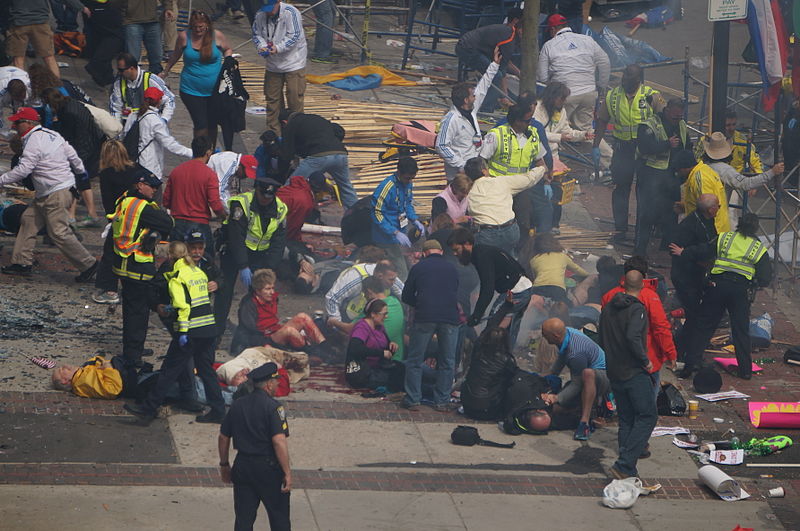
The Boston Marathon was widely called “terrorism” when people had no idea who committed it. (cc photo: Aaron Tang)
In the wake of mass violence, a nation struggling to understand turns to its news outlets to see how they frame events. The language journalists use in the immediate aftermath of a bloodbath helps form public attitudes and has a major impact on official reactions.
When two bombs went off at the Boston Marathon on April 15, 2013, killing three and injuring hundreds, it was inevitably a huge story: A search of the Nexis news database for US newspapers on the next day turns up 2,593 stories mentioning the marathon, virtually all of them about the bombing. Of these, 887, or 34 percent, used the word “terrorism” or a variant (“terrorist,” “terroristic” etc.)—even though the bombers, let alone the bombers’ motivations, would not be known until days later.

Dylann Roof, suspect in the Charleston church massacre, wears white supremacist emblems and allegedly told friends he was hoping “to start a civil war”—yet he was rarely called a “terrorist” in media coverage.
When nine people were killed at Emanuel African Methodist Episcopal Church on April 17, 2015, there were 367 stories in the next day’s papers that mentioned “Charleston” and “church,” according to Nexis—a big story, though not given the blockbuster treatment of the Boston Marathon bombing. Of these 367 stories, 24 mentioned “terrorism” or “terrorist”–just 7 percent, even though a suspect, Dylann Roof, was named on the first day, with evidence presented that he was motivated by a white supremacist ideology and a desire “to start a civil war” (Columbia, S.C. State, 6/18/15).
Some suggest that the word “terrorism” has been so politically manipulated and selectively applied that we would do well to drop the whole concept. But politically motivated violence that targets civilians—which is the core of the various definitions of “terrorism”—is an actual phenomenon that is hard to talk about without a label.
If media are going to use the word, though, they need to have a single standard for its application. By applying the word to a bombing with initially unknown perpetrators, and largely declining to use it in connection with a massacre allegedly perpetrated by a white supremacist hoping to spark a race war, media failed that test.
Jim Naureckas is the editor of FAIR.org.
Research assistance: Michael Tkaczevski.



Thanks for voicing the basic question :”Can someone please define what exactly qualifies one to be termed a ‘terrorist’?” For there is no consistency whatsoever in its application by press & politicians alike, while
we all see the bias that permeates its use.
Unknown killers may be suspected of reacting to US killing of civilians in foreign lands. The media, negligent in labeling the US killings as acts of terrorism, have a pent up need to call terrorists those who then respond to US terrorism with acts in kind.
A known white supremacist, on the other hand, is more closely identified with the US attitude towards those in other lands. Not only that, the white supremacist killer is only acting out US foreign policy since at least the end of World War II.
Imagine, if you can, living in a place where an unmanned aircraft, armed with weapons, circles over villages whose people, all the while knowing of this overhead menace, going through their days (and nights) never knowing if or when they will be subject to attack. We’re talking about children living their lives not under a metaphoric nuclear cloud, but under an actual, hovering, lethal weapons system. That is Terror.
Damn any country who would do such a thing!
Three died in Boston.
Nine in Charleston.
Three times the coverage?
Even a third?
Can we gauge from that how much black lives matter to the media
Or how little white terrorism?
Yes there is a definition of terrorist, and Barack ‘the drone’ Obama is the epitome of a terrorist. Certainly he has terrorized more people over greater portion of the world than any other. And he continues to do so, hiding behind his day job as POTUS.
Glenn Greenwald wrote about this very thing
https://firstlook.org/theintercept/2015/06/19/refusal-call-charleston-shootings-terrorism-shows-meaningless-propaganda-term/
June 17, not April 17.
Readers should visit the 6/13/2014 FAIR BLOG post by Steve Rendall, titled “When Is Terrorism Not Terrorism”.
This excerpt sums it up nicely, and explains the present media reluctance to label White nationalist violence as “terrorism”:
“It doesn’t say much for journalists making independent judgments. But as Ibrahim Hooper of the Council on American Islamic Relations told the Post:
‘Without a doubt, if these individuals had been Muslim, it not only would be called “terrorism” but it would have made national and international headlines for weeks…. It was an act of terror, but when it’s not associated with Muslims, it’s just a day story that comes and goes.’
“Perhaps the most revealing quote in Farhi’s report came from Daniel Bynam of the Brookings Institution, who told him media avoid the ‘terrorist’ label in such cases because ‘many of the objectives [of right-wing extremist groups] are close enough to legitimate political movements’ that the labeling might disturb those in the movements ‘who don’t have violent aims.'”
Let’s translate: When White nationalist sentiment Venn-diagrams with mainstream conservative sentiment, then White nationalist violence cannot be labeled “terrorism”. Because, frankly, Republican and conservative fee-fees cannot be offended (the left cannot be said to have “legitimate political movements”, per the American right and mainstream journalism and opinion punditry.)
Donald: Like your analysis, particularly your summary in the final paragraph. I think it’s spot on.
We love FAIR. But this “terrorist” trope needs to be jettisoned. Look up Kevin Alexander Gray, a South Carolina civil rights activist and community organizer who edited the book “Killing Trayvons: An Anthology of American Violence” on DemocracyNow schooling on that subject in a deep way.