


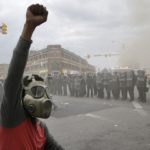
“Why is there so much anger?” If you were wondering that before you read the Washington Post‘s “primer,” you’re probably still wondering. (Algerina Perna/Baltimore Sun)
In the wake of public protests over the death of an African-American man in the custody of the Baltimore Police Department, the Washington Post (4/28/15) offered “A Freddie Gray Primer: Who Was He, How Did He Die, Why Is There So Much Anger?”
The “who was he” part came from the “no angel” school of journalism—stressing Gray’s “frequent run-ins with the law,” sniffing that he “lived off” compensation for childhood lead-poisoning. It’s not all negative—friends recalled him as “loyal and warm, humorous and happy.” But as in other pieces in this genre, the point seemed not so much to humanize the victim as to allow readers to judge whether he deserved to live or die.
Post writers Peter Hermann and John Woodrow Cox described Gray as “at the moment…the nation’s most prominent symbol of distrust in police.” Does he really symbolize “distrust in police”—or police violence against black men?
But the Post couldn’t refer to Gray as a symbol of police violence, because as far as the paper was concerned, there was no way to tell whether any police violence occurred at all; in the next section—“How did he die?”—his death was presented as a complete mystery. Which was not surprising when you look at the sourcing:
The officers said…. Officials say…. police officials said…. Officials said…. Baltimore police have acknowledged…. Police have said…. Those involved in the arrest…. City officials have promised…. Baltimore Mayor Stephanie Rawlings-Blake said….

Freddie Gray: The Post didn’t see his brutal death as sufficient to explain a community’s anger.
(photo: Jamiea Speller)
The heading on the final section, “Why is there so much anger?,” implicitly played down Gray’s importance as an individual—isn’t a brutal death with no credible explanation reason enough for community anger?—though the article did tie Gray’s death to “what activists say is a much larger national issue: police mistreatment of black men.” After listing some of the more infamous recent examples of black men or youths killed by police—Michael Brown, Tamir Rice, Eric Garner, Walter Scott—the piece continued: “Those tensions were only heightened in West Baltimore, where relations between residents and police have long been strained.”
But a series of deaths are not “tensions”—they’re actual violence, with real lives lost. Nor is “strained” the appropriate word to use for relations between police and residents where police have repeatedly killed those residents.
An ACLU of Maryland report found 109 people killed in police encounters in the state in a five-year period from 2010–14. Sixty-nine percent of those killed were black. (Maryland is 29 percent black.) Forty-five were not armed in any way; 80 percent of these victims were black.
You get a good sense of the human lives—and the racism—behind these statistics in a Baltimore Sun article (9/28/14) about the city’s police brutality settlements (summarized by Conor Friedersdorf in the Atlantic—4/22/15).
None of this was included in the Post’s explanation of community anger—though the passage did find space to mention “violent rioters who set cars ablaze, looted businesses and injured more than a dozen officers.”
Inequality by Design
“Blacks should be quarantined in isolated slums in order to reduce the incidence of civil disturbance, to prevent the spread of communicable disease into the nearby white neighborhoods, and to protect property values among the white majority.”
—Baltimore Mayor J. Barry Mahool in 1910, cited by Richard Rothstein in “From Ferguson to Baltimore: The Fruits of Government-Sponsored Segregation” (Economic Policy Institute). Rothstein explained to CounterSpin (5/8/15) that the segregated, substandard housing conditions of Freddie Gray’s neighborhood are no accident.




Wow, this article is fastidious, my younger sister is analyzing these things, therefore I am going to let know her.|