


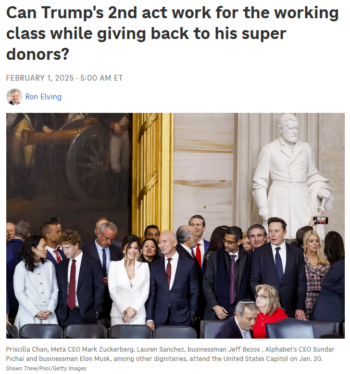
NPR (2/1/25) investigates how a politician who surrounds himself with fellow billionaires can “work for the working class.” NPR‘s suggestion: tax cuts for the very wealthy.
“Can Trump’s Second Act Work for the Working Class While Giving Back to His Super Donors?” asks NPR.com (2/1/25). The answer, from NPR senior editor and correspondent Ron Elving, is a resounding—maybe!
Elving presents the politics of the second Trump administration as a perplexing paradox:
Today we are confronted with an alliance between those whom political scientists might call plutocrats and those who are increasingly labeled populists. The contrast is stark, but the symbiosis is unmistakable. And we all await the outcome as the populist in Trump tries to co-exist with his newfound ally Musk, the world’s richest man with abundant clout in the new administration.
After a meandering tour of US history from Andrew Jackson to William Jenning Bryan to Ross Perot, Elving concludes: “We may only be at the beginning of an era in which certain political figures can serve what are plausibly called populist causes by calling on the resources of the ultra-rich.” Huge, if true!
Elving’s evidence that Trump is a “populist”—or at least has a populist lurking inside him—is remarkably thin, however:
Trump has shown a certain affinity with, and owes a clear debt to, many of the little guys—what he called in 2017 “the forgotten men and women.”… With his small town, egalitarian rallies and appeals to “the forgotten man and woman,” he has revived the term populism in the political lexicon and gone further with it than anyone since Bryan’s heyday.
Trump “made a show of working a shift at a McDonald’s last fall,” Elving notes. And he “used his fame and Twitter account to popularize a fringe theory about then-President Obama being foreign born and thus ineligible to be president,” which “connected him to a hardcore of voters such as those who told pollsters they believed Obama was a Muslim.” Elving suggests that this is the sort of thing populists do.
But when it comes to offering examples of actual populist policies from the first Trump administration, Elving admits that there aren’t many to speak of:
If Trump’s rapid rise as a Washington outsider recalled those of 19th century populists, Trump’s actual performance as president was quite different. In fact it had more in common with the record of President William McKinley, the Ohio Republican who defeated Bryan in 1896 and again in 1900 while defending the gold standard and representing the interests of business and industry.
In fact, says Elving, “Trump in his first term pursued a relatively familiar list of Republican priorities,” with “his main legislative achievement” being “the passage of an enormous tax cut…that greatly benefited high-income earners and holders of wealth.” For genuine journalists, for whom politicians’ actions are more significant than their words, that would be the most meaningful predictor of what Trump is likely to do going forward.
But Trump’s second term, Elving suggests on the basis of nothing, could be quite different: “As Trump’s second term unfolds, the issues most likely to be vigorously pursued may be those where the interests of his populist base can be braided with those who sat in billionaire’s row on Inauguration Day.” Such as? “The renewal of the 2017 tax cuts is an area of commonality, as is the promise to shrink government.”
So—a restoration of the same tax cuts that “greatly benefited high-income earners and holders of wealth”? That how NPR thinks Trump in his second term “can serve what are plausibly called populist causes”?
All hail the unmistakable symbiosis!
ACTION ALERT: You can send a message to NPR public editor Kelly McBride here. or via Bluesky: @kellymcb.bsky.social. Please remember that respectful communication is the most effective. Feel free to leave a copy of your message in the comments thread of this post.
FEATURED IMAGE: NPR depiction of candidate Donald Trump as a tribune of the working class.




I think that Mr. Elving was describing how T is marketing himself as a populist; many of his followers want less government and taxes without perhaps considering the consequences. The fox leading the ill-informed, where the ill-informed “may” be forgiven for their tough times. That the tax cuts are for the wealthy, maybe some believe it trickles down. Just thinking out loud — a dangerous thing to do in a comments section!
Well, in the context of the administration’s threat of investigating NPR and PBS’s enhanced underwriting practices, they have to appear unbiased. Of course, this investigation doesn’t make sense because you would think a way to save the government money would be to encourage more underwriting. Just a red herring to get congressional investigations and hearings going to smear public broadcasting. Last time this happened Mr. Rogers testified and swayed the Republicans. Let’s hope some public media figure can come to the rescue again. And have the citizens rally for public media.
Thanks for this heads-up. Used your link to send a note to NPR. My note included the following points:
— Will Rogers coined “trickle-down” in 1932, calling out then-president Herbert Hoover.
— The Hoover Institution, founded on Hoover’s policies, has close ties to the Heritage Foundation, author of Project 2025.
— Robert Reich calls trickle-down a hoax. I call it meshuganomics.
— NPR should fire Ron Elving and re-hire him as Satire Editor. Proposing more trickle-down with a straight face, would fit the job.
“Nothing unites Americans more than dysfunctional government.”
LMAO
At least he is clear-eyed about a dangerous world. All very innocuous on the surface and his discipline always trumps his conviction.
MAGA has ‘Won’ the sensitive young man and POC. This isn’t a political force that draws all voters to Trump – it’s a human one.
As a crazy pundit said on CNN , white women will complain about not having blueberries for their smoothies. What will we all do?
I love when corporate slop is fed to me with identity politics
I hate NPR so much now. I’m sure they were always weaksauce but they should be so much better.
Elving’s wait-and-see approach won’t help NPR. Trump and his handlers and acolytes won’t be mollified or deterred from removing public funding or suing. If he thinks he is deterring Trump he’s kidding himself.
NPR claims that the feds supply only 10% of its funding. They worry most about securing and holding on to corporate and foundation underwriters, the ranks of whom have been declining. In March 2023, under Biden, NPR laid off about 10% of its staff. One of the issues employees brought up with management was how minority staff members were adversely affected.
https://www.bloomberg.com/news/newsletters/2023-03-30/tensions-flare-inside-npr-after-staff-layoffs-and-town-halls
My point is that NPR was already running scared. It fears to risk alienating any of the pillars of its support. The Trump regime’s bullying makes NPR even more risk-adverse and Elvings’ words seem to bear that out. The same sort of quiet capitulation is happening in private corporate media. They all must be called out. Thank you, FAIR, for continuing to do that.