Is Thomas Friedman Even Listening?
If Friedman had actually listened to what speakers at the rally had to say, he would have heard plenty of discussion of the day’s violence.
FAIR is the national progressive media watchdog group, challenging corporate media bias, spin and misinformation.


If Friedman had actually listened to what speakers at the rally had to say, he would have heard plenty of discussion of the day’s violence.
In the wake of a FAIR action alert, the New York Times printed the following correction on Saturday, October 4: An article on Wednesday about renewed criticism of the Bush administration for its handling of intelligence before the Iraq war misstated the circumstances under which international weapons inspectors left Iraq in 1998. They were withdrawn […]
In the wars of the 1980s and ’90s, military planners placed considerable emphasis on controlling the information that reached the American public. Journalists were excluded from the wars in Grenada and Panama until the fighting was already concluded. This in turn led to complaints from journalists, and in the 1990 war in Iraq, code-named Operation […]
Scott Ritter, the former United Nations weapons inspector, spent the last several years telling anyone who would listen that Iraq probably did not possess any significant quantities of banned weapons. We now know that Ritter was most likely correct; U.S. forces occupying Iraq since late March have failed to find any weapons of mass destruction. […]
The superstar columnist George Will has an impressive vocabulary. Too bad it doesn’t include the words “I’m sorry.” Last year, Will led the media charge when a member of Congress dared to say that George W. Bush would try to deceive the public about Iraq. By now, of course, strong evidence has piled up that […]
By the time the war against Iraq began, much of the media had been conditioned to believe, almost as an article of faith, that Saddam Hussein’s Iraq was bulging with chemical and biological weapons, despite years of United Nations inspections. Reporters dispensed with the formality of applying modifiers like “alleged” or “suspected” to Iraq’s supposed […]
The Liberation of Iraq “I want to be certain that nothing is shown that would incite violence in a city that was extremely tense when we took over two-and-one-half weeks ago, and which still has folks who are totally opposed to what we’re doing and are willing to do something about it. . . . […]
In the build-up to the war against Iraq, U.S. television spent much time speculating about whether Saddam Hussein might acquire uranium for weapons. But the same outlets showed little curiosity about the U.S. and Britain’s actual use of uranium weapons during the war. Many U.S. and British munitions use a dense, toxic metal known as […]

Since the invasion of Iraq began in March, official voices have dominated U.S. network newscasts, while opponents of the war have been notably underrepresented, according to a study by FAIR. Starting the day after the bombing of Iraq began on March 19, the three-week study (3/20/03-4/9/03) looked at 1,617 on-camera sources appearing in stories about […]
On April 26, ABC‘s World News Tonight led with a major scoop. Anchor Claire Shipman announced at the top of the broadcast, “U.S. troops discover chemical agents, missiles, and what could be a mobile laboratory in Iraq. An ABC News exclusive.” But ABC‘s “exclusive,” as it turns out, appears to be false. The April 26 […]
Hans Blix, Dennis Kucinich and the Dixie Chicks are in very different lines of work — but they’re in the same line of fire from big media for the sin of strongly challenging the president’s war agenda. Let’s start with Blix, who can get respectful coverage in American media — unless he’s criticizing the U.S. […]

On April 8, 2003, U.S. military forces launched what appeared to be deliberate attacks on independent journalists covering the war, killing three and injuring four others.

Although the invasion of Iraq is being fought under the name “Operation Iraqi Freedom,” it has constricted the range of expression sanctioned by media outlets within the U.S.
The Disarmament Nightmare Subheads over a March 4 New York Times article: “More Missiles Destroyed; Washington Is Concerned Over Possible Complications for Effort to Disarm Iraq.” Nothing like disarming to complicate disarmament. NBC Nightly News (2/27/03) was even more alarmed about the missile destruction, with Andrea Mitchell reporting: “For the U.S., it’s a nightmare scenario. […]
In a breakdown of major U.S. newspapers’ positions on the Iraq issue before the invasion began, the trade magazine Editor and Publisher (3/14/03) labeled the New York Times “strongly dovish,” based on its stance in a March 9 editorial: “If it comes down to a question of yes or no to invasion without broad international […]

Of all 393 sources, only three (less than 1 percent) were identified with organized protests or anti-war groups.
On February 24, Newsweek broke what may be the biggest story of the Iraq crisis. In a revelation that “raises questions about whether the WMD [weapons of mass destruction] stockpiles attributed to Iraq still exist,” the magazine’s issue dated March 3 reported that the Iraqi weapons chief who defected from the regime in 1995 told […]
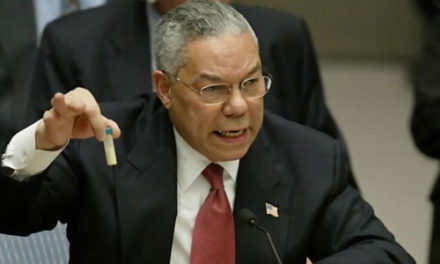
In reporting on Secretary of State Colin Powell’s February 5 presentation to the United Nations Security Council, many journalists treated allegations made by Powell as though they were facts. Reporters at several major outlets neglected to observe the journalistic rule of prefacing unverified assertions with words like “claimed” or “alleged.” This is of particular concern […]

While teams of U.N. experts scouring Iraq have yet to find any hidden caches of chemical, biological or nuclear weapons, some U.S. journalists seem to have already turned up their own smoking guns. Whether out of excess zeal or simple carelessness, the media’s intensive coverage of the U.N. inspections has repeatedly glided from reporting the […]
A dozen years after the Gulf War, public perceptions of it are now very helpful to the White House. That’s part of a timeworn pattern: Illusions about previous wars make the next one seem acceptable. As George Orwell observed in 1984: “Who controls the past controls the future; who controls the present controls the past.” […]

