WaPo Editors: We Have to Help Destroy Yemen to Save It
The Washington Post vaguely acknowledges Washington’s role in the bloody siege of Yemen, but insisting that the US should remain involved in the bombing for the sake of humanitarianism.
FAIR is the national progressive media watchdog group, challenging corporate media bias, spin and misinformation.


The Washington Post vaguely acknowledges Washington’s role in the bloody siege of Yemen, but insisting that the US should remain involved in the bombing for the sake of humanitarianism.

Why exactly should those of us who don’t own lots of stock in Microsoft and Pfizer care if China doesn’t pay them licensing fees and royalties?

What counts as “far left” to the Washington Post, the newspaper owned by the world’s richest human?

The debate in the New York Times and Washington Post over President Donald Trump’s decision to withdraw from the Joint Comprehensive Plan of Action (JCPOA), better known as the Iran deal, revolves around which tactics America should use to dominate Iran.

Washington Post columns argue Haspel should be confirmed as the next director of the CIA—despite having overseen a black site prison where detainees were brutally tortured, and directing the destruction of evidence of this illegal and inhumane practice—because it’s the feminist thing to do.

For casually threatening economic ruin, inciting violence against entire populations, pushing for bombing faceless Muslims, or downplaying racism and child rape, there’s no better outlet than long-time echo chamber of power-serving conventional wisdom, the Washington Post.

Corporate media outlets were glad that the US, France and Britain bombed Syria in violation of international law, but lamented what they see as a dearth of US violence in the country.
The curators of American public opinion at the three most influential broadsheets in the United States have decided that dissent from the build-up to new airstrikes on Syria is not really an opinion worth hearing.

The very possibility of US withdrawal from Syria rendered apoplectic journalists who are convinced of the legitimacy of Washington’s domination of the country—international law be damned.

“What Next in Africa?” read a recent Washington Post headline. Among the possible answers not considered by the Post article: “Close US military bases,” “End US drone strikes” or “Stop US special forces raids.”

The Washington Post calling for “reform” of Social Security and Medicare is a bit like the morning coffee, although somewhat less pleasant.

It’s notable—and uniquely sketchy—when the Washington Post not only uses prime media real estate to uncritically hype Amazon’s primary corporate sales pitch, but does so while failing to disclose that Amazon’s CEO is the paper’s boss.

How did a tax cut that mainly benefits a small group of top earners become broadly popular? One reason is the nonstop deluge of stories over the past two months, cheerleading alleged “tax cut bonuses” from large corporations.

It’s hard to think of a better illustration of the concept of cognitive dissonance than the Washington Post unironically referring to Mike Pence as a “superhero” in an article about the dangers of propaganda.
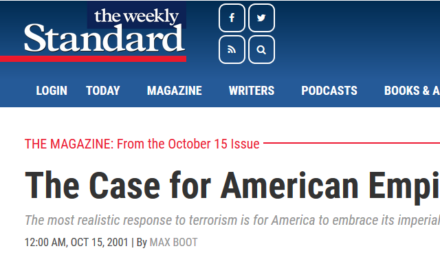
Max Boot’s hiring by the Washington Post goes to show, again, that the most certain way to move up in the media pundit universe is to consistently echo US national security orthodoxy—without pause or regret.

Not only is all blood taken from his words, but the quotes highlighted seem handpicked precisely to ameliorate the guilt of the Washington Post’s more conservative white readers in the hackiest manner possible.

The Washington Post’s proto-obituary sets the standard for all other flattering, ahistorical profiles of the senator that will invariably come down the pipe.

A review of 15 opinion pieces featured in the Washington Post shows voices even remotely sympathetic to the government of President Nicolás Maduro are omitted entirely.

It almost sounds like the newspaper owned by the second-wealthiest person in the world doesn’t want people talking about how much the extremely rich own compared to the rest of us.

There is no evidence that debt is limiting our ability to spend more in these and other areas. There is a strong case that fears over the debt, raised by folks like Fareed Zakaria, are limiting our ability to invest for the future.

