

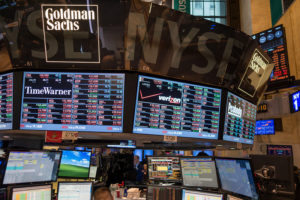
If Wall Street is getting all the benefits of the economy, maybe that’s just because we haven’t put enough Wall Streeters in charge. (cc photo: Scott Beale)
Illustrating that nothing rattles corporate media like progressive populism, the Washington Post‘s David Ignatius (12/24/14) is the latest establishment journalist to launch a salvo against Sen. Elizabeth Warren (D-Mass.) and “her jihad against Wall Street.”
Echoing the New York Times‘ Andrew Ross Sorkin (FAIR Blog, 11/26/14), Ignatius goes after Warren for opposing the nomination of Antonio Weiss to be the Treasury Department’s undersecretary for domestic finance. He makes the same extraneous points Sorkin did about Weiss (He’s a Democrat! He publishes the Paris Review!) and similarly misrepresents Warren’s primary reason for opposing him, which is, as she wrote in the Huffington Post (11/19/14), that “Weiss has spent most of his career working on international transactions,” so “neither his background nor his professional experience makes him qualified to oversee consumer protection and domestic regulatory functions at the Treasury.”
Ignatius also criticizes Warren for including on her “enemies list” Timothy Geithner and Lawrence Summers, despite the fact that they “had never worked as private bankers.” Summers may not have been a private banker, but he was a managing director of the hedge fund D.E. Shaw, which paid him $5.2 million; he also got $2.7 million in “speaking fees” from financial firms, including major banks like Citigroup and JP Morgan Chase (Salon, 4/4/09). But he wasn’t a private banker!
As for Geithner, he started his career at Kissinger Associates—with friends like that, who needs an enemies list?

Elizabeth Warren (cc photo: New America Foundation)
Aside from picking on these poor non-bankers, Ignatius complains that Warren refuses to celebrate “the Obama administration’s biggest domestic policy success”: the revival of Wall Street after the 2008 financial crisis. “When historians look at the Obama presidency,” writes Ignatius, “they’re likely to credit the president especially for doing the politically unpopular things that were needed in 2009 to salvage the financial wreckage.” Historians, actually, are likely to point out that most of these things—like the Emergency Economic Stabilization Act and the Troubled Asset Relief Program (TARP)—were initiated in 2008, before Obama took office.
Regardless of who was responsible, Ignatius feels that Warren should apologize for having questioned TARP—which “made a $15 billion profit, Treasury announced last Friday.”
As economist Dean Baker (CEPR, 7/26/12) has pointed out, this is “not the way serious people do accounting.” The government loaned money to Wall Street at highly subsidized interest rates—and the difference between the rates they paid and the rates that were available from private sources is a bailout that will never be paid back.
And the real question, of course, is not how much the government paid to bail out Wall Street, but whether bailing out Wall Street was a worthwhile thing to do. It’s worth quoting Baker (Guardian, 9/20/10) at length on this point, because it’s not a point of view you’ll often see in media outlets that are owned by the same financial elites that got bailed out:
Had it not been for the bailout, most of the major center banks would have been wiped out. This would have destroyed the fortunes of their shareholders, many of their creditors, and their top executives. This would have been a massive redistribution to the rest of society—their loss is our gain.
It is important to remember that the economy would be no less productive following the demise of these Wall Street giants. The only economic fact that would have been different is that the Wall Street crew would have lost claims to hundreds of billions of dollars of the economy’s output each year and trillions of dollars of wealth. That money would, instead, be available for the rest of society. The fact that they have lost the claim to wealth from their stock and bond holdings makes all the rest of us richer, once the economy is again operating near normal levels of output.
Instead, we have the same Wall Street crew calling the shots, doing business pretty much as they always did. The rest of us are sitting here dealing with wreckage of their recklessness: 9.6 percent unemployment and the loss of much of the middle class’s savings in their homes and their retirement accounts.
Ignatius concedes, in the last paragraph of his column, that Warren has a point: “Warren and the neo-populists are right that the recovery hasn’t benefited Main Street as much as it has Wall Street and that the fruits of American prosperity are skewed toward the wealthy.”
“As much as” is an understatement; while the Dow Jones Industrial Average has risen 275 percent since its March 2009 low, Americans’ median income is still 10 percent below what it was in 2007 (FAIR Blog, 11/18/14). That’s not skewed fruit, that’s a major redistribution of wealth from the middle class and poor to the very wealthy.
Not to worry, though; Ignatius has a solution to the problem of Wall Street prospering at the expense of Main Street: Make sure Wall Street stays in charge. He ends his column: “Fixing this problem will surely be harder if liberal Democrats such as Weiss, who understand the financial world enough to challenge it, are barred from government for the offense of working on Wall Street.”
After all, who knows better than foxes how to kill chickens—why not keep them in charge of the henhouse?



Looking under the TARP …
Saving their necks
So they can keep their Guccis on ours
Its profited them, and a getting a person to see a particular point of view, is pretty much inversely proportional to the amount their lifestyle is dependant upon not seeing that point of view.
Ignatius can’t be that dense, can he?
He’s as Dense as Osmium which is 3/4 of ton per Cubic Foot.