

Taking a country to war is the most consequential step political leaders can take. So it would follow that a free press tasked with holding political leaders accountable for such a fateful decision would exercise the utmost scrutiny when it comes to reporting on the costs—both financial and human.
This necessarily rigorous journalistic oversight should never be satisfied with repeating vague claims of progress or accepting easily contradicted evidence about having achieved peace. Literal human lives, both civilian and military, hang in the balance, and so as a war drags on, it becomes increasingly important for a free press to avoid complacency and ruthlessly interrogate the facts on the ground.
Tragically, coverage of US military combat in Iraq offers an untold number of examples where the corporate press spectacularly failed to live up to this critical responsibility. Whether it was the unabashed cheerleading that colored much of the reporting during the first Gulf War (Extra!, 4/91) or the credulous parroting of false WMD claims in the lead-up to the 2003 re-invasion—with the New York Times earning special condemnation (FAIR.org, 7/21/16)—the US media has compiled a dreadful record when it comes to Iraq.
And, true to form, in the past two weeks we’ve see another, less monumental but still insidious, case of inaccurate Iraq war coverage. Coincidentally, this latest mistake comes courtesy of corporate media’s “factchecking” structure.

Beto O’Rourke: “Twenty-seven years in Iraq…with no definition or strategy or end in sight.” (cc photo: Erik Drost/Wikimedia)
It all stems from a comment by Democratic presidential candidate Beto O’Rourke, who has begun inserting a critique of our country’s endless war posture into his stump speeches. At his campaign launch in February, and in several public appearances since, he has commented along these lines (from a March 30 speech):
Do we really want to fight wars forever? Twenty-seven years in Iraq, 18 years, almost, in Afghanistan and counting, with no definition or strategy or end in sight. Trillions of dollars we are spending to fight and to rebuild countries that we’ve invaded.
While the claim of 18 years of military combat in Afghanistan is incontrovertible, some in the press pounced on O’Rourke’s description of an Iraq war that is “27 years and counting.” The Associated Press (4/2/19) drew first blood. In a long factcheck of false statements by Trump, writers Hope Yen, Calvin Woodward and Eric Tucker incongruously wedged in a critique of O’Rourke’s 27 years claim, flatly declaring that he had “misstated the length of the US involvement in the Iraq War.”
This kind of forced false equivalence in factchecking is not new. FAIR (12/7/19) has previously demonstrated how traditional news orgs, already awash in a sea of Trump’s dishonesty, often contort themselves to shoehorn supposedly false comments by left-of-center politicians into the voluminous coverage of the president’s many lies and distortions.

“His math is off,” the Washington Post (4/9/19) said of O’Rourke’s statement that the US had been at war in Iraq for 27 years–as if it were a question of arithmetic, and not of the Post‘s insistence that air patrols over an unwilling country are not an act of war.
Not to be outdone, the Washington Post (4/9/19) also took O’Rourke to task for his “27 years and counting” claim. Writing in his Fact-Checker column, Glenn Kessler said “O’Rourke’s math for the Iraq War left us flummoxed.” Parsing what he asserts were the begin and end states of US military combat in Iraq, Kessler rests his main objection on the 12-year interregnum between the end of coalition ground hostilities in the first Gulf War in late February 1991 and the second US ground invasion in March 2003. Giving O’Rourke “Three Pinocchios,” Kessler concluded:
There are three, or maybe four, points at which the United States can be labeled as fighting in Iraq in the past three decades. But there has not been a continuous war.
This is, simply put, not true. But it offers a clear tell to how corporate media have grown inured to nearly two generations of US military combat in Iraq, and increasingly normalized our nation’s violent power projection around the world.
In fact, the end of ground hostilities in 1991’s Operation Desert Storm merely marked a transition to a new kind war in Iraq: a US/UK air combat occupation known in military parlance as operations Northern and Southern Watch. This “no-fly zone” covered more than half of Iraq’s total airspace, and lasted from the end of the 1991 Gulf War right up until the March 2003 invasion. Nevertheless, Kessler quickly glosses over this period in two paragraphs, briefly mentioning 1998’s Desert Fox cruise missile attack on Iraq, but then archly concludes: “But no troops entered Iraq in this period.”
This is a chilling and astoundingly outdated calculus by Kessler. (The AP avoided this particular mistake by failing to mention the 12-year no-fly zone altogether—an even more stunningly negligent oversight.) War is not simply defined by the presence of infantry soldiers maneuvering over foreign terrain. Taking control of another country’s airspace with armed aircraft is no less an act of war than implementing a naval blockade of a country’s ports.
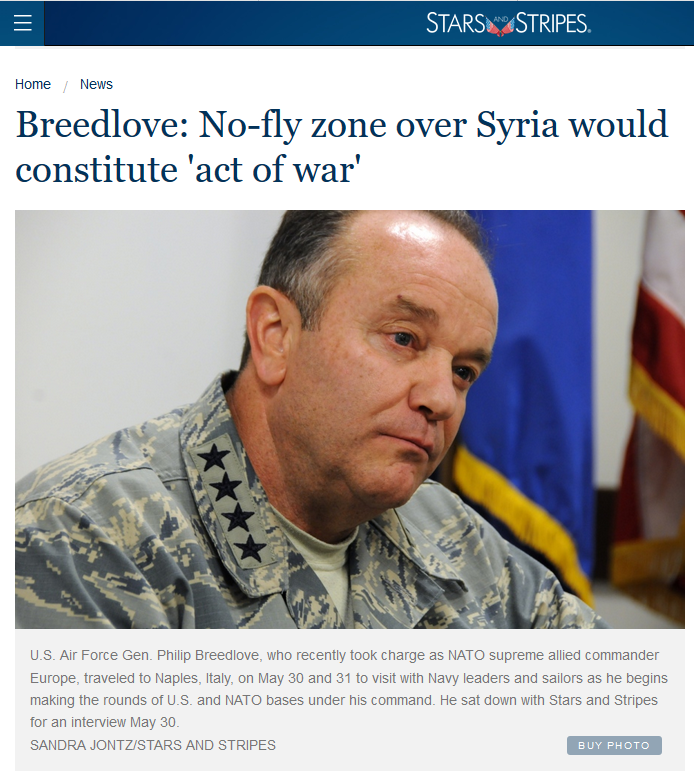
NATO’s military commander recognized that a no-fly zone is an act of war (Stars & Stripes, 5/31/13)—but that reality eluded the Washington Post factchecker.
But don’t just take my word for it. Here’s the NATO Supreme Allied Commander Gen. Phillip Breedlove saying the exact same thing back in 2013 , when US politicians like Sen. John McCain began calling for a no-fly zone over parts of Syria in the early stages of that country’s horrible civil war: “It is quite frankly an act of war and it is not a trivial matter,” he told Stars & Stripes (5/31/13).
And even though the Iraq no-fly zones were ostensibly a continuation of UN Resolution 688, that doesn’t make them any less of a form of combat operations. UN-sanctioned war is still war.
Indeed, to read this public report from the UK National Archives is to get much better grasp of the deadly consequences of the US/UK no-fly-zone operations. From just 1991 to 1993, the report noted at least five separate air combat incidents:
The first two years involved relatively routine patrolling of the no-fly zone, although two Iraqi fighters were shot down and elements of Iraq’s ground based air defen2e system posing a threat were attacked in three incidents in December 1992 and January 1993.
During the last of these series of US/UK attacks—a strike against Iraqi intelligence headquarters in retaliation for an alleged assassination plot to kill President George H.W. Bush—nine civilians were reportedly killed and 12 more were wounded by an errant coalition missile. In September 1996, the allied coalition also launched two separate cruise missile attacks into Iraq, in response to an Iraqi army incursion against Kurds in northern Iraq.
Then, in December 1998, the US and Britain launched Operation Desert Fox, after Iraq refused to comply with UNSCOM inspections at a few sensitive sites, although, contrary to many subsequent, erroneous press reports, Iraq did not expel the inspectors from the country (FAIR.org, 3/6/00).
Though Kessler does mention Desert Fox as “four-day bombing campaign” in his column, he left out all the details and key context of the scale of what was involved. According to the UK archives, in Desert Fox:
US and UK forces used over 400 cruise missiles (more than in the 1991 Gulf Conflict) and 218 tactical bomber sorties to attack 100 targets, including:
- sites identified as being involved in Iraq’s weapons of mass destruction programs;
- command and control facilities through which Saddam controlled military and internal security forces;
- the Iraqi Republican Guard;
- the Iraqi air defense system;
- airfields, including those associated with helicopter forces used for internal repression.
While no specific figures exist for Iraqi military personnel killed by Desert Fox, various contemporaneous reports put the civilian casualty total at several hundred, with around 60 to 70 killed. In the wake of this carnage, Iraq summarily refused to accept the continued no-fly zone patrols, and for the next five years resisted this air occupation with repeated combat responses, as the UK report points out:
Coalition aircraft were fired at by Iraqi surface-to-air missiles and anti-aircraft artillery or targeted by fire control radars. In responding to this threat, coalition aircraft targeted a variety of different elements of Iraq’s Integrated Air Defense System, such as radar sites and associated communications and control networks, surface-to-air missile batteries and anti-aircraft artillery positions. RAF Jaguars flying reconnaissance operations in the northern no-fly zone did not carry or drop air-to-ground ordnance, but RAF Tornado aircraft did so in the southern no-fly zone on numerous occasions.
During the more than 12 years of air patrols over Iraq, the US alone averaged more than 34,000 annual military sorties, according to the Washington Institute for Near East Policy. And an October 2002 Congressional Research Service report calculated that the total costs of these two massive, ongoing no-fly zone operations came to more than $10 billion.
All of these attacks and untold number of deaths does not rise to the definition of war to the Post’s Kessler or to the AP. This is both historical and journalistic malpractice—and the furthest thing from accurate, contextual factchecking.
One wonders if these two news organization would so cavalierly dismiss, if not wholly disappear, Russian or Chinese fighter jets patrolling the eastern half of the United States and occasionally shooting down our military aircraft or bombing our air defense systems. Of course, the question answers itself.
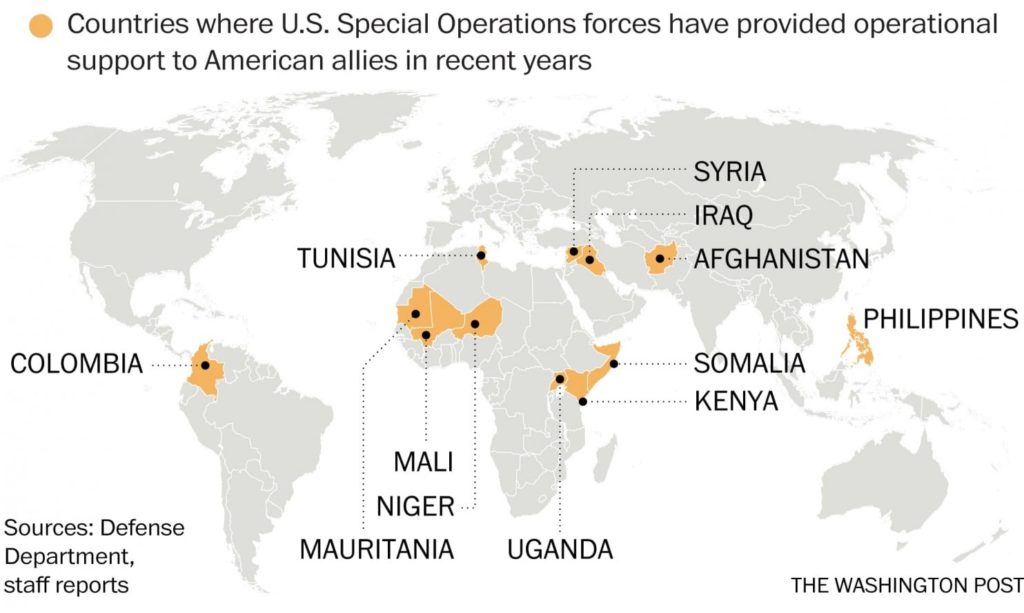
Although the Washington Post (4/17/16) reported in 2016 that “American troops have been in Iraq since the 2003 invasion,” for purposes of factchecking Beto O’Rourke in 2019, they didn’t exist.
Kessler also subtracts the nearly three years, from 2012 to late 2014, when regular US ground combat units were absent from the country. Once again, though, having regular troops on the ground is not the definition of being engaged in combat. In fact, one US soldier was still killed by hostile fire during this period, according to iCasualties.org. Furthermore, a Post report (4/17/16) noted that US special operations advisors had remained in northern Iraq from the claimed end of combat hostilities in 2011 right up through the ISIS takeover of Mosul in 2014.
But what’s even more inexplicable is that Kessler brushes aside an admission by the US military itself that our country has been in continuous combat operations since the first Gulf War. In his column, Kessler included this defense of the 27 years claim by an O’Rourke campaign aide:
Evans said O’Rourke’s remarks were inspired by Gen. Stephen W. Wilson, the Air Force’s vice chief of staff, who came before the House Armed Services Committee on October 3, 2017, and stated: “The 26 years of continuous combat has limited our ability to prepare . . . against advanced future threats. Scenarios with the lowest margin of error and the highest risk to national security. This nonstop combat, paired with the budget instability and lower than planned top lines, has been the United States Air Force, the smallest, oldest equipment and least ready in our history.”
If anything, one could argue O’Rourke is slightly too low, and that 28 years and counting would be more accurate. But Kessler effectively dismisses this testimony, in a classic case of “Who are you going to believe: Me or your lying eyes?” and instead sides with a handful of former Bush and Obama White House officials who say otherwise. His verdict for O’Rourke: “Three Pinocchios,” his column’s second-highest rating for rhetorical dishonesty.
For context, here are some other, recent “Three Pinocchio” fact-checks from the Washington Post, for comparison:
- Trump’s claim that his daughter Ivanka has created “millions of jobs” (2/27/19)
- GOP Rep. Liz Cheney’s claim that the Green New Deal would “eliminate air travel” (2/14/19)
- Vice President Pence’s claim that the Trump administration “has stood strong for a free and independent press and defended the freedom of the press on the world stage” (11/20/18)
The absurdity on offer here by the Post (and the AP) is obvious, but it’s also symbolic of corporate media’s broader bias in war coverage toward US military adventurism, and the institutional timidity that it creates. In a way, O’Rourke’s scathing critique of the excessively violent nature of US foreign policy for the past three decades also contains an implied condemnation of the media that have enabled this endless war posture. After all, you’ll never succeed in holding politicians accountable for flawed wars if you can’t recognize what war looks like in the first place.
Messages can be sent to the Washington Post at letters@washpost.com, or via Twitter @washingtonpost. Please remember that respectful communication is the most effective.
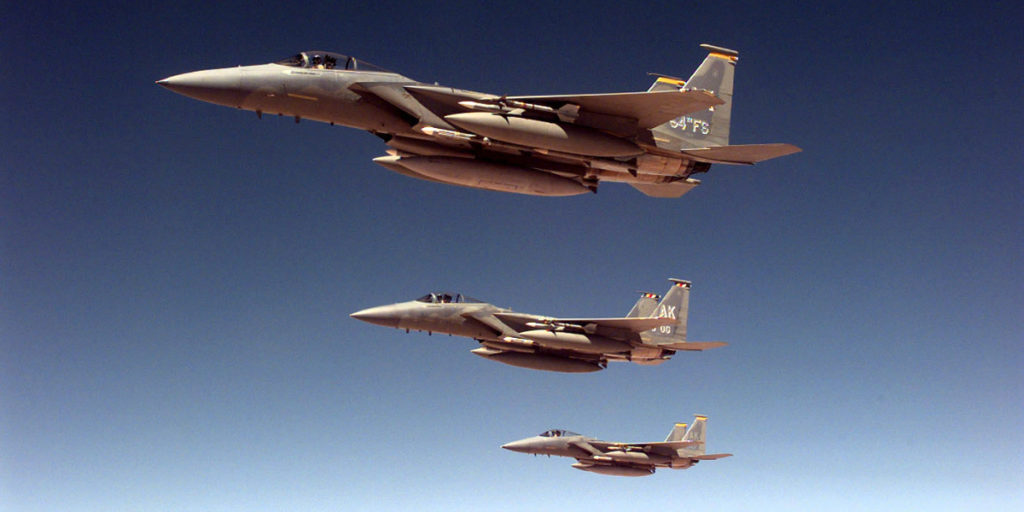
Featured image: US fighter planes over Iraq in 1998 (photo: Greg L. Davis/USAF)



I agree, war is not just dropping bombs—it’s the sanctions, it’s the lying CIA, it’s the spies who spy on Congress, it’s the spies who say nothing when they know warring is a lie———- the WMD story was an act of war. America has been at war eternally, it seems. Only congress can declare war—do the appointed officials know his—or do they just ignore it? 800 bases around the world—-all those planes, all those tanks, all those dead families and children and lies, lies , lies. Congress is not doing its job—maybe it’s time for a national referendum———THE PEOPLE vote for war—as after all. they are the ones who will come back dead or damaged or mentally destroyed. Although to be fair to Congress , if they individually vote for war- they – should go too. To vote for the war God, surely means that Congress should meet him——–on that level playing field!
It’s nice of O’Rourke to say that, but if he really wanted to effect change, he would’ve done the right thing while in Congress, and stopped voting for the massively bloated Pentagon budget.
Just out of curiosity do you know how he voted? I do know that Fort Bliss and White Sands Missile Range are in his district so it’s possible that some money would be going there. It’s hard to have principles when the MIC has embedded itself in every freaking aspect of our lives and is part of nearly all our communities.
Is there any other information besides that he may have voted “yes” on the budget?
Great article. I think this passage is vital:
“One wonders if these two news organization would so cavalierly dismiss, if not wholly disappear, Russian or Chinese fighter jets patrolling the eastern half of the United States and occasionally shooting down our military aircraft or bombing our air defense systems. Of course, the question answers itself.”
The only success I’ve had speaking with friends, colleagues, et al. about U.S.-involved military action is to reverse the roles in the story. For example, talking about the 1998 Al-Shifa bombing doesn’t get a rise. But imagining a foreign military bombing of a U.S. pharmaceutical factory does. Talking about U.S. / S.K. war games doesn’t get a rise, but imagining a Chinese / Mexican war game exercise designed to mimic war against the U.S. does. The key question: “What would be the U.S. response if the shoe were on the other foot?”
There is no doubt Americans would count a foreign military-enforced “no-fly zone” over parts of the U.S. to be an act of war. Certainly the actual bombing on this country and killing of Americans would be considered an act of war. It’s embarrassing to suggest otherwise.
And since the 1991 – 2003 period is at issue, the U.N. sanctions against Iraq should be part of the discussion. Those sanctions likely killed hundreds of thousands of Iraqis from 1991 – 2003, which is especially significant when compared to the far lesser number killed during Desert Storm). Taking a cue from the article, would Americans consider it an act of war to be embargoed by a foreign military while hundreds of thousands of Americans died? Of course they would. Especially if that same foreign military decimated the U.S. power grid, water treatment plants, roads, bridges, etc. all in attempt to increase the effect of those sanctions. We’d call it genocide, and we’d do everything possible to end it.
a.s. — I agree entirely with the ‘role reversal’ argument. Christ, the media in this country goes goddamn ape-shit crazy when ONE(1) small (by military standards) home-made bomb goes-off every 5 or 10 yrs in this country (e.g. the ~1970 bomb in Madison, WI; the Oklahoma City bomb, the Boston Marathon bomb a few years ago, to name a few I recall) — and it’s justified because innocent civilians including women & children were killed & injured. But what’s eternally galling is the lack of virtually ANY MSM media concern when our military drops 10’s of THOUSANDS of bombs —- virtually all of them much bigger than the Boston Marathon bomb for sure — and kills thousands of people, or even MILLIONS if you encompass the Korean ‘Action’ or the Vietnam ‘War’ (undeclared as it was) — there’s NO sense of proportionality… it’s just a whole categorical shift. It’s like all of a sudden the word ‘humans’ means ‘field mice’ when it’s used in reference to people under OUR bombs. The media throws out some weak, transparent lies and juvenile palliatives, and everyone in this country gets back to the latest episode of this season’s hottest show. It’s fortunate for the US public that there’s NOT a moral, vengeful god, with an afterlife because our secular actions would not be rewarded kindly…
Yes, proportionality goes right out the window. The 9/11 attacks were atrocious, inhumane acts that killed ~3,000 civilians. The War in Afghanistan has killed ~40,000 civilians (maybe more) and resulting in perhaps 150,000 total deaths. Obviously there are differences between the two situations, and no one claims a single terrorist attack is the same thing as a full scale military invasion. But the huge disparity in deaths, casualties, disruption to society, costs, etc. deserve at least some consideration.
Of course Iraq is a far worse story.
Yes, indeed. The key is that it is really, really hard to challenge peoples’ deeply held ideologies, which determine what is or isn’t counted as a “fact”. It is much easier to acknowledge someone else’s ideological stance and try to argue within it. For instance, an excellent book about the Soviet artist Aleksandr Zhitomirsky talked about his propaganda leaflets dropped on nazi soldier combatants during WWII. Ones that made communist arguments weren’t very effective. Ones that argued that Hilter was a fraudulent pretender to the legacy of the great Otto von Bismark, and that hilter was undermining the greatness of Germany, were convincing to the nazi soldiers. Though obviously this recognition has its limits. More generally, as Alexander Parvus argued in 1905: do not abandon our own political demands, do not conceal divergences of interest, watch our ally as we would watch an enemy, concern ourselves more with using the situation created by the struggle than with keeping an ally.
“an untold number of examples where the corporate press spectacularly failed to live up to this critical responsibility.” When this country finds itself in ashes, it will be because the corporate press wrote the manifesto for its destruction “Failure To Live Up To Responsibility.”
Beto O`Roarke`s 27 years don`t matter; the Fact is that America and it`s UK Puppet Killed 1 Million Iraqis after 2003 . A War Cime and Crime Against Humanity. George W.Bush should be Garrotted with Barbed Wire.