

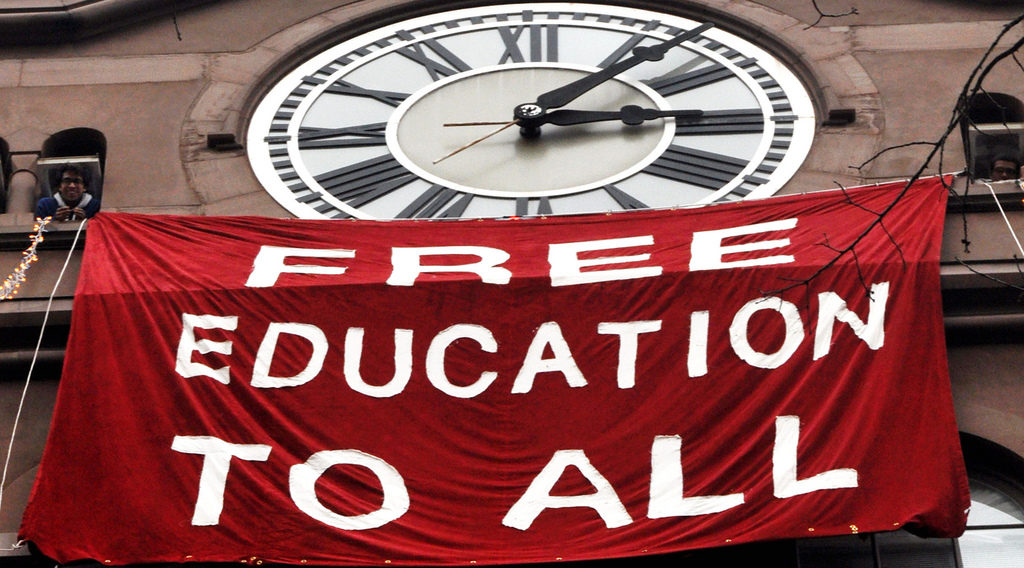

Protest against the imposition of tuition at New York City’s Cooper Union, historically a tuition-free private college. (cc photo: Michael Fleshman)
Although corporate media outlets have blasted presidential candidate Bernie Sanders for “living in an economic fantasy world,” his proposed plan for free tuition in public universities is hardly radical. To be funded by a modest financial transaction tax—0.5 percent on stock transactions and 0.1 percent on bond transactions—it’s essentially an older policy being reinstated to create revenue for a social program.
Many countries, including the UK, France, Japan, India and Taiwan, already have similar taxes and the US had one until 1966. And a number of industrialized nations, like Germany, Slovenia, the Czech Republic and the Scandinavian countries, have instituted free college tuition without evident chaotic societal breakdown.
And yet a flurry of media “experts” have rushed to denounce not only the financial tax as a means to fund college tuition, but the prospect of socialized higher education as a concept.
Oddly enough, they present their fight against free higher education as advocacy for the poor.
At the Washington Post (2/23/16), education writer Jeffrey J. Selingo capped off “The False Hope of Free College” with “expertise” from the right-wing American Enterprise Institute, concluding with touching concern for students in poverty: “Free tuition fails to change the college-going patterns of low-income students and quickly becomes an entitlement for those students who need it the least.”
Selingo echoed Hillary Clinton’s comment last November (Talking Points Memo, 11/14/15): “I disagree with free college for everybody. I don’t think taxpayers should be paying to send Donald Trump’s kids to college.” (Trump’s children actually attended Wharton and Georgetown—private schools not covered by Sanders’ plan—but perhaps they would have gone to CUNY had it been tuition-free.)
Three days later, NPR’s Planet Money (2/26/16) invited a panel of 22 economists “from across the political spectrum” to comment on some of the proposed policies of the presidential primary candidates. The show—made possible of course with financial support from Personal Capital, a financial advising and “wealth management” firm—ran an online brief of the panel, with three quotes on Sanders’ education plan and three on Clinton’s.
While Clinton’s plan—a work-study program that would pay for community college, provided students work 10 hours a week—received a positive, negative and an ambivalent review, Sanders’ plan was panned by all three economists quoted:
- 2007 Nobel Laureate Eric Maskin called Sanders’ plan “too indiscriminate. Many students can afford to pay a considerable amount toward their higher education. It is wasteful to give them a free ride.”
- Hilary Hoynes at UC Berkeley replied, “I favor making tuition free for low- and moderate-income students. But I don’t think it makes sense to subsidize high-income families for their children to attend college. ”
- Larry Samuelson at Yale put it bluntly: “There are many who can and should pay for college.”
Former UC Berkeley chancellor Robert J. Birgeneau took this argument ad absurdum in the LA Times (2/29/16) with “Why Does Bernie Sanders Want to Increase Income Inequality?” Birgeneau, whose chancellorship is best remembered for cracking down on Occupy Cal, eventually made the confounding argument that free higher ed would mean low-income students wouldn’t attend at all:
Zeroing out tuition nationally would require tripling public funding for most state colleges and universities. It is entirely unrealistic to believe that taxes would be increased enough to provide that funding…. Said starkly, zero tuition equals zero low-income students.
In “Bernie Sanders’ Free College Tuition Boondoggle,” a comparatively more substantive article at the Pete Peterson–funded Fiscal Times (3/1/16), Marc Joffe contradicted both Selingo and Birgeneay, saying that free higher ed would attract students that might not otherwise attend college. But he retained the same concern that the policy would benefit the privileged:
Some of the new spending will subsidize rich kids who don’t need the money or will be wasted on students unprepared for higher education and thus likely to drop out. Funds that middle-class investors need for a secure retirement will be diverted to the already profitable college textbook business.
Sanders has been explicit in targeting Wall Street in his campaign, but the recent backlash to free higher education has not offered a defense of the financial industry. It would be difficult, after all, to sell the idea that a fraction of a percentage tax would destabilize American markets. What the experts have done instead is argue that welfare is for the poor, and that people who can pay, should pay.
In our austerity economy, it’s easy to see how the definition of poverty is constantly shaved down until virtually no one qualifies as poor or deserving enough to receive benefits. There are countless examples, most recently the SNAP time bomb leftover from Clintonian welfare reform, which stands to eliminate for stamps for between 500,000 and a million people on April 1.
Higher education has seen both dramatic and subtle cuts to federal as well as state funding over the years. (As recently December of 2014, Congress slashed $303 million in Pell Grants.) Meanwhile, in-state tuition and fees at public universities has increased by 296 percent since 1995 alone.
While media-cited economists treat the idea that people who can afford to pay for college should pay as common sense, there is a long economic tradition of questioning such “means-testing” for benefit programs—illustrated by the resistance to cutting Social Security and Medicare benefits for the wealthy. As economist and New York Times columnist Paul Krugman (Conscience of a Liberal, 7/24/11) argued:
If you want the well-off to pay more, it’s just better to raise their taxes…. A tax rise would get a significant amount of revenue from the very, very rich (because they have so much money), while means-testing would end up imposing the same burden on $400,000-a-year working Wall Street stiffs that it imposes on billion-a-year hedge fund managers.
(Krugman doesn’t actually think of people making $400,000 a year as “working stiffs”—it’s an allusion to a remark by Gordon Gekko in the film Wall Street—but he uses them to illustrate the difference “between the filthy rich and the merely affluent.”)
Former World Bank chief economist Joseph Stiglitz actually argued against means-testing entitlements by making an analogy to the seemingly more obvious case of education. “We don’t means-test public education,” he told AlterNet (12/31/12), “because we believe that we want people to have the same opportunities and we lose out on that with means-testing.”
Even Matt Yglesias at Vox (3/10/16), who (in true neo-liberal fashion) considers means-tested higher education “more progressive,” praises the strength in simplicity of Sanders’ plan, saying, “Clinton’s plan seems like it was written by higher-education wonks for an audience of higher-education wonks.”
Large national programs like the British National Health Service are less vulnerable to austerity, largely because nearly everyone in the UK uses them and therefore a large number of people would object to cuts in services. You don’t need to be a democratic socialist like Bernie Sanders to conclude from this that if you want a service to be both high-quality and secure in its permanence, it should not be merely a service for the destitute.
The economists and higher education policy wonks that have been dominating the media’s response to Sanders’ education plan are often portrayed as objective specialists merely assessing the feasibility of a financial tax to fund free college for all. What they’re actually doing is taking a hard ideological line against the robust, comprehensive projects required of a welfare state.
Amber A’Lee is a writer in Brooklyn.




Wait a minute. My tuition at UC Berkeley in 1968 was zero. Everyone on campus went to college tuition-free. Some of my class-mates came from low-income homes. This wasn’t Sweden or Mars. It all worked just fine.
I was the beneficiary of an inter-generational investment in my education, which I appreciate to this day. I want to thank all the residents of California in 1968 for their commitment to the UC system and students in the state.
Is FAIR part of the Sanders campaign?
I’m curious, because Dr. Jill Stein and the Green Party have been promoting free higher education AND, student debt relief for more than 4 years.
http://www.gp.org/the_green_party_on_education
FAIR is beginning to lose its integrity. You ought to be concerned.
@Brian- Read FAIR’s “About” page. They’ve been around since 1986… a smidge earlier than the start of Sanders campaign.
@Stan Sorscher
Like you, I went through college in California while other citizens paid the bills. I thank them for that, but wish that they’d give me an opportunity to repay the debt: Raise taxes and make higher education tuition-free again. I don’t understand how we could have lowered our culture’s estimation of education so low that we’re content in having a generation of graduates who face the rest of their lives as wage slaves to an absurd educational debt load that, thanks to the efforts of good old Joe Biden in sealing their fate while carrying water for the financial service world in changing the Bankruptcy Act to screw students.
In 1960, Pat Brown, while Governor of California signed the Master Plan for Higher Education, which provided for tuition-free education from community college through graduate school. Under the Plan, every qualified resident of California would be guaranteed a space at a campus in the UC, State University and community college system. If there was not enough room to meet the needs of the population, new campuses were to be built (UC Santa Cruz was one such campus created under the plan).
Ronald Reagan, while Governor, did what he could to undermine the Plan, but it would wait until 1978, when Howard Jarvis sold the voters Prop 13, a measure to reduce the rate of increase in valuation assessments for property tax purposes on elderly homeowners (keeping granny from losing her house to excessive taxes). It was an era of “tax revolt” and the ignorant and credulous voters lined up to be fleeced. What the voters unwittingly authorized was the treatment of commercial real estate (shopping centers and such) under the same rules, thereby gutting the basis for funding of education. It was a nasty slight-of-hand that caused California to drop from the number one State for college funding to its current next-to-last status. California has a Democratic governor, state senate and state assembly…yet they continue to do nothing to change the state system.
Do we, as a country, really value an educated public so little?
Nicely done, Amber! Good to see you on FAIR. :)
@TeeJae I’ve been a member and fan of FAIR probably since inception. However, your answer did not address my concern about a Sanders bias, based on almost daily stories and analysis about the Sanders campaign and not a single thing about the Green Party and our candidates, including Dr. Jill Stein in the last 3 years.
Here’s from your “about’ page:
“…We work to invigorate the First Amendment by advocating for greater diversity in the press and by scrutinizing media practices that marginalize public interest, minority and dissenting viewpoints…..”
Based on your own goals, I think you are failing and as a Green, I’m extremely disappointed. To me, FAIR looks much more like a Democratic Party lap dog than a media watchdog supposedly advocating for diverse viewpoints, minority and under-represented positions, etc.
I called you out because I expect more from FAIR.
We are all given a different level of intelligence, which gives everyone a different level of wealth and an ability to experience true happiness. For happiness comes only by giving, only by experiencing compassion, pity and giving charity in a way that produces a grateful response.
So, as democracy is achieved only by everyone having equal wealth, namely everyone passing their excessive wealth down to a lower class where it belongs, pure slavery is the idea that those born the most intelligent have the right to employ at starvation wages those who are the least intelligent.
And so, by simple testing, a person’s intelligence level can be established and so long as his grades meet the standard, free to them should be the knowledge.
TO — Brian Setzler
“FAIR looks much more like a Democratic
Party lap dog than a media watchdog”
At such a late date, why is your Green Party, the Libertarian Party and a couple dozen other groups doing harm to the Bernie Sanders bid to be President by refusing to back the only hope we have for a non-establishment non-neocon in the White House?
The voting public hates our neocon war-hawk government, now is the time to organize behind the only candidate that could give us a new government — what is your problem?
Bernie Sanders has ten thousand supporters for each and every voter that Jill Stein can count on — what are you trying to accomplish?
Which begs the question, do you “looks much more like a Democratic
Party lap dog than a media watchdog”?