

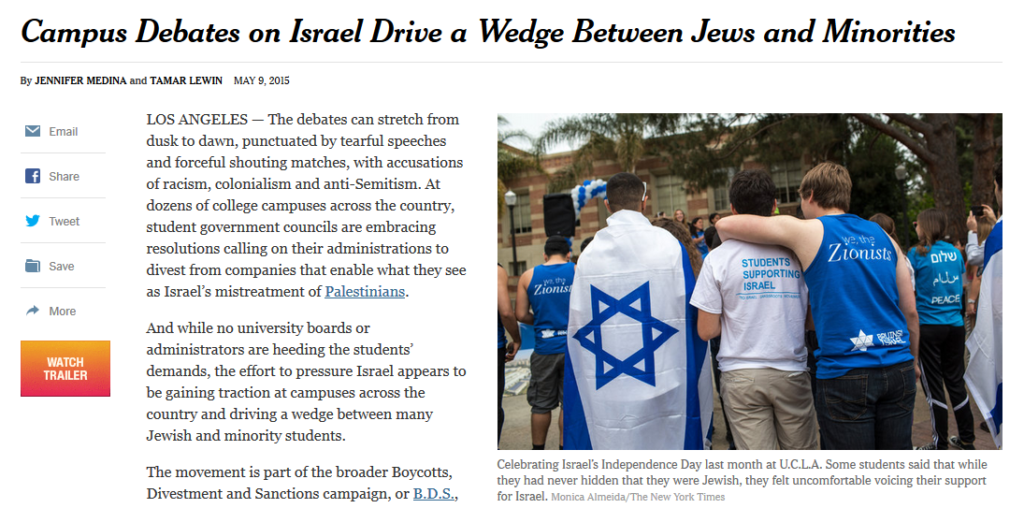

The New York Times (5/9/15) frames the BDS story as an issue that mainly affects Jewish college students.
Despite increasingly frequent victories for the global Boycott, Divestment and Sanctions (BDS) movement confronting the state of Israel, and the heightened panic expressed by its critics, the New York Times virtually ignores the movement’s momentum. When attention is paid to BDS, coverage doesn’t focus on the role of the movement in the struggle for Palestinian rights, but instead amplifies critics of BDS and focuses on charges that the movement is a form of antisemitism.
The BDS movement, initiated in 2005 by Palestinian intellectuals and activists, is a nonviolent resistance movement that calls for economic pressure on the state of Israel to recognize the rights of occupied Palestinians.
In a New York Times article (7/2/15) about two failed divestment efforts that, according to the story’s lead, “dealt a blow” to “a pro-Palestinian economic campaign against Israel,” reporter Rick Gladstone acknowledged that BDS “has been gaining traction in the United States.” That throwaway line is the end of the story for readers, since the Times rarely covers successful BDS efforts, either in the US or abroad.
Although the Times did cover both the United Church of Christ’s vote (6/30/15) and the Presbyterian Church’s vote (6/20/14) to divest from companies that profit from Israel’s occupation of Palestine, here are seven recent BDS victories that were ignored by the Times:
- September 2015: The Icelandic capital Reykjavík’s vote to boycott Israeli goods and the backlash from pro-Israel groups that led the city to severely limit the boycott.
- August 2015: The Black Solidarity Statement with Palestine that “wholeheartedly endorse[d]” BDS, signed by over 1,100 black scholars, activists, artists, students and organizations, including Cornel West (mentioned by the Times 34 times in the last two years), Angela Davis (14 times), Mumia Abu-Jamal (nine times) and Talib Kweli (19 times).
- June 2015: The United Nations’ annual World Investment Report, which found that foreign direct investment in Israel plummeted by half after Israel’s 51-day assault on Gaza in 2014.
- April 2015: French multinational Veolia’s decision to sell most of its business assets in Israel after seven years of pressure from BDS activists.
- February 2015: Stanford University student government’s vote to support divestment (though see below).
- January 2015: University of California/Davis student government’s vote to support divestment, making it the seventh of ten UC schools to do so.
- October 2014: Anthropologists’ statement to boycott Israeli institutions, signed by over 1,000 scholars.
When the Times does cover campus activism on the Israel-Palestine conflict, it opts to focus on the debate about antisemitism instead of focusing on the role of divestment and boycott resolutions in the campaign for Palestinian rights.
A May 2015 front-page article by Jennifer Medina and Tamar Lewin, “Campus Debates on Israel Drive a Wedge Between Jews and Minorities” (5/9/15), centered on the idea that Jewish students are threatened and marginalized by BDS activism. Ali Abunimah later reported in the Electronic Intifada (5/12/15) that Medina only asked Safwan Ibrahim, a member of Students for Justice in Palestine (SJP) at UCLA, questions about claims of antisemitism—ignoring the BDS movement’s tactics or motivations.
David McCleary, a Jewish member of SJP at UC Berkeley, said he felt like he was being given a Jewish “litmus test” by contributing reporter Ronnie Cohen, who apparently questioned McCleary’s Judaism in light of his involvement with SJP. “For them to find out that SJP at UC Berkeley is disproportionately Jewish interferes with that narrative that they are trying to invent,” McCleary told the Electronic Intifada.
An earlier story by Medina, “Student Coalition at Stanford Confronts Allegations of Antisemitism” (4/15/15), also focused on the “debate over what constitutes antisemitism” in light of the Stanford student government’s vote to support divestment—an event that the Times did not cover in its own right, but only as an opportunity to run a piece about a Jewish student’s experience of being asked about divestment.
Times reporter Adam Nagourney ended an article (3/5/15) with a quote from Natalie Charney, student president of the UCLA chapter of the Jewish student organization Hillel:
People say that being anti-Israel is not the same as being antisemitic. The problem is the anti-Israel culture in which we are singling out only the Jewish state creates an environment where it’s OK to single out Jewish students.
Despite the reference to “the Jewish state,” the territory controlled by the government of Israel contains more Arabs than Jews–though most of the Arabs are excluded from political participation. Why does only activism in support of Israel’s disenfranchised majority, and not the defenders of Israel’s system of ethnic apartheid, prompt questions of campus bias in the New York Times?
Gunar Olsen is an editorial intern at FAIR and a student at Fordham University. Follow him on Twitter at @GunarOlsen.
You can send a message to the New York Times at letters@nytimes.com, or write to public editor Margaret Sullivan at public@nytimes.com (Twitter:@NYTimes or @Sulliview). Please remember that respectful communication is the most effective.





Wouldn’t expect any less from that zionist rag.
Bravo!
People intuitively understand that a united group is necessary for a political movement. What most people aren’t aware of is many of the organizations are on the internet and have continual contact with people outside of Palestine. To invoke their platform as a sacred, sovereign oath is more than a bit misguided.
It’s commonly believed that the BDS movement was initiated from Palestinian civil society organizations. This is only half the story. I myself can recall encouraging groups in Palestine to find a platform that could smooth over difficult areas of dispute in the movement. I had prided myself as an expert. I would read over poll data and ask myself what it would take for their objectives to be met. Boycott and divestment would probably work to achieve an end to the occupation. I recall figuring sanctions or massive war as the only effective tool to bring an end the racist state of Israel.
I don’t believe my assessment was realistic or even safe, and I’m very ashamed of that. You cannot destroy a wall by kicking it with your foot no matter how much you want to see the wall removed, nor does it ultimately matter how evil the creator of the wall is. As Netanyahu has proved, he thrives on war, receiving continual funds from a US president who clearly doesn’t like him. The left-wing inside Israel reflexively takes a stand against BDS to protect their state, and only rarely is able to acknowledge the immense injustice their parties have taken part in.
Some divestment has happened but only alongside unbelievable horrors. US aid increased during the horrors. The Arab Spring collapsed under IMF boycott and resulted in increased stranglehold from the south.
Needless to say, the exaggerated expectations I had mistakenly encouraged were not challenged by the officially sanctioned Palestinian solidarity movement, but from Noam Chomsky. He slammed the so-called movement that I had helped instigate as one that was dangling a carrot in front of suffering people. Simply put, Palestinians don’t have the influence that other successful movements have. They don’t influence the Israeli economy like Blacks did in South Africa. They might not even have the numbers to sustain a massive peace movement like Indian independence groups did against the British.
The game is stalemate and the longer we wait for a perfect solution the more we are giving the racist state what they want, to sit comfortably uncomfortable in their fear of The Other, blocking independence, and defining themselves as the reasonable ones. There is no choice but bite the bullet and salvage what we can while overthrowing racism in the longer-term.
“When the Times does cover campus activism on the Israel-Palestine conflict, it opts to focus on the debate about antisemitism”
As do all pro israel groups … who cares about a little issue like truth!
L: what does “biting the bullet” look like right now?
Gunar Olsen –
Finding a way to agree with the Jewish Israeli peace movement is what I mean by biting the bullet. We can defend humanity’s right but this independence movement is much less powerful than people are willing to admit. To end the state, short of divine intervention, the choice is either sanctions to force them to agree to regime change which would be unheard of (hence like kicking a brick wall), or tolerating a 2-state solution. The closest we came was a push to make Herzog prime minister, which Netanyahu successfully parried, and would not have resulted in an anti-settlement prime minister anyway. As I alluded, the Jewish left does not accept the proposal of ending the state, in the US or Israel. The divide in Israel right now is more pro-negotiations, and anti-negotiations.
Alongside the politics is ideological propaganda to recruit new members. Thus, the the Jerusalem Center for Public affairs can argue this since the US “refused to answer repeated questions about whether the Obama administration viewed itself as legally bound by the April 2004 Bush letter to Sharon on defensible borders and settlement blocs. It would be better to obtain earlier clarification of that point, rather than having both countries expend their energies over an issue that may not be the real underlying source of their dispute.” The Atlantic’s Jeffrey Goldberg more directly lied that “settlements are not easily reversed” and that “Arab rejection of Israel does predate settlements,” relying on the memory hole to suppress repeated offers to make peace by the PLO and Hamas.
In other words, elites are leveraging the lack of a deal to block a deal, and the lack of concrete action by the US to block understanding of the conflict. So the pressure I think should still be directed at Israel yes but in relation to the imperial power of the US, whose citizens are too bamboozled to ultimately care enough, and so will not act against them. This depends on the gut-feeling that Israel is doing something exceptional, making the desert bloom and civilizing the nomadic plains of the Levant. You can call your movement whatever you want but if it doesn’t break the state-colonial mystique of the Jewish occupation there isn’t a whole lot that will change. So from the US perspective I still think our task is to recover the reality of the occupation from the memory hole, and to humanize Palestinian people.
The people I think most successful at this do not focus all of their efforts on appeals to authority but to reality. I think Yousef Munayyer and Max Blumenthal, both hard-line BDS, as well as Noam Chomsky, are responsible for moving elite opinion to the left by patiently accumulating the facts, creating a body of knowledge that is able to sustain criticism from liars, which coupled with a movement, can result in successful resistance.