


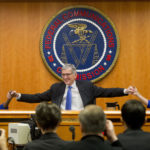
An NPR blogger’s report (6/14/16) on a court ruling approving net neutrality rules was accompanied by a photo of FCC commissioners celebrating. But the FCC majority’s perspective was strangely missing when the blogger was interviewed on All Things Considered (6/14/16). (photo: Pablo Martinez Monsivais/AP)
Everyone should have access to the same internet content: That’s the principle that guided last year’s FCC decision to reclassify high-speed internet as a utility subject to the same kinds of regulation as electricity, landline phone service or other utilities that serve the public good. It’s a principle widely embraced by advocates of net neutrality, but opposed by ISPs and cable companies, who want a world in which internet content can be filtered and throttled. Even before the ink was dry on the FCC’s Title II reclassification, the ISPs took the FCC to court, claiming the agency had overstepped its bounds.
This week, that DC Circuit Court took the FCC’s side, agreeing that broadband internet’s role as the conduit to the content shaping everyday experience made reclassification a sensible choice.
“Over the past two decades, this content has transformed nearly every aspect of our lives,” the judges wrote, “from profound actions like choosing a leader, building a career and falling in love to more quotidian ones like hailing a cab and watching a movie.”
In other words, the court agreed that reclassifying the internet is a step forward, a way to recognize profound changes that have occurred in the media landscape since the emergence of the web. Why, then, did NPR’s coverage of the ruling on All Things Considered (6/14/16) seem to suggest the opposite?
The segment opened with a strong nod to the anti-neutrality camp, describing the ruling as “a massive blow to internet service providers” and quoting Republican Sen. Ted Cruz’s description of net neutrality as “Obamacare for the internet.” Then, rather than drawing directly from either the court’s written decision or FCC chair Tom Wheeler’s reaction, host Kelly McEver turned to NPR tech blogger Alina Selyukh for context and analysis.
Asked to explain what reclassification meant, Selyukh chose a backward-looking analogy, claiming the FCC “put Internet service providers into the same kind of bucket as an old telephone company.” And when asked to summarize arguments made in court, she focused on widely disputed claims by ISPs and cable companies that “this approach is so outdated that it will stifle innovation and it will stop them from investing in these really important networks.”
Along with implying that the FCC’s decision reflected an outdated understanding of technology, the All Things Considered segment left out one of the most important consequences of Title II reclassification over the past year — namely, the FCC’s attempt to establish new privacy protections for broadband users. The overall impression of the piece is that the FCC is pursuing regulation for regulation’s sake.
I should mention that Selyukh has written a more balanced post on the topic for NPR’s breaking news blog The Two-Way (6/14/16), in which she brings up the new privacy rules, quotes from the court decision, and remembers to mention a key player in the net neutrality struggle omitted by All Things Considered—the American public, who weighed in with 4 million comments during the FCC comment process and who overwhelmingly supported the idea of the open internet.
Anyone reading Seyukh’s post on The Two-Way would come away with a fairly good sense of what’s at stake in the ongoing battle over net neutrality. Too bad they couldn’t get that same information listening to National Public Radio.
Lisa Lynch is a visiting associate professor of communications and journalism at Drew University in New Jersey, researching the intersection between culture, technology and political change.
You can contact NPR ombud Elizabeth Jensen via NPR’s contact form or via Twitter: @ejensenNYC. Please remember that respectful communication is the most effective.




tits, for the love of God tits . . .
NPR FUNDING
2% Government
3% Public
95% Corporate rich
Of the 95%, 57% of that from Warren Buffet’s, President Obama’s bosom buddy, spiritual, debate and economic advisor BNSF Railroad. Motto: We blow up Canadian cities with our fossil fuel bullet trains. Keystone Pipeline? We don’t need no stinkin’ Keystone Pipeline.
Thank your for pointing out the inaccuracy of thesse NPR reports, several of which involved Dina Temple-Raston. Because of this evolving pattern I did a cursory search of her works and found the she featured on the Council of Foreign Relations website under Leadership and Staff. Although their mission statement says otherwise, the secretive CFR is notorious for its undo influence on governments and the media. In future I will examine more closely any information disseminated by her through NPR and other media outlets
thank you for allowing comments without subscription. In a free speech nation with increasing surveillance anonymity can be ones only security
National Propaganda Radio, with levels of dishonesty begining to approach those commonly seen at the Washinton Post.
Hard to believe NPR would turn into corporate shills. I’m very disappointed in them.
Much of the traditional corporate media (which now includes PBS) which didn’t have its origins on the Internet, has long been wary of the Internet, since they don’t like the competition and the fact that they don’t control the whole thing. Ending net neutrality, to put the Internet more firmly into the hands of like-minded corporations, is something that many traditional media outlets want to see.