

The April 15, 2016, episode of CounterSpin reaired excerpts from Sanho Tree’s interview on the Hiroshima bombing, originally aired in August 1995. This is a lightly edited transcript of the rebroadcast.

Sanho Tree: “By and large, the mass media don’t speak out, because they would essentially have to call the president a liar and challenge his official rationale.” (image: Stuff)
Janine Jackson: Media reports noted that Secretary of State John Kerry was the highest-ranking sitting US official to visit the war memorial in Hiroshima. US ambassadors have shown their respects, and Jimmy Carter went there when he was out of office. But from non-blame-assigning references to “one of the most destructive acts of World War II,” as a New York Times article had it, to an obliviously ethnocentric focus on how these commemorations have, as the Times said, “long troubled American diplomats,” nothing suggests that US media find much to grapple with.
And why would they when, as the paper of record tells us, “a majority of Americans have long believed that the bombings were necessary to force Japan’s surrender and to spare American lives”? That’s why “any hint that the US was apologizing could prove highly damaging politically.”
Well, corporate media have shown little interest in probing the official history on Hiroshima and Nagasaki. Did you know, for example, that on August 9, 1945, Harry Truman declared falsely in a radio address:
The world will note that the first atomic bomb was dropped on Hiroshima, a military base. That was because we wished in this first attack to avoid, insofar as possible, the killing of civilians.
On the 50th anniversary of the bombing of Hiroshima and Nagasaki in August of 1995, CounterSpin spoke with military and diplomatic historian Sanho Tree, who had just collaborated with Gar Alperovitz on The Decision to Use the Atomic Bomb and the Architecture of an American Myth. Sanho Tree is today the director of the Drug Policy Project at the Institute for Policy Studies. We asked, first of all, about the key issues US media were discussing just prior to the bombing.

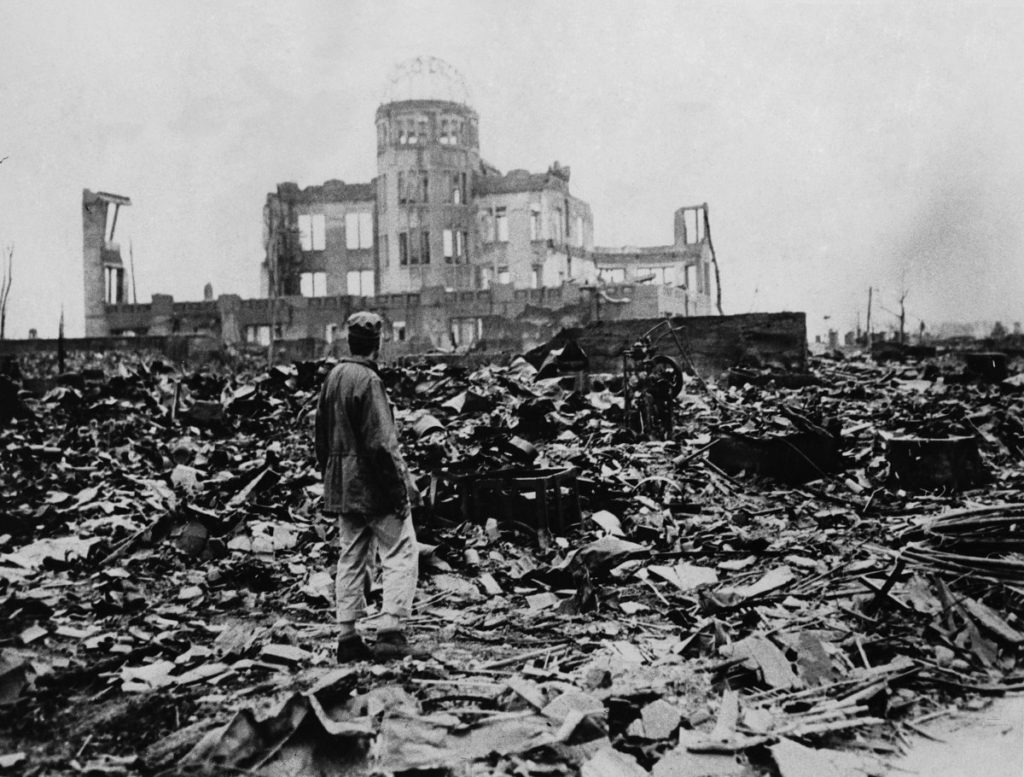
AP photo of the ruins of Hiroshima after the atomic bombing.
Sanho Tree: The first was the rapid deterioration of the Japanese war economy and military situation, that their navy was at the bottom of the sea, their air force was nonexistent, and that she was reduced to crashing kamikaze planes into ships. Their fighters were gone, the American planes were going over Japan unopposed.
Another point was unconditional surrender, that the Allied war aim of unconditional surrender was interpreted by the Japanese to mean the execution of the emperor, that he would be prosecuted and perhaps hung as a war criminal, and the Japanese regarded him as a deity. And all of Truman’s advisors advised him, you know, you’ve got to tell them to keep the emperor or they’ll keep on fighting forever.
A third point was the Russian entry into the war. The Soviet Union was neutral throughout this period, and was going to declare war on Japan in mid-August by common agreement with the United States and Great Britain. This was the secret agreement made at Yalta.
And the fourth was the peace feelers that were breaking out all over Europe and also in the Soviet Union, that the Japanese were trying to reach American emissaries to explain to them what terms they wanted for surrender. And the one term that always came up was the retention of the emperor.
JJ: Everything changed, though, after the bomb was dropped, including in the media.
ST: Throughout the media there was this pretty much a euphoria, oh thank God, the war is over. Many attribute this to the bomb, even though their own newspapers and their own magazines had reported that the Japanese were already defeated and were seeking peace. There are a few critics, people of conscience, the religious community continued to speak out. By and large, the mass media don’t speak out, because they would essentially have to call the president a liar and challenge his official rationale.
And the people who do speak out, it’s interesting, are the conservatives. The first decade and a half, up until the 1960s, it’s the conservatives and the right wing that keep up the steady drumbeat saying that Hiroshima was not necessary. And this is completely forgotten about today. The National Review, for instance, or Human Events or a far-right-wing journal called The Freemen, these were all journals that were saying that this was an atrocity. And the National Review headline was “Hiroshima: An Assault on a Beaten Foe.” This is 1958, William F. Buckley’s journal. And, of course, nowadays Buckley takes a completely different position, says they were necessary.
JJ: CounterSpin asked if it wasn’t strange that contemporary complaints about a Smithsonian exhibit of the Enola Gay being too critical of the United States, for example, were labeling revisionist what had actually been an open position in the US media at the time.
ST: Absolutely. For instance, the Washington Post kept up the steady drumbeat throughout the spring and summer of 1945, saying you must change the terms of surrender, day after day, and every other day it seemed that they were having a different editorial trying to drive home this point, that the emperor must be spared, you know, that’s the only way to get a surrender out of Japan.
And, of course, now the Washington Post ridicules all this stuff as revisionist. This is their own position. They were in fact so proud of their editorials, they published a booklet around 1946, and it was called Psychological Warfare: The Special Weapon That Had Japan Defeated and Ready to Yield 13 Days Before the Atomic Bombs Were Dropped. They were so proud of their role back then, and now they dismiss all of this as revisionist.
JJ: We asked Tree to describe the Washington Post’s coverage of the controversy at the Smithsonian about the display of the Enola Gay.
ST: The Washington Post, for instance, Ken Ringle, one of their key reporters on this beat, reproduced an erroneous quote in the Wall Street Journal, and this is in August of 1994, which touched off the firestorm in Washington. And the quote was attributed to the curators of the exhibit, and the quote read—it was describing the kamikaze pilots, and it said, “these youths, their bodies overflowing with life.” And, of course, this was actually a caption that said this was said by another kamikaze pilot, describing his comrades. And this was a Japanese view. But the Wall Street Journal attributed it to the curators. Ringle repeated it the next day in the newspaper, in the Washington Post, and it becomes this political football at that point.
And, you know, suddenly it blows up in everyone’s faces, and everyone goes running for cover. You will not see in the exhibit, for instance, quotes by General Eisenhower or Admiral Leahy, who was the chief of staff of the president and presiding officer of the Joint Chiefs of Staff. Both of them had tremendously powerful quotes where they talk about how they didn’t think it was necessary and advised so. And they called it—you know, Leahy calls it a “barbarous weapon,” and it was of “no material assistance in our war against Japan. The Japanese were already defeated and ready to surrender.” That’s gone.
JJ That was Sanho Tree, discussing media coverage of the US bombing of Hiroshima and Nagasaki on CounterSpin in 1995.



I don’t think arguing or bickering over this issue is useful.
The facts are changing, and if anything it is a negative affect.
You look at Germany and Germany has admitted and changed
their culture about WWII. Japan still admits no wrongdoing
and some of these kinds of comments make it seem like
“someone” expect that a country can wage war against
the world for profit, killing, torturing tens of millions, untold
millions, destroying the planet, burning up resources, and
then just say, sorry and expect no price to be paid.
If there is anything still that is important about this war it is
that Japan take responsibility for what it did and open their
country instead of being a closed racist country.
Well said. It’s just too bad that it needs to be said.
So: Are you justifying the two a-bombings?
That’s a heavy responsibility you’re burdening me with, but if it must be, my answer is YES,YES, YES, YES, YES. Any more questions?
How do I find right wing viewpoints on the intertubes?
Why bother? You can’t handle the truth.
Wow, Bruce. I can’t believe you haven’t looked at the news or done some research before you start talking…
.
The Japanese have apologized formally again and again, supposedly starting with Emperor Hirohito apologizing for the Pearl Harbor to MacArthur (this may or may not have happened). The most recent apology was when PM Abe apologized for the “Comfort Women” they took from Korea (and other countries) during the war.
I’m not saying they couldn’t apologize more, or that they shouldn’t, but your statement, ” Japan still admits no wrongdoing.” is a blatant falsehood.
https://en.wikipedia.org/wiki/List_of_war_apology_statements_issued_by_Japan#2010s
I don’t know where you get all this stuff from my post. In general the Japanese were late to admit fault and apologize, and certainly late with any compensation. There were a lot of stories in the media about Japanese businessmen traveling in Asia getting drunk in bars and singing Japanese war songs. It is all past and gone now and Japan has comported itself as a great power.
>> I’m not saying they couldn’t apologize more, or that they shouldn’t
That is just what I am saying. Also Japan is a very racially non-diverse country and culture. I really like the Japanese sensibility in art and pottery, their culture is amazing, and like all culture has a lot of misery and sadness behind it. My understanding is, no one emmigrates to Japan … pretty much similar to Saudi Arabia and China. I think that is a problem. I don’t know how to solve it but it is worth mentioning.
Waging war(s) against humanity for profit? Sounds like U.S. of A!
“Farad Homayoun” sounds like a complete fool to me.
The US are a peace loving people. But they must eliminate all possible threats. Which is everybody. This is a natural law and a God given right. It is kill or be killed.
“The US are a peace loving people”?!
Read a little recent history, focussing especially on South-East Asia, Latin America, and the Middle East.
What an ignorant statement!
Why not post some pictures of Nanking or the gruesome fatal
experimentation Japanese “scientists” did to innocent victims
of their imperialism beside the atom bombings as well?
Bruce is right. Tell it to the Chinese they used for “bayonet practice”. Tell it to the Korean “Comfort Women”. Tell it to the tortured in the POW camps.
No one really knew what would happen with the new technology and I can’t blame Truman for using any means available to end it.
Have the Japanese owned up to it? What does it say in their high school history books?
A couple of fundamental errors in your comment, Paul.
1. You pardon Truman for using any means to end it, but it appears you missed the title of this article: “The Japanese Were Already Defeated…”
2. “Nobody really knew what would happen…” Untrue. It had been tested, and its destructive effects had been measured. That’s why some politicians, scientists and others argued against its use *before* it was dropped, yes?
All these responses regarding Japanese atrocities are beside the point. They’re valid, just not in the context of this article.
It is easy to say now that the Japanese were already defeated,
but the fact is that they were not. They may have made overtures,
but how do you trust the country that committed the Pearl Harbor
sneak attack.
Further, they were still fighting, and Americans, and others were
still dying.
Now we have access to their memos, thinking, books, history
and whatever else people wanted to say to embellish things, but
it was not like back then there was even reliable communication
world-wide.
Yes, one can point out some new facts, but trying to spin them
into blaming the US for using the Atom Bomb … well, I just do not
know about. What if it had never been used, and the US, Russia
and China developed it and then later someone who had no idea
what the real consequences of its use would be started a nuclear
war?
There are lots of things that can be speculated about, but coming
to conclusions about them over half a century later is just trolling.
All Straw men; you bring up straw men to attack and defend something that was at the time not only controversial, but even by the standards of the day Barbaric.
” What if it had never been used, and the US, Russia and China developed it and then later someone who had no idea what the real consequences of its use would be started a nuclear war?”
Complete and utter bollacks. It was well known the consequence of the use of nuclear weapons, and guess what ‘Russia and China” and dozens of other countries have developed nuclear arsenal. The only thing that stops anyone is the fact that they don’t them used on them, if they use them on someone else.
And there was more than just speculation about this, there were, just as there was the opposition to wars in the middle east that were ignored by the media and the government in 2003, plenty of opposition to it’s use.
All your doing is ‘rationalizing’ an act that should not have been committed. The fact still remains that the U.S. is the only country in the world who has used a nuclear weapon in the act of war. There was no more justification for it, than than overthrow of Iraq, and the lie that they were just ‘one moment away’ from using WMD’s.
spot on … USA is well hated or feared world wide, for very good reason … time for the PEOPLE of the USA to ACT … become a democracy , not the autocrocy that currently exists
I think the overthrow of Iraq was justified … it was just executed idiotically. In the long term history of the world despotic rulers like Saddam Hussein cannot be allowed to stay in power. Same with Assad, Khaddafi, etc.
History moves to fast now to have millions of unfortunate people living under these kinds of governments. In the long term Iraq is better off and what is happening now is horrible, but it is more the consequences of the kinds of governance these countries have had than what the US did … although I do harshly criticise the US for how it conducted the war.
For example from the first day firing missiles at residential neighborhoods in Bagdhad because they thought Saddam Hussein was there was a war crime as far as I am concerned. This was not done in a military way, it was out of control and stupid.
Japan has been painting itself as the victim of a war They themselves started. Japan was offered surrender before and after both Hiroshima and Nagisaki. After Nagisaki B 29 raids countinued for 5 days befor Japan surrendered. That is not a nation ready to surrender. One needs only look at Opetation Meetinghouse a 10 day bombing campaign against Japan that +should+ have brought a nation seeking surrender to do so.
Japan was seeking peace on conditional terms, which the US was not willing to accept. That the US should have accepted them is a legitimate argument, that the war was about to end anyway is nonsense. The US was going to keep at it until an unconditional surrender was given. The bomb provided, at the very least, the ability of the Japanese government to save face in surrender (public statements were made to the effect of ‘we cannot fight this weapon’) which they in turn were not going to go without.
The US eventually accepted a conditional surrender (the Japanese still have their Emperor, yes?); not coincidentally the same condition the Japanese were originally requesting before the bombs dropped.
Japan surrendered unconditionally. The US allowed a ceremonial role after the fact.
he only had a ceremonial role , already … commenting without having a clue is not productive
Actually Japan got better terms that it should have because
the US did not really know the ramifications of taking the
Emperor away, which should have happened.
Also, the US was worried about Japan falling into the Russian
influence. One can argue they got off easy … if there is anything
that can be called easy about a world war.
The conditions were also changing as was the political thinking
of the principals involved … remember we have had 80 years to
think about this now, the leaders back then were doing it without
perfect knowledge in real time, the best they would.
Oh, for God’s sakes. Just give it up. When are you people ever going to give America credit for doing the right thing. You make me sick.
Who knows if America did the “right” thing here, but the war ended, and
that is something.
The problem is that since the Spanish American war … like the early 1900s
America was murdering people like it was going out of style in the
Phillipines and South America, and that continued … it still continues today,
though at a much reduced effort.
Trying to imprint right or wrong on these things is really impossible. It was
certainly wrong and inhuman what the Japanese did in Asia, but look at
what the US was doing to its native population. Why just arbitrarily pick
some place to start keeping track.
Like I said look up all the places where the US “acted” militarily and see
how that worked and what the effects were. The fact is that the US was
the strongest country because of resources, and geography and we have
internalized that into American Exceptionalism, and we are in for a rude
awakening at some point when other factors, such as China’s sheer
economic size starts to swamp some of our advantages.
My personal opinion is that the US should be pivoting politically to
be more inline with our more or less BS propaganda and about
freedom and democracy for all by joining with the developed nations
block and promoting real democracy, education, health care, freedom,
etc – because otherwise we have no basis to ask people to fight for
our values.
In WWII notice that Americans … men, women, minorities all gained
because they were necessary … and then after WWII the elite started
to roll that back. This proves that the US elite is just like any other,
maybe worse since every other developed country in the world –
ala Bernie Sanders has vacation, living wage, suppport net, universal
health care, education, etc ….
The US is turning into the most regressive nation on the planet.
That may not be our initial conditions, but it is our current trajectory.
Americans apparently have no idea how chilling and horrifying it is to hear them arguing (in near total ignorance of real history) in favour of nuking and incinerating 100 000 children, no matter what their supposed intentions — but I have to say, anyone who has looked into this knows that the intentions were evil (and I use that term advisedly). 1. Not only did the Japanese have no oil left (how do you fight a modern war with no oil?), but they were, as the article says, in negotiations for surrender on terms that were EXACTLY what the US eventually agreed to. 2. Go to the museum at Hiroshima. On the wall in a frame is an epistle from senior Pentagon officials explaining, before the bomb was dropped, that it SERVED NO TACTICAL PURPOSE, but that the “sunk cost” of around $4B into the Manhattan project could never be justified to voters unless the bombs were actually dropped. 3. On top of THAT, there was the stated necessity of performing “scientific experiments” on the subject of the effects of a nuclear blast on human test subjects. So Paul O, your argument about what the bombs would do is actually a mark against your nation. 4. Even if you accept that the war might have been shortened by a month or two, what kind of human being argues that this should be accomplished by incinerating tens of thousands of innocent children??? It’s a sick, racist, jingoistic argument that even if you honestly believe in it and aren’t just being cynical, ought to get you exiled from decent human society for making it. Let’s say some Air Force General came up to Truman and told him the war would be shortened by pressing a button and burning to death 100 000 American kids in their beds at home. You think this would make it into US History textbooks as a “great event” in American history?! Apparently because these particular innocent kids had a different skin tone and spoke a different language, the History texts are A-OK with it. But then the American genocide of its Indigenous cultures gets short shrift inside the US too. Slavery is considered a “contentious” issue, for God’s sake. All I can say is, Americans, YOU NUKED TWO CITIES FULL OF KIDS. And now you celebrate yourselves for doing it. Do not dare to try to justify that moral sickness with arguments like “The adults in Japan were mean too”. Are you children, or monsters? Or can you live up to your self-image as the City on the Hill? Grow up.
>> Americans apparently have no idea how chilling and horrifying it is to hear them arguing (in near total ignorance of real history) in favour of nuking and incinerating 100 000 children
Dude … no one is arguing in favor of that, they are just looking back and resisting judging the past disproportionately in the future for what are basically present day political trolling.
And you know that the US has not used nuclear weapons since WWII, so that argument is essentially dead.
Your characterizing this as celebrating is really off the wall … and you know it.
It ‘serves no tactical purpose’ because they believed it would have exactly the same effect as leveling the cities by conventional bombing (the scientists made some disastrously wrong assumptions about the radiation hazard), which they were going to do instead.
Like to be perfectly clear here, you are in effect advocating for killing tens of thousands of civilians with conventional weapons. There was no option in the military thinking that said ‘don’t kill a lot of civilians’, only ‘kill a lot of civilians with one bomb’ or ‘kill a lot of civilians with 500,000 bombs across three weeks of raids’.
And by nuking those two cities, we probably saved the lives of miiions of Japanese, not to mention, of course, the American lives that the bombs saved.
On the contrary, had the US accepted the first official offer of surrender, US lives might have actually been spared on Iwo Jima.
Bruce, your comment that “comments make it seem like
“someone” expect that a country can wage war against
the world for profit, killing, torturing tens of millions, untold
millions, destroying the planet, burning up resources, and
then just say, sorry and expect no price to be paid.” is the single least self-aware statement I have ever read. Read that comment over and substitute the word “someone” for “Americans” and you will get a sense of just how about 99% of the rest of the (better educated) world sees the legacy of the USA on the world stage. The Imperial Japanese were no angels — no imperialists are — but holy Hannah, do you Yankees have a blind spot a mile wide when it comes to your own country’s actions!
Quit extending your own imagination into my arguments, read my arguments
and quit where I quit, and stop trying to extrapolate them hyperbolically.
War is evil. There is no such “just war” or “moral war”. The use of atomic bombs on Japan was a crime against humanity, period.
What about the fire bomb raids? Were they okay because they were not nuclear?
Just to be contrary, there’s the book “Japan’s Secret War” by Wilcox published in 1984 by Morrow, based on a 1946 Atlanta Constitution article (whose author was still alive in 1984.)
The 45 page introduction to the book, claims that the Japanese had a nuclear weapons program with production facilities in what would be now North Korea, and in fact tested their own atom bomb after the US attack on Hiroshima.
(Too Wilcox’s detriment, he now appears to be someone purveying birther nonsense, but 30 years ago this book would have been considered normal mainstream popular history.)
Wilcox spent a good deal of time in Japan researching this book, and the Japanese certainly had an atomic weapons research program. Obviously, Wilcox couldn’t conduct research in North Korea in 1982, and the program in the 40s was supposed to have been run by a private industrial group, not exactly by the Japanese Army or Navy.
” …and in fact tested their own atom bomb after the US attack on Hiroshima.”
I have his book…somewhere, and it does not say this; furthermore, I wonder why the book was written because it could be boiled down into showing how pathetic, half-hearted, and ineffective the Japanese efforts were, It was a very unsatisfying read, Nothing really happened, although the author did to his best to turn their sorry efforts into a great unknown mystery. “Mystery” is better than nothing.
The Wilcox book most certainly does say exactly what I claimed.
I suggest you read the introduction, which is what I noted above has the story.
You seem to have confused the body of the book with the intro.
So unless there is some massive change to the edition you have, you are in significant error.
Now you force me to find the book. It’s around here some place, but I can’t remember where just now. However., first I’ll check the book reviews to save time. I’ll start tomorrow morning.
This is taken from a review. It’s the way I remember the book. I’ll still look for the book, though.
“Robert Wilcox couldn’t find the definite answers. Much of his research is unfortunately larded with such phrases as “perhaps” or “possibly.” Some of the oral accounts of a Japanese bomb experiment are secondhand or possibly repeated versions of a similar rumor.”
This is taken from a review. It’s the way I remember the book. I’ll still look for the book, though.
“Robert Wilcox couldn’t find the definite answers. Much of his research is unfortunately larded with such phrases as “perhaps” or “possibly.” Some of the oral accounts of a Japanese bomb experiment are secondhand or possibly repeated versions of a similar rumor.”
Warren,
I’m not interested in what a review somewhere says, nor did I anywhere say the the book is absolutely true.
However it is absolutely true that the book talks about a possible atom bomb test off Korea by Japan in August 1945.
Read the section of the book that I specified.
Off topic
The US is the only nuclear power with a first strike policy as evidenced by Hiroshima.
In the 50s and 60s it was the evil Russians who supposedly had the first strike policy because of which US citizens were told to build bomb shelters.
The US continues to “upgrade” its arsenal.
The native American people were helpless, arrows against bullets helpless and only because of this did we commit genocide upon them, wasting every man, woman and child in each village of them.
The people of Japan were helpless, their military at the bottom of the sea totally useless and only because of this did Truman nuke vaporize 220,000 of them.
That is the cowardly and gutless wonder nature of the society we live in .
Bruce K. illustrates the mind set that can still justify anything the US does, by definition if the US does it, it must be justified. The fact of Japanese crimes, aggression etc are beside the point. This was not the justification given for dropping TWO of these weapons. Even in a so called “Just War” in pure self-defence the war must be proportional, the use of the weapons satisfy neither of these criteria.When you say you are not arguing to kill hundreds of thousands of women and children, that is precisely the basis for your arguments.
How about the Tokyo fire bomb raids? Were they more acceptable to you?
This is an interesting discussion. I know the US pros and cons for why the bomb was dropped–2x. And someone can correct me if I am wrong, but I believe Hiroshima and Nagasaki were targeted because those were two of the few Japanese cities left standing after all the firebombing. But I think the discussion above will always go around in a circle unless you begin at a different starting point. Instead of writing words to the effect that Japan was ready to negotiate peace, write that the Japanese ruling class was ready to negotiate peace. This is a paradigm shift. In other words don’t view Japan as a monolithic society. It’s ruling class was very willing to use its own population as cannon fodder to advance its imperialist goals in the East, just as the US ruling class has used its own population as cannon fodder in all the wars it’s been engaged in. A line in MLK’s speech given at the Riverside Church in (I think) 1968 about a different war comments on the injustice of sending young black men to Viet Nam to fight for the civil rights of the Vietnamese that they were denied back home. Of course, these men–both black and white–weren’t really fighting for the civil rights of the Vietnamese, were they? So long as your average person believe they have more in common with billionaire politicians and less with workers and peasants overseas, this situation will persist. So argue and discuss all you want, you won’t resolve anything until you recognize the class and power divisions in any society and the self-interest of that class.
War is awful. WWII was especially awful. 40 million people were killed. Pearl Harbor was awful. The blitz of London was awful. The siege of Leningrad was awful. The rape of Nanking was awful. The Bataan death march (which my uncle survived) was awful. The Dresden firebombing was awful. Iwo Jima and Okinawa were awful. Curtis LeMay’s B-29 air raid over Tokyo was awful. And yes, the atomic bombing of Hiroshima was awful. Leaders in wartime have a plethora of far-reaching, life and death decisions to make in rapid succession and in great haste. Could the US have won the war without dropping the atom bomb had we simply agreed to keep the emperor? In hindsight, one could reasonably make that argument. But Truman and our leaders didn’t have the luxury of pondering this notion for long. They simply wanted to end the war as quickly as possible. This being the case, I would hesitate to be too hard on them or second guess them very much. Every day they hesitated GIs were being killed by zealous Japanese soldiers whose fanatical devotion made them fight to the death. It’s horrible to think of all the civilians killed at Hiroshima, but it’s also horrible to think of the number of Americans who would have been killed in an invasion of the home islands. War is insane, and one of the insane, reprehensible rules of war is that order to win you have to kill more of the other side than they kill of yours. WWII was one of the greatest tragedies in the history of humankind. The real lesson of all this is to make sure nothing like it every happens again
I have the JAPANESE book and movie on the end of the war (Japan’s Longest Day). Some people will never change their minds, no meter what the facts are, but I think that most people upon reading the book or seeing the movie, will better appreciate Truman’s decision to drop the bombs. These people were FANATICS. Here’s a link: http://www.amazon.com/Japans-Longest-Pacific-Research-Society/dp/4770028873
Here’s an interesting timeline:
August 6, 1945: Atomic bomb dropped on Hiroshima
August 9, 1945: Atomic bomb dropped on Nagasaki
August 14, 1945: A group of officers launched a coup attack to seize control of the Imperial Palace. Yes, even after the bombs were dropped, some fanatics demanded a final battle on Japanese soil. The honor of Japan depended on that, or so they thought.They were determined to continue the fight, even if it meant the annihilation of their country. That would be a glorious way to go. If that seems hard to believe, what about the Japanese who refused to surrender for decades after the war. There were unsubstantiated reports of holdouts as late as the ‘80s, but there were definitely some who surrendered or were captured in January and October of 1972, and March and December of 1974. That’s what we would call fanaticism, but what the Japanese called patriotism at the time.
August 15, 1945: Emperor Hirohito announces surrender in radio address to the country.
There is simply NO EXCUSE for the use of the atomic bombs in Japan, just as there’s no excuse for bombing Dresden and other German cities the way the British and US did. It is very well known and accepted that the RAF and USAF were very successful at ensuring the survival of American-owned factories in Germany. This proves that it was very doable for the allies to avoid murdering civilians in Germany (and this is at least equally true of Hiroshima and Nagasaki and other civilian-intensive areas of Japan).
The Trinity test was July 16. There wasn’t even a second test before sending one to Tinian. The bomb was dropped August 6. The design dropped on Japan was different than the Trinity device and had never been tested. The Soviet Union attacked Japanese forces in Manchuria on August 9.
The bombs were prepared with such great urgency, and some dangerous shortcuts and errors, because there was a risk that Japan would surrender before they could be used
Jackalope;
“The design dropped on Japan was different than the Trinity device and had never been tested.”
there were two different A-bombs and both types were used:
1. Little Boy – Uranium Bomb (U-235) – needed no testing, 2 sub-critical U-235 masses combined to produce an explosion used over Hiroshima – dropped by the B-29 Enola Gay
2. Fat Man – Plutonium (P-239) – needed to be tested in the desert (Trinity) to establish that the implosion method would work, and was the used over Nagasaki – dropped by the B-29 Bockscar
We want so much to have other countries apologize for their crimes, why can’t we apologize for ours? We have said we never will, because that shows weakness, and a detriment to our exceptionality: Why can’t we start by apologizing to the American Indians, to the Negro slaves, to the Mexicans, the Hawaiians, the Napalm victims in Vietnam, Japanese concentration camps, our regime changes in Iran, Chile, Nicaragua, Cuba, Iraq, torture (black sites, extraordinary renditions, Abhu Graib, Bagram, our support to Saudi Arabia with its record against human rights and its spread of Wahhabism, for our doctrine of Manifest Destiny,…………
” He who is free of sin throw the first stone”, “Those who cannot learn from history, are condemned to repeat it” . We are the only country who has used the atomic bomb on innocent civilians, and that is a War Crime according to the UN of which we are a member.
Hear, hear!
Memories are very short.
We estimated that with the fanatic defense smaller numbers of Japanese had put up on outlying territories, invasion of the main island defended by many more Japanese troops would cost us 1,000,000 dead.
Each of the following battles led up to a planned invasion of Honshu (main Japanese island), where Japanese combatants fought with greater determination and many Japanese civilians chose suicide. [This is not the full list of battles]t
The 82-day Battle for Okinawa which was to be the last one before invading Honshu, cost us 14,000 dead. The Japanese lost 20,000 many of them civilians
The Battle for Iwo Jima (mid Feb 1945 to late Mar 1945, cost us 6,800 dead. The Japanese fought with great determination and lost far more men.
Peleliu went from mid-Sep to late Nov 1944 and cost us 1,800 dead with many more wounded.
The Battle for Saipan from mid-June to mid-July 1944 cost us 3,400 dead plus many more wounded. Japanese forces lost far more and propaganda spooked 22,000 civilians into suicide rather than face an unknown end at American hands.
Japanese peace feelers before and after Iwo Jima were discounted. If you want out of the war, why not broadcast in the clear that they wanted to talk about peace? Why go thru back channels?
Just talking about peace would not have satisfied the US, because just before and as bombs were falling on Pearl Harbor, Japanese diplomats were going thru the motions. We thought any peace feelers would only be a repeat and we were tired of being in the war. No negotiations! No polite exchanges! Those were the American position. We wanted sure surrender.
Truman was a brand new President, whom FDR never bothered keeping in the loop. (That is mainly how Presidents handled VP’s until Eisenhower and especially Carter. Truman was all for ending the war fast and was informed of the A-bomb’s destructive force.
The A-bombs were dropped on smallish Japanese cities, one of them however was Japan’s military R&D center. After both A-bombs the Japanese did not request negotiation, just a request for the US to accept immediate surrender with a few other small requests added. We did not have to accept any of them.
So quit trying to re-write history. Furthermore, while many Japanese starved during American occupation, many had starved before Pearl Harbor, when the Japanese surprise attacked several other nations’ territories. [For information on the latter, just read FDR’s request for a war declaration.]
Even though the occupation was at first rough on the Japanese, many of them recognized that we never tried to do to them, what they would have done to us, had events been reversed