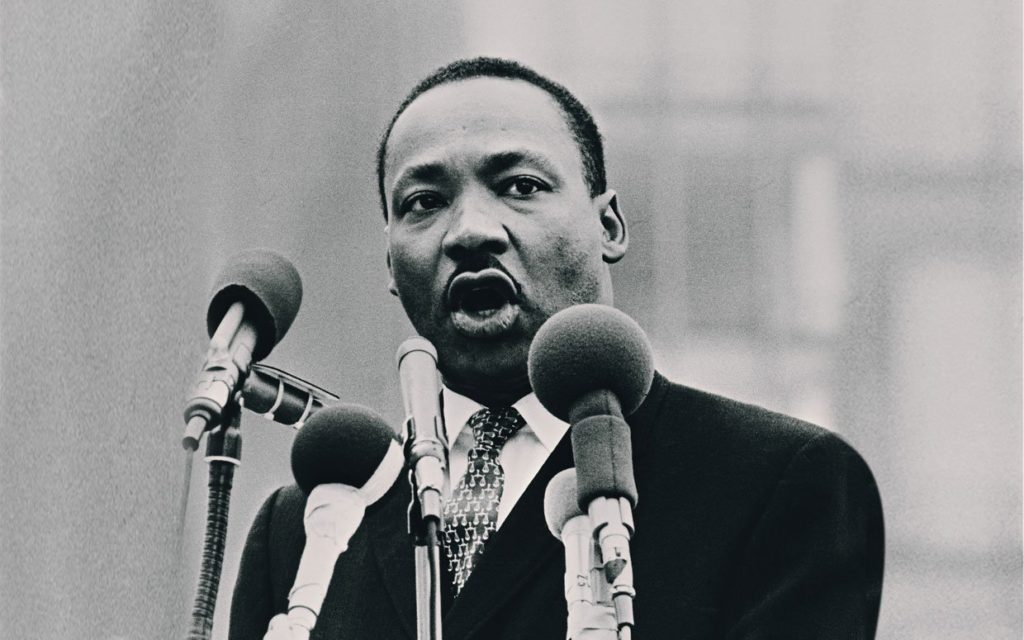
It's become a TV ritual: Every year in mid-January, around the time of Martin Luther King's birthday, we get perfunctory network news reports about "the slain civil rights leader."
The remarkable thing about this annual review of King's life is that several years — his last years — are totally missing, as if flushed down a memory hole.
What TV viewers see is a closed loop of familiar file footage: King battling desegregation in Birmingham (1963); reciting his dream of racial harmony at the rally in Washington (1963); marching for voting rights in Selma, Alabama (1965); and finally, lying dead on the motel balcony in Memphis (1968).
An alert viewer might notice that the chronology jumps from 1965 to 1968. Yet King didn't take a sabbatical near the end of his life. In fact, he was speaking and organizing as diligently as ever.
Almost all of those speeches were filmed or taped. But they're not shown today on TV.
Why?
It's because national news media have never come to terms with what Martin Luther King Jr. stood for during his final years.
In the early 1960s, when King focused his challenge on legalized racial discrimination in the South, most major media were his allies. Network TV and national publications graphically showed the police dogs and bullwhips and cattle prods used against Southern blacks who sought the right to vote or to eat at a public lunch counter.
But after passage of civil rights acts in 1964 and 1965, King began challenging the nation's fundamental priorities. He maintained that civil rights laws were empty without "human rights" — including economic rights. For people too poor to eat at a restaurant or afford a decent home, King said, anti-discrimination laws were hollow.
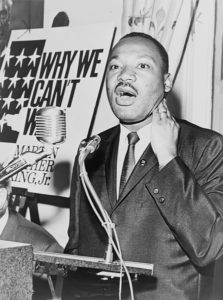
Noting that a majority of Americans below the poverty line were white, King developed a class perspective. He decried the huge income gaps between rich and poor, and called for "radical changes in the structure of our society" to redistribute wealth and power.
"True compassion," King declared, "is more than flinging a coin to a beggar; it comes to see that an edifice which produces beggars needs restructuring."
By 1967, King had also become the country's most prominent opponent of the Vietnam War, and a staunch critic of overall U.S. foreign policy, which he deemed militaristic. In his "Beyond Vietnam" speech delivered at New York's Riverside Church on April 4, 1967 — a year to the day before he was murdered — King called the United States "the greatest purveyor of violence in the world today."
From Vietnam to South Africa to Latin America, King said, the U.S. was "on the wrong side of a world revolution." King questioned "our alliance with the landed gentry of Latin America," and asked why the U.S. was suppressing revolutions "of the shirtless and barefoot people" in the Third World, instead of supporting them.
In foreign policy, King also offered an economic critique, complaining about "capitalists of the West investing huge sums of money in Asia, Africa and South America, only to take the profits out with no concern for the social betterment of the countries."
You haven't heard the "Beyond Vietnam" speech on network news retrospectives, but national media heard it loud and clear back in 1967 — and loudly denounced it. Life magazine called it "demagogic slander that sounded like a script for Radio Hanoi." The Washington Post patronized that "King has diminished his usefulness to his cause, his country, his people."
In his last months, King was organizing the most militant project of his life: the Poor People's Campaign. He crisscrossed the country to assemble "a multiracial army of the poor" that would descend on Washington — engaging in nonviolent civil disobedience at the Capitol, if need be — until Congress enacted a poor people's bill of rights. Reader's Digest warned of an "insurrection."
King's economic bill of rights called for massive government jobs programs to rebuild America's cities. He saw a crying need to confront a Congress that had demonstrated its "hostility to the poor" — appropriating "military funds with alacrity and generosity," but providing "poverty funds with miserliness."
How familiar that sounds today, more than a quarter-century after King's efforts on behalf of the poor people's mobilization were cut short by an assassin's bullet.
As 1995 gets underway, in this nation of immense wealth, the White House and Congress continue to accept the perpetuation of poverty. And so do most mass media. Perhaps it's no surprise that they tell us little about the last years of Martin Luther King's life.
See also:
- "The Right Has a Dream: Martin Luther King as an Opponent of Affirmative Action," Paul Rockwell, Extra! (5-6/95)
- "Speak Truth to Power: But Not When It Can Hear You," Peter Hart, Extra! (4/06)
- Rick Perlstein on Conservatives & Martin Luther King -- CounterSpin (1/19/07)
- "Honoring King While Clouding His Legacy," Norman Solomon, MediaBeat (4/2/98)
- "Smothering the King Legacy With Kind Words," Norman Solomon, MediaBeat (2/2/06)
--------------------------------------------------------------------------------
Jeff Cohen and Norman Solomon are syndicated columnists and authors of Adventures in Medialand: Behind the News, Beyond the Pundits (Common Courage Press).
Corrected version: An earlier version of this column mistakenly attributed a quote from Life to Time magazine.


Rakeem http://fair.org/media-beat-column/the-martin-luther-king-you-dont-see-on-tv/
Remembering Dr. Martin Luther King, Jr.
Have you ever heard about the secret Pentagon task force called the Vietnam War Crimes Working Group? If not, then watch our interview with journalist Nick Turse about his new book, "Kill Anything That Moves: The Real American War in Vietnam." Two Vietnam vets have been nominated for top posts by Obama: John Kerry and Chuck Hagel. If confirmed, do you think their war experiences might influence future U.S. foreign policy decisions?
Today would have been Martin Luther King Jr.'s 84th birthday. In his honor, we're featuring his famous "Letter From a Birmingham Jail", originally published in 1963.
MLK's birthday today: worth remembering that King lived beyond 1965, as when MLK day comes, no one seems to remember the King that lived until 1968, but only up until the Civil Rights Act. In the latter years of his life, King became an outspoken opponent of the Vietnam War, of American imperialism, economic exploitation and was beginning a major national "poor peoples movement." One year after giving this speech, for which he was attacked by the media and politicians, King was murdered. In the 1990s, the King family took the case to court and proved that MLK was murdered by the US government for speaking out against Vietnam and empire (see: King Family Center website, they have the court transcripts posted there, since the media obviously did not cover the issue). This speech is as relevant today as it was when it was spoken, if not more so. Perhaps just replace the names of the countries from Vietnam et. al. to Afghanistan, Pakistan, Yemen, Somalia, Palestine, Libya, Syria, Honduras, Mali, Philippines, et. al.
Somethings of this historical importance should not be copyrighted.
http://webcache.googleusercontent.com/search?q=cache:http://fair.org/media-beat-column/the-martin-luther-king-you-dont-see-on-tv/
MLK Jr was a radical revolutionary militant that the FBI (J Hoover) & media tried to defame and stop from influencing others. Remember the REAL MLK Jr. Not the one that media portrays him as.
http://fair.org/media-beat-column/the-martin-luther-king-you-dont-see-on-tv/
[...] It's become a TV ritual: Every year in mid-January, around the time of Martin Luther King's birthday, we get perfunctory network news reports about "the slain civil rights leader." The remarkable t... [...]
The Martin Luther King you don't see on TV http://fair.org/media-beat-column/the-martin-luther-king-you-dont-see-on-tv/
"you don't use mlk's prophetic fire as just a moment of presidential pagentry.. the righteous indignation of mlk jr becomes a moment of political calculation, and that makes my blood boil"
http://fair.org/media-beat-column/the-martin-luther-king-you-dont-see-on-tv/
Kinda unfortunate this article is 18 years old.
Dr. Martin Luther King
ON PEACE (1964):
"Sooner or later all the people of the world will have to discover a way to live together in peace and thereby transform this pending cosmic elegy into a creative psalm of brotherhood. I refuse to accept the view that mankind is so tragically bound to the starless midnight of racism and war that the bright daybreak of peace and brotherhood can never become a reality. This is why right temporarily defeated is stronger than evil triumphant."
Martin Luther King 1929 - 1968
3 breaths 3 x daily sending peace to all beings.
[...] The Martin Luther King You Don’t See on TV [...]
[...] Martin Luther King Jr. Quotes You Never Hear. The Martin Luther King You Don’t See on TV. Beyond Vietnam, 1967. And of course “Letter from a Birmingham [...]
All of you with these pictures of Obama next to MLK please read this!!!! http://fair.org/media-beat-column/the-martin-luther-king-you-dont-see-on-tv/
I have written pieces like this myself; an important reminder, particularly today...
"True compassion," King declared, "is more than flinging a coin to a beggar; it comes to see that an edifice which produces beggars needs restructuring." Honor him, but don't cloud his legacy.
Martin Luther King Jr day is rapidly becoming my favorite holiday. Most people only know of his I had a Dream speech, which is amazing in and of itself, but his broader message on compassion is awe inspiring. That and its literally the last holiday that hasnt been ruined by commercialism. http://fair.org/media-beat-column/the-martin-luther-king-you-dont-see-on-tv/
In honor of Martin Luther King, please take the time to watch this incredible speech he gave against the Vietnam War. "There comes a time when silence is betrayal."
[...] FULL ARTICLE @ FAIR [...]
perspective
Happy Martin Luther King Jr. Day! LIKE this to commemorate the life and legacy of Dr. Martin Luther King Jr.!
Maynn I'm bout to spit some controversial shit on this status. Some people gon like it, and some people won't... but I'ma tell it like I see it.
Today, on January 21, 2013, I actually saw more Facebook statuses about Obama than I did about Martin Luther King.
A lot of y'all niggas need to calm down and identify the differentiation between heroes and politicians.
Get the two mixed up and you turn into one of them crazy motherfuckers in these foreign countries that be hopping on cars n shit for their political party.
Whether you Democratic or Republican, anyone glorifying a politician on the level of God is on some fucked up shit, real talk.
Y'all need to stop living inside the box and stop acting like motherfuckin sheep.
Because in the end, ain't nobody give a fuck about you but you.
Thanks for the article. The problem as I see it, is not so much that the last years are left out, as that it may show there is not "the balance" in questioning our leaders policies in the media that would lead to a real discussion. I do think Martin may have not really been as aware as he could have been about dogmatic communism and it's threat (i could be wrong), but, really he was so astute and chose his words so carefully.. The thing that sticks with me about King is that I feel he was fundamentally a builder... and a bridge. Finally, people could say he was overly polemical, but heck Southeast Asia was a mess at the time to put it lightly.
Letter to MLK from the FBI - Source Enclosed.
Source: http://www.lettersofnote.com/2012/01/king-like-all-frauds-your-end-is.html
KING,
In view of your low grade... I will not dignify your name with either a Mr. or a Reverend or a Dr. And, your last name calls to mind only the type of King such as King Henry the VIII...
King, look into your heart. You know you are a complete fraud and a great liability to all of us Negroes. White people in this country have enough frauds of their own but I am sure they don't have one at this time anywhere near your equal. You are no clergyman and you know it. I repeat you are a colossal fraud and an evil, vicious one at that. You could not believe in God... Clearly you don't believe in any personal moral principles.
King, like all frauds your end is approaching. You could have been our greatest leader. You, even at an early age have turned out to be not a leader but a dissolute, abnormal moral imbecile. We will now have to depend on our older leaders like Wilkins, a man of character and thank God we have others like him. But you are done. Your "honorary" degrees, your Nobel Prize (what a grim farce) and other awards will not save you. King, I repeat you are done.
No person can overcome facts, not even a fraud like yourself... I repeat — no person can argue successfully against facts... Satan could not do more. What incredible evilness... King you are done.
The American public, the church organizations that have been helping — Protestant, Catholic and Jews will know you for what you are — an evil, abnormal beast. So will others who have backed you. You are done.
King, there is only one thing left for you to do. You know what it is. You have just 34 days in which to do it (this exact number has been selected for a specific reason, it has definite practical significance). You are done. There is but one way out for you. You better take it before your filthy, abnormal fraudulent self is bared to the nation.
http://fair.org/media-beat-column/the-martin-luther-king-you-dont-see-on-tv/
Jeff Cohen and Norman Solomon published the following analysis in 1995:
"In his last months, King was organizing the most militant project of his life: the Poor People's Campaign. He crisscrossed the country to assemble "a multiracial army of the poor" that would descend on Washington — engaging in nonviolent civil disobedience at the Capitol, if need be — until Congress enacted a poor people's bill of rights. Reader's Digest warned of an "insurrection."
King's economic bill of rights called for massive government jobs programs to rebuild America's cities. He saw a crying need to confront a Congress that had demonstrated its "hostility to the poor" — appropriating "military funds with alacrity and generosity," but providing "poverty funds with miserliness.""
And yes many African Americans and Blacks showed their true colors when Dr. King started talking about like children and the poor in other countries like Vietnam. http://fair.org/media-beat-column/the-martin-luther-king-you-dont-see-on-tv/
"Dr. King would be proud to see our Global Strike team - comprised of Airmen, civilians and contractors from every race, creed, background and religion - standing side-by-side ensuring the most powerful weapons in the US arsenal remain the credible bedrock of our national defense. . . Our team must overlook our differences to ensure perfection as we maintain and operate our weapon systems. . . Maintaining our commitment to our Global Strike team, our families and our nation is a fitting tribute to Dr. King as we celebrate his legacy."
The choice is ours!
[...] in the mainstream media or in our high school history textbooks. In fact, King himself wanted “radical changes to the structure of our society,” something that mainstream history ignores. What we see is the [...]
[...] information on the whitewashing of Martin Luther King Jr.’s radical views and legacy, see “The Martin Luther King you don’t see on TV” by Jeff Cohen and Normon Solomon and “Dr. King, forgotten radical” by Kai Wright. And [...]
[...] It's become a TV ritual: Every year in mid-January, around the time of Martin Luther King's birthday, we get perfunctory network news reports about "the slain civil rights leader." The remarkable t... [...]
Noting that a majority of Americans below the poverty line were white, King developed a class perspective. He decried the huge income gaps between rich and poor, and called for "radical changes in the structure of our society" to redistribute wealth and power.
"True compassion," King declared, "is more than flinging a coin to a beggar; it comes to see that an edifice which produces beggars needs restructuring."
By 1967, King had also become the country's most prominent opponent of the Vietnam War, and a staunch critic of overall U.S. foreign policy, which he deemed militaristic. In his "Beyond Vietnam" speech delivered at New York's Riverside Church on April 4, 1967 — a year to the day before he was murdered — King called the United States "the greatest purveyor of violence in the world today."
From Vietnam to South Africa to Latin America, King said, the U.S. was "on the wrong side of a world revolution." King questioned "our alliance with the landed gentry of Latin America," and asked why the U.S. was suppressing revolutions "of the shirtless and barefoot people" in the Third World, instead of supporting them. http://fair.org/media-beat-column/the-martin-luther-king-you-dont-see-on-tv/
[...] 1967, King called the United States “the greatest purveyor of violence in the world today” – and said, “A nation that continues year after year to spend more [...]
[...] 1967, King called the United States “the greatest purveyor of violence in the world today” – and said, “A nation that continues year after year to spend more money [...]
[...] 1967, King called the United States “the greatest purveyor of violence in the world today” – and said, “A nation that continues year after year to spend more money [...]
[...] 1967, King called the United States “the greatest purveyor of violence in the world today” – and said, “A nation that continues year after year to spend more money [...]
[...] 1967, King called the United States “the greatest purveyor of violence in the world today” — and said, “A nation that continues year after year to [...]
[...] 1967, King called the United States “the greatest purveyor of violence in the world today” – and said, “A nation that continues year after year to spend more money [...]
[...] 1967, King called the United States the greatest purveyor of violence in the world today and said, A nation that continues year after year to spend more money on [...]
[...] 1967, King called the United States “the greatest purveyor of violence in the world today” – and said, “A nation that continues year after year to spend more money [...]
[...] 1967, King called the United States “the greatest purveyor of violence in the world today” — and said, “A nation that continues year after year to spend [...]
[...] 1967, King called the United States “the greatest purveyor of violence in the world today” — and said, “A nation that continues year after year to spend [...]
[...] 1967, King called the United States “the greatest purveyor of violence in the world today” — and said, “A nation that continues year after year to spend [...]
[...] 1967, King called the United States “the greatest purveyor of violence in the world today” — and said, “A nation that continues year after year to spend [...]
[...] 1967, King called the United States “the greatest purveyor of violence in the world today” — and said, “A nation that continues year after year to spend [...]
[...] 1967, King called the United States “the greatest purveyor of violence in the world today” — and said, “A nation that continues year after year to spend [...]
[...] 1967, King called the United States “the greatest purveyor of violence in the world today” — and said, “A nation that continues year after year to spend [...]
[...] 1967, King called the United States "the greatest purveyor of violence in the world today"–and said, "A nation that continues year after year to spend [...]
[...] 1967, King called the United States “the greatest purveyor of violence in the world today”–and said, “A nation that continues year after year to spend more [...]
[...] 1967, King called the United States “the greatest purveyor of violence in the world today” – and said, “A nation that continues year after year to spend more money [...]
[...] 1967, King called the United States “the greatest purveyor of violence in the world today” – and said, “A nation that continues year after year to spend more money [...]
[...] 1967, King called the United States “the greatest purveyor of violence in the world today” — and said, “A nation that continues year after year to spend [...]
