President Donald Trump sparked outrage when he equated Nazis and counter-protesters in Charlottesville, referring to the anti-racist activists as the “alt-left.” The implication was that they were the equivalent of the “alt-right,” two sides to the same coin, showing there was—in his words—evil “on both sides.”
But it’s important to remember that the “alt-left” rhetorical gambit—deliberately equating leftists with the “alt-right,” itself a euphemism for internet-savvy racism—was popularized by centrist pundits and Democratic Party apparatchiks attempting to stigmatize challengers to the center-left establishment. As it turns out, there’s no way to suggest that unruly leftists are as bad as neo-Nazis without suggesting that neo-Nazis are no worse than unruly leftists.
As the New Republic’s Sarah Jones (8/16/17) noted, while the “alt-left” term was coined by right-wing personalities like Sean Hannity, it quickly morphed into a catch-all smear employed by those charged with defending the more corporate, pro-war wing of the Democrats. It was a go-to insult online for The Nation’s Joan Walsh, Daily Beast’s Michael Weiss, Daily Kos and Vox Media founder Markos Moulitsas, Observer and Time writer Nick Cohen, MSNBC’s Joy Ann Reid and Center for American Progress head Neera Tanden, among others.
The term was similarly employed by historian Gil Troy in Time (12/6/16), Vanity Fair‘s James Wolcott (3/3/17) and Ray Suarez on NPR’s On the Media (6/12/17).
All these pundits and writers presumably thought equating leftists with Nazis was an easy way to score points and position themselves on the Reasonable Liberal Left. What they did instead was provide fodder for anyone on the right, looking to trivialize the threat of an emerging neo-Nazism, to “both sides” the problem out of existence.
There are hundreds of ways to criticize the left that don’t involve likening them to Nazis, but these weren’t the ones settled on by establishment-defending flacks in urgent need of a swipe at left critics, especially after the disastrous 2016 election. The reliance on Nazifying Sanders backers, socialists, anti-fascists, anarchists and a whole host of anti-right, anti-centrist activists fed the toxic ideological stew that made Trump’s false equivalency not only possible, but entirely banal.
The extent to which horseshoe-theory pablum is drilled into people’s heads, by everything from public schools to pop culture, can’t be overstated. Even everyday political terms—from “moderate” to “extremism,” from “radicals” to “the center”—are highly normative labels, tossed around without much thought. What constitutes “extremism” is just as ideologically worthless. As FAIR (4/20/17) noted after Bret Stephens’ hiring by the New York Times, anti-Arab racism, climate denial, rape apologia and non-stop warmongering are not considered outside the “mainstream”—but single-payer healthcare is.
UK Labour leader Jeremy Corbyn was routinely called “hard left” (Washington Post, 4/30/17), “far left” (The Atlantic, 6/13/17) and “fringe” (New York Times, 9/5/16)—loaded labels meant to deride—while he advocated objectively popular programs such as free college, protecting the National Health Service and raising taxes on the wealthy (FAIR.org, 9/6/16).
Setting the limits of debate, as media critics have noted for decades, is the corporate media’s primary function. This goes a long way toward explaining why nominal media liberals, charged with opposing Trump and the emerging far right, would prioritize demonizing the left—even if doing so helped pave the way for Trump’s neo-Nazi whitewashing.
SIDEBAR:
‘Clashing’ With a Fascist as He Runs You Down
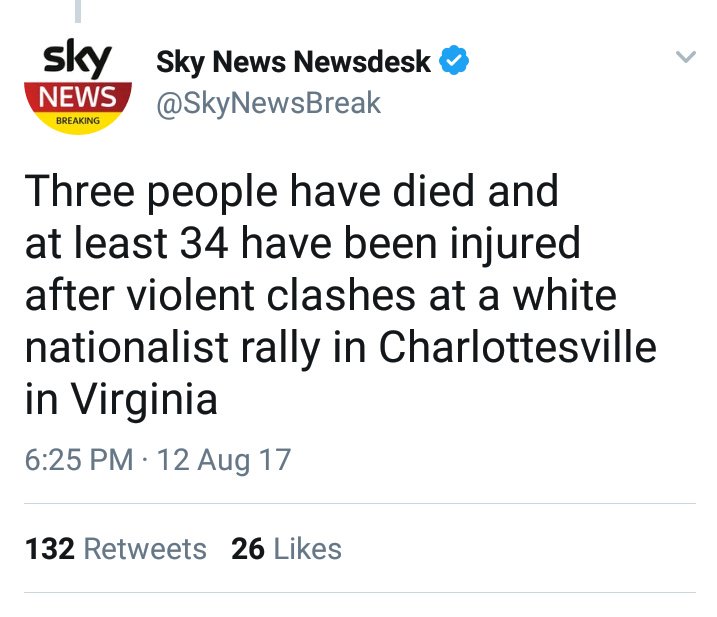
The Washington Post, Boston Globe, AOL News, The Hill, BBC and Sky News UK all chose to frame the ramming of a car into anti-fascist protesters in Charlottesville as “clashes.”
The BBC’s breaking news tweet, “One dead amid clashes between US white nationalists and counter-protesters in Charlottesville,” is an extremely odd way to describe a person driving a car into a crowd—as was AOL’s “1 Dead, 34 Injured in Clashes at Virginia Rally.”
The term “clashes”—as FAIR (10/14/15) has noted before—is designed to obscure blame, presenting a picture of two equal sides engaging in violent activities. Reading “one dead” after “clashes” at a white nationalist rally gives us no idea who died, or who did the killing.
–A.J.