

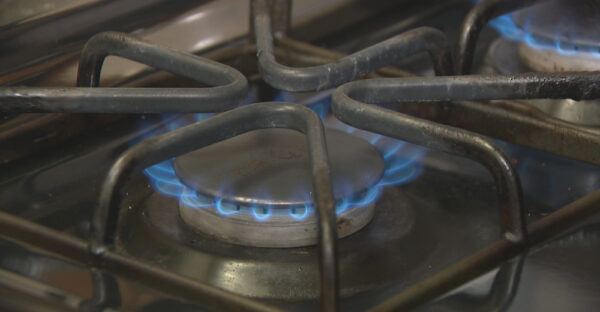
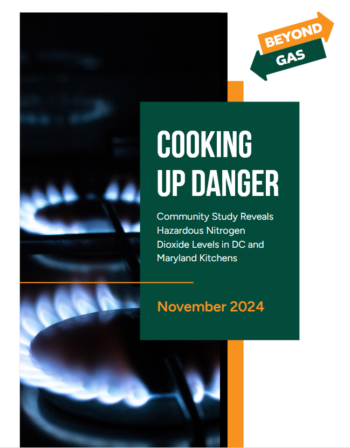
Beyond Gas (11/24): “We found indoor NO2 pollution levels from moderate gas stove use far above the health
standard set by the EPA for outdoor exposure.”
It was the sort of feel-good, David-vs.-Goliath story that’s perfect ahead of the Thanksgiving holiday.
A coalition of DC-area faith, tenant and environmental groups spent two years studying the health impacts of gas stoves. Just ahead of the holiday, when countless families would be spending hours in their kitchens cooking turkey and fixings, the coalition released their report, and it was a shocker.
After running the gas oven and two burners for 30 minutes, nearly two-thirds of homes studied registered higher levels of nitrogen dioxide than the EPA health-protective standard.
Nitrogen dioxide, or NO2, is a gas linked to wide-ranging health problems, from asthma to heart issues, and possibly “tied to increased risk of developing Type 2 diabetes, as well as cognitive development and behavioral issues in children,” the report noted.
For the grassroots group, called the Beyond Gas Coalition, the most pressing message to get to families was how to lessen their exposure to NO2 by keeping windows open during and even after cooking with gas stoves.
Longer term, the group encourages localities to ban gas appliances in new construction—a step already taken by DC and Montgomery County, Maryland, the two jurisdictions Beyond Gas studied. (Those bans will take effect in 2027.)
Despite the timeliness of Beyond Gas’s findings, only two news outlets covered the release: the Washington Informer (11/22/24), a venerable Black newspaper, and WUSA9, the local CBS affiliate owned by the media conglomerate Tegna (formerly part of Gannett).
WUSA, in fact, produced no less than three stories on the day of the report’s release (Heated, 11/27/24). Unfortunately, WUSA’s stories were quickly followed by an about-face.
Yanked without explanation

WUSA‘s report (11/27/24) on the dangers of gas stoves disappeared from its website—then came back in a more industry-friendly form.
WUSA’s trio of pieces began running on the morning of November 21, but by that evening, two of the three links to its stories were broken. “I thought it was just a glitch or something,” Barbara Briggs, co-author of Beyond Gas’s report, told the climate newsletter Heated (11/27/24).
Washington City Paper (11/27/24) reported:
When [Beyond Gas] called up WUSA to inquire, they say the message they received from the producer who worked on the story was that the station made the decision at the behest of the utility company, choosing to pull the story down and hide the video from its YouTube channel until it could include a statement from Washington Gas.
Of course, Washington Gas was under no obligation to ever give a statement.
“[WUSA] essentially told Washington Gas, ‘We’ll kill the story, and let you decide when and whether we republish it,’” Mark Rodeffer, a member of Sierra Club’s DC chapter, told Heated‘s Emily Atkin. “It’s shocking to me that they’re letting one of their advertisers dictate stories.”
“Washington Gas has sponsored many WUSA environmental stories,” Heated reported, “most of which are designed to bolster the utility’s environmental reputation.”
While Washington Gas wasn’t initially named in WUSA’s main report, Scott Broom, the environmental reporter who produced the story, noted in his report the gas industry’s objection to findings linking NO2 exposure to negative health outcomes, as well as the industry’s lawsuits against DC and Montgomery County over banning gas appliances.
But Washington Gas apparently wasn’t happy with Broom’s story, and it was quietly yanked without explanation.
New and improved

Heated (11/27/24): “The incident raises questions about how much fossil fuel sponsorship is influencing environmental and public health journalism—both in the DC region and beyond.”
Then, just as suddenly, the story reappeared six days later (11/27/24), now with Washington Gas’s fingerprints all over it. An editor’s note affixed to the top read: “This story…has been updated to include additional research and sources regarding the safety of gas stoves.”
A more honest editor’s note might have read: “We changed this story to keep a sponsor happy.”
WUSA’s apparent accommodations to Washington Gas—a greedy local monopoly utility owned by the Canadian multinational AltaGas—started right at the top of the new story. Here’s the opening to Broom’s original story (which can still be accessed via the Wayback Machine):
As families prepare for Thanksgiving feasts, a new report highlights what studies show is a serious health hazard in the kitchen: gas stoves and ovens.
In the updated version, WUSA downgraded the health hazard from “serious” to merely “potential.”
Broom’s second paragraph initially stated that “a study” had “revealed” that nearly two-thirds of the gas-stove-kitchens tested exceeded standard NO2 levels. The updated version now says “a report” only “claims” this.
Further down, things got stranger. The new version contains a long tangent conveying a gas industry talking point that has nothing to do with the story.
“Gas appliances can play an important role in reducing health hazards in poor countries where people rely on dirtier fuels such as wood and kerosene,” WUSA reported, citing a study likely handed to it by Washington Gas.
Better than nothing?
You might think the advocates who spent two years working on their study would be outraged at WUSA. But the DC area’s local media scene is in such disrepair that any coverage, no matter how problematic, may be better than the all-too-common nothing.
“It’s not like public radio has done anything,” a resigned Briggs told Heated. “It’s not like any of the other stations have carried it.”



This is hardly news, despite it being new. Any news organisation that relies on advertising or sponsorship will always tailor its stories to suit its biggest payers. The solution is worker-owned media, publicly funded. Advertising is a waste of resources anyway and would not even be necessary under socialism, but that is too extreme for FAIR.
The corrupting influence of money in the news media and in the political system is beyond self evident. However, what do you mean by worker-owned & publicly-funded? If it were publicly funded wouldn’t that make it publicly owned? How could the workers own the media company and the main source of revenue be publicly funded? Or are you talking subsidized by that public source of money? Are you talking about a government worker and private worker joint venture or privately run but with federal money? Or, is that what people talk about when they say there should be a worker owned co-op running the news?
Either way, I don’t see how, with as broke-ass as us workers are, such a thing could ever be possible, at least not in the U.S.
Also Rebecca, on a scale of 1 – 10, 1 being not at all and 10 being a strong maybe, how difficult would it be for a bunch of FAIR and other indie news readers to pool their money and crowd source a mass media company buyout?
Seems if Musk can buy Twitter, us workers should be able to do something akin to that as well, no? Why not try it with something like buying out MSNBC or heck, let’s shoot for the Moon and buyout Alphabet Inc.?
Not joking, curious about what you think, thanks.
There are numerous means for workers to own the organisations in which they work. Under capitalism, however, it’s difficult to make them succeed, as so many failures teach us: the power of capital to buy out or otherwise undermine worker-owned businesses is profound (see, for example, the struggles of Ben & Jerry’s ice cream). Worker co-operatives would be my favoured method, but how to make a news organisation pay without advertising? Funding through membership is one route. Further ideas at
https://www.cicopa.coop/about/what-is-a-cooperative/
So grateful for this article from Pete Tucker. I feel horrible for media that are struggling and vital to our society. But the rewording of the WUSA article at the hands of corporate interests is deeply problematic.
Thanks, Max!