

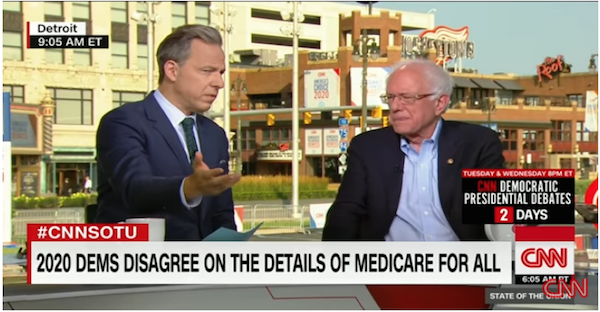
CNN Bashes Medicare for All Because It’s ‘Popular’
CNN’s Erin Burnett (7/15/19) pressed Joe Biden spokesperson Symone Sanders to attack Bernie Sanders’ healthcare plan for raising taxes (not coincidentally, the line of attack that had been identified as most effective in polling by the corporate advocacy group Third Way—FAIR.org, 10/2/19):
As a general idea, Symone, a lot of people like the idea of Medicare for All, right? And that’s in part because it sort of rings like it’s free, Medicare for All, right? But it is not free. It has an estimated price tag of $3 trillion a year…. It is not free, but it sounds that way to a lot of people. How can you explain that to Democratic-based voters that Medicare for All may sound good, but doesn’t really come out that way?
After Symone Sanders tried to talk about Biden’s own healthcare propos-al instead of attacking Medicare for All, Burnett (who makes an estimated $3 million a year) held on tight: “Are you trying to explain to voters that Medicare for All is not free, right? It comes at immense cost.” After still more resistance, Burnett explained why she wouldn’t let it go: “The reason I’m pushing so hard on this is that [Medicare for All] is popular.”
Hooray for Hollywood Propaganda!
The Atlantic (9/15/19) published a peculiar piece complaining that Hollywood doesn’t produce enough government propaganda. Boston College’s Martha Bayles offered China as an example of a country where the film industry operates “as an essential part of the effort to bring public opinion in alignment with the party’s ideological worldview.” Sounds like criticism? No, her complaint is that “not since the end of World War II have the [Hollywood] studios cooperated with Washington in furthering the nation’s ideals.” She even complains about a dearth of censorship: “Washington refrains from asking Hollywood to temper its more negative portrayals of American life, politics and global intentions.”
After bemoaning the fact that Hollywood doesn’t sell “America’s ideals” the way China’s movie industry does, Bayles includes a parenthetical that destroys her whole thesis: “(The exception is the Department of Defense, which insists on approving the script of every film produced with its assistance.)” This “exception” has produced some
800 feature films since 1911—not including films that contain messages injected by other US government agencies, like the CIA, FBI and Home-land Security, which go entirely unmentioned by the Atlantic piece.
Straight From the General’s Mouth
In the Newsweek article “NATO Superiority Over Russia Has ‘Eroded,’ Forcing Alliance to Create New Strategy, US General Says” (9/18/19), reporter David Brennan presents the views of the highest-ranking US military officer, Joint Chiefs of Staff chair Gen. Joseph Dunford, unencumbered by any contrary perspective or challenging questions. No one points out, for example, that if NATO doesn’t have “superiority” over Russia when the alliance’s military spending is 17 times as large as Russia’s, it must be really terrible at spending money effectively. Nor is there any mention, when Dunford complains that Russia is fielding “capabilities that are not compliant with the [Intermediate-Range Nuclear Forces] Treaty,” that that treaty is one that Trump has already unilaterally renounced (FAIR.org, 7/12/19)—information that Brennan was surely aware of, because he reported it the previous month (Newsweek, 8/2/19).
Worrying About a ‘Premature’ End to the Forever War
With US troops occupying Afghanistan for 18 years, the Afghan War is now the US’s longest overseas war. Still, when Donald Trump made noises about bringing those troops home, establishment media were quick to point out that this would be too soon. The New York Times (9/7/19) warned of “anarchy in Afghanistan after a premature American exit,” while USA Today (9/18/19) wrote that “critics fear a premature withdrawal would encourage the Taliban to re-take control of the country.” The LA Times (8/14/19) worried about “an overly hasty downsizing” of military and other US forces in Afghanistan, some of whom were not yet born when the US first sent troops there.
They Have ‘Oligarchs,’ We Have ‘Philanthropists’
Ever notice how US media call powerful billionaires in Russia “oligarchs,” while people with the same wealth and power in the United States are “businessmen”—when they aren’t “philanthropists”? Alan MacLeod (FAIR.org, 9/14/19) looked up the most recent 50 articles to use the word “oligarch” in the New York Times, CNN and
Fox News websites; sure enough, out of these 150 mentions, 135 referred to people from Russia, Ukraine or other former Soviet states. Only two applied to people from the US—one of which was a reference on Tucker Carlson Tonight (Fox News, 4/2/19) to Cory Booker as a “constitutional oligarch.” (Booker’s net worth is about $1.5 million—or about 0.03% of the estate of late “philanthropist” David Koch.)



