


WaPo’s Word Problem Hides Palestinian Victims
“Palestinians Kill 3 Israelis as Violence Mounts in ‘Day of Rage,’” read the Washington Post headline over a story (10/13/15) that began, “Three Israelis were killed and nearly two dozen injured in a series of Palestinian attacks.” The piece described “almost two weeks of daily violence, including a spate of attacks by knife-wielding Palestinian teenagers,” with Palestinians also using “a car, a gun and a meat cleaver to kill and injure Jewish Israelis.”
Only in the sixth paragraph does the story acknowledge that Palestinians have also been killed in the “daily violence”:
Eight Israelis have been slain and dozens have been wounded in the last couple of weeks, while at least 28 Palestinians have been killed by Israelis. According to Israeli authorities, a dozen of the slain Palestinians were attackers; the rest died in clashes with Israeli forces.
Here’s the math the Post didn’t bother to do: 16 Palestinians were killed in “clashes,” meaning slain by the Israeli security forces while armed, if at all, with rocks or improvised weaponry that posed little or no threat to the Israelis. (See Mondoweiss, 10/10/15, for a description of one such “clash.”) In other words, Palestinian victims outnumbered by 2-to-1 the Israeli victims who were the only ones mentioned in the headline, the lead and the first several paragraphs of the Post story.
Afghan Hospital Bombed by the Country That Must Not Be Named
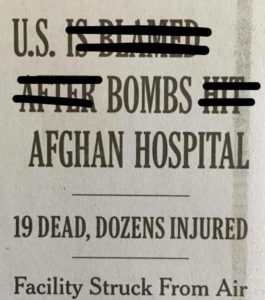
New York Times headline improved by @OneKade
After the US military attacked a Doctors Without Borders hospital in Kunduz, Afghanistan, killing at least 22 people, the New York Times provided a lesson on how to disguise responsibility for an atrocity (FAIR Blog, 10/5/15). The paper’s first headline (10/3/15) went through several permutations, from “Airstrike Hits Hospital in Afghanistan, Killing at Least 9” through “Afghan Hospital Hit by Airstrike, Pentagon Says” and “US Investigates After Bombs Hit Afghan Hospital,” finally ending up in the print edition as “US Is Blamed After Bombs Hit Afghan Hospital.” Note that none of these headlines actually said that the US bombed the hospital.
Days later, as US officials were trying to explain how their forces happened to target the hospital, the Times still couldn’t seem to bring itself to write a headline that clearly explained who was responsible for the bombing. “US General Says Afghans Requested Airstrike That Hit Kunduz Hospital” was the head on one story (10/6/15). An accompanying graphic displayed the classic circumlocution, “A Hospital Is Hit in the Battle for Kunduz.”
PolitiFact Fumbles Facts on Iran Deal

U.S. Senator Ted Cruz (R-TX) addresses a rally against the Iran nuclear deal at the U.S. Capitol, Washington, DC, September 9, 2015Photo by Jonathan Ernst/Reuter
The factchecking project PolitiFact (9/10/15) rightly deemed to be false Sen. Ted Cruz’s statement that the negotiated nuclear deal “will facilitate and accelerate the nation of Iran acquiring nuclear weapons.” But in making that determination, PolitiFact perpetrated errors of its own, as Nima Shirazi (FAIR.org, 9/25/15) pointed out.
For example, PoliFact wrote that “the deal requires Iran to give up 97 percent of its stockpile of highly enriched uranium, the kind needed to make nuclear weapons.” But none of Iran’s uranium is more than 20 percent U235, which is the IAEA’s threshold for high enrichment—and 90 percent U235 is needed to make a nuclear bomb. PolitiFact also says the deal requires Iran to “cease production of plutonium”—something Iran has never produced.
Does NYT Mislead About Voting and Class? Depend On It
New York Times columnist Thomas Byrne Edsall (10/7/15) devoted a column to arguing that “Democrats now depend as much on affluent voters as on low-income voters”:
Because high-income voters turn out in higher percentages than low income voters…the top two income quintiles of the electorate contributed the same number of votes to Obama’s victory in 2012 as the bottom two income quintiles…. In other words, upscale voters were just as important to the Obama coalition as downscale voters.
The obvious problem with this argument is that Obama got more votes than his opponent among lower-income voters, and fewer votes from upper-income voters. If Democrats actually depended on affluent voters, in other words, we’d be discussing President Romney’s re-election campaign right now.
Edsall notes, accurately, that Democrats (like Republicans) depend on wealthy donors. But he mixes this up with his misleading claims about wealthy voters, equating going after votes with going after dollars—as if oligarchy were just another kind of democracy.
Lesson From Greece: ‘Don’t Fear the Media’
The one important lesson is that the people out there—if the message is right, if you are sincere, if you forget about spinning and speak to their heart and address them directly as adults—are not going to be terrorized by the media. Don’t fear the media. The media can be bypassed if the message is right and its sincerity defeats hypocrisy.
—Former Greek Finance Minister Yanis Varoufakis, asked what incoming British Labour Party leader Jeremy Corbyn could learn from his experience (Channel 4 News, 9/14/15)
‘Let’s Talk About the Real Issues’

Sen. Bernie Sanders, I-Vt. speaks at Las Vegas Democratic debate. JOHN LOCHER/AP
Let me say something about the media, as well. I go around the country, talk to a whole lot of people. Middle class in this country is collapsing. We have 27 million people living in poverty. We have massive wealth and income inequality. Our trade policies have cost us millions of decent jobs. The American people want to know whether we’re going to have a democracy or an oligarchy as a result of Citizens United. Enough of the emails. Let’s talk about the real issues facing America.
—Sen. Bernie Sanders in the first Democratic presidential debate (10/13/15)



