

In the past decade, right-wing domestic extremism claimed 71 percent of terror-related deaths in the US, compared with just 3 percent for left-wing extremists, with the remaining 26 percent attributed to Islamist extremism (ADL, 1/17/18). The only year in the past decade when right-wing extremism did not top other varieties was 2016, when the mass shooting at Pulse Nightclub in Orlando by a self-proclaimed member of ISIS claimed the lives of 49 people.
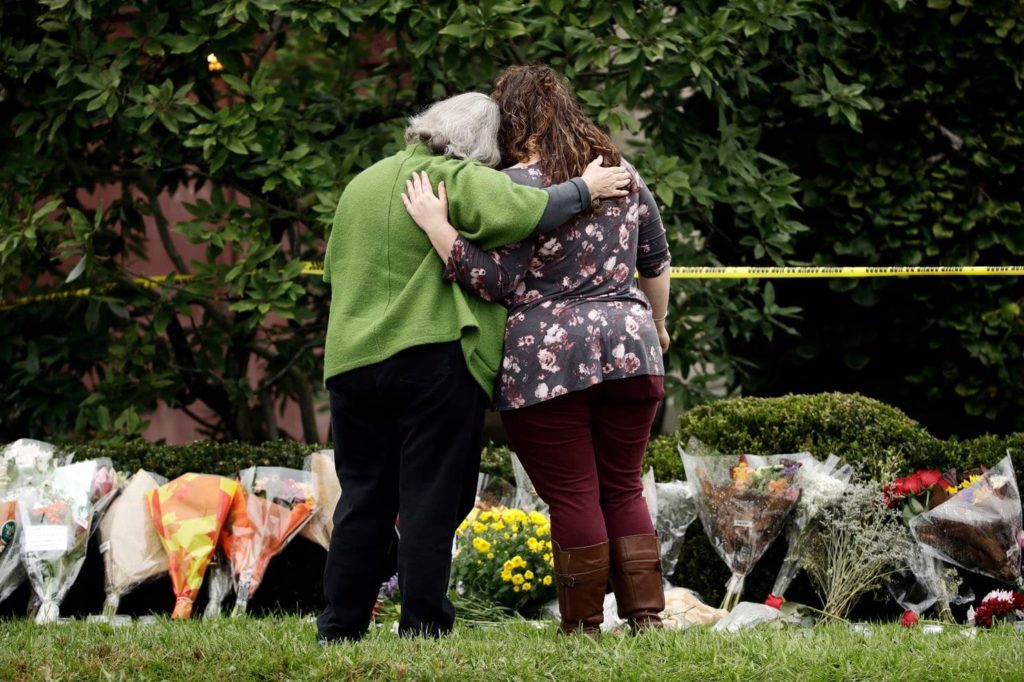
Clearly, left-wing violence is near nonexistent when compared to the rising levels of right-wing extremism. Yet the day after an antisemitic immigration foe killed 11 people in a Pittsburgh synagogue, Hugh Hewitt lamented in the Washington Post (10/28/18) that violent acts are regularly perpetrated by both sides of the political divide. Hewitt grouped political harassment in the same basket as political violence, and equated the “moron” who interrupted Mitch McConnell’s dinner, and the “mobs” that harassed Texas Sen. Ted Cruz, Trump advisor Stephen Miller and Homeland Security Secretary Kristjen Nielson, with attempted political assassins and bloodthirsty antisemitic conspiracists. This sort of whataboutism provides necessary cover for Republicans who commit politically unpopular acts, such as orphaning and imprisoning migrant children, from being confronted by their constituents.
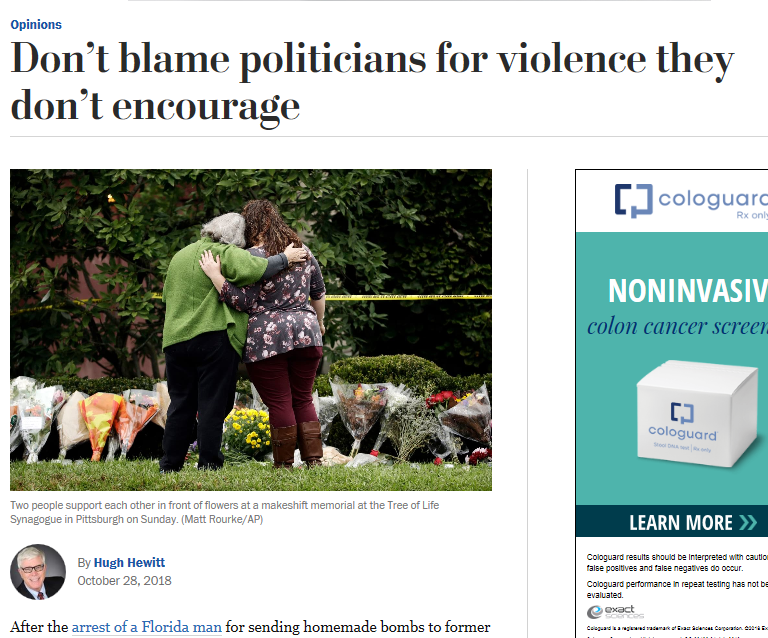
Like Donald Trump, commentator Hugh Hewitt in the Washington Post (10/28/18) argues that both the left and right are at fault.
Hewitt argued President Donald Trump and other Republicans should not be held in contempt for potentially inciting violent acts. He maintained that determining “incitement” is a slippery slope for free speech, and that responsibility lies “with criminals, not convenient political targets.” But did Hewitt consider the slippery slope of determining “incitement” when he supported the 2011 extrajudicial killing of Muslim cleric Anwar al-Awlaki, a US citizen who used his Internet videos to preach radical jihadism?
Other sites displayed similar false equivalence. The day before a Trump supporter began sending pipe bombs to George Soros and other critics of the president, Douglas Schoen put out an ill-timed piece in The Hill (10/21/18) maintaining that “both sides are culpable” for political violence, and that the US should “come together” to tackle such pressing problems as “the debt and the deficit.” In the Daily Beast (10/26/18), Matt Lewis was hesitant to conflate ruining politicians dinners with bombs, but he nonetheless opined for civility from both sides and tut-tutted the mainstream media for stoking such divisiveness. (He included a jab about “caravans full of illegals”–a popular subject of right-wing conspiracy theories.)
The New York Times (10/26/18) ran a story on the pipe bomb campaign that began by victim-blaming some of the targets by highlighting their negative comments toward Trump, as if those explained assassination attempts against them.
On an episode of The View (10/29/18), Meghan McCain invoked the weak past affiliation of Minnesota Rep. Keith Ellison with Louis Farrakhan, the head of the Nation of Islam and a prominent antisemite, as proof that the left is just as culpable for political violence as the right. While Farrakhan is indeed an antisemite, as well as a homophobe and a misogynist, his 10,000-member Nation of Islam has been politically irrelevant for decades, and Farrakhan hardly has the reach and power of Trump or other Republican politicians and media figures who reach tens of millions daily. Placing Farrakhan on the political left also ignores his quasi-endorsement of Trump.
McCain, who once described dinner interruptions by protesters as “extremely dangerous,” is a bit disingenuous in her criticism; in the past, she has pushed conspiracy theories about sanctuary cities, while The Federalist, the right-wing news outlet run by her husband Ben Domenech, is a frequent publisher of conspiracy theories.
On NBC’s Meet the Press (10/28/18), Chuck Todd brought on conservative blogger Erick Erickson to speak about the bombings and shootings of the previous week. Erickson castigated “the American people as a whole” for the volatile political situation, stating that Trump alone should not be blamed for the attacks. Todd failed to disclose that Erickson is a frequent promoter of conspiracy theories, including that of the refugee caravan and Parkland shooting survivor David Hogg as a so-called “crisis actor.”
After speaking with Erickson, Todd brought on Ohio representative and GOP campaign chair Steve Stivers, who urged Americans to “keep their dialogue civil.” Stivers said he “hasn’t been shy about showing moral leadership,” though he had aired scaremongering Soros ads for Republican politicians in advance of the midterms, depicting the Jewish billionaire as the paymaster behind protesters in what Mother Jones (10/28/18) described as “a classic anti-Semitic trope.” While Todd did bring up this point, he did not press Stivers further on the [Soros] ads, which the GOP continued to air even after the bombing attempts and the synagogue shooting.



