


Planet Money host Adam Davidson took a look at fracking in this Sunday’s New York Times Magazine (12/16/12)–and he loved what he saw.
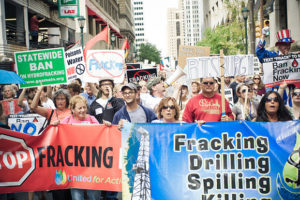
Photo: Flickr/joshlopezphoto
The piece is about the supposed economic boom times that are right around the corner, thanks to drilling for natural gas. As Davidson points out near the beginning, “The American steel industry recently received the economic equivalent of a gift from the heavens: natural gas extracted by means of hydraulic fracturing, or fracking.” And fracking will, as Davidson sees it, be of particular benefit to domestic industries:
Ed Morse, an influential energy analyst at Citigroup, argues that the natural-gas industry will bring around 3 million new jobs to the United States by the end of this decade. He also expects that fracking will add up to 3 percent to our GDP and trillions in additional tax revenue. Along the way, it will turn around perennial stragglers, like steel and manufacturing. For millions of workers, there could not be any better news.
What’s not to love, then? “Fracking, of course, is not universally embraced,” Davidson admits. There are questions about the chemicals used to extract the gas, he writes–but then quickly pivots to a discussion of how regulators have stepped up to take a harder look at the practice. Davidson admits: “Regulations are determined, in large part, by politics. And the politics of fracking are changing and are very likely to change drastically in coming years.” By that he means the “resource curse,” which involves regulations shaped more by the needs of a particular industry than, say, the public.
He writes:
Many believe this already describes the oil economies of Louisiana, Texas and Oklahoma and, increasingly, North Dakota, where the fracking industry is entrenched. Politically and economically, it’s hard to argue with an industry that has helped keep the state’s unemployment rate at about 3 percent.
And once again: “There will be trillions of dollars of new wealth. Will environmental and health concerns have any chance against that juggernaut?”
That’s a good question, broadly speaking. More narrowly: How much did such questions factor into his report on fracking? Very little, from what appears on the page. There is no serious discussion of environmental costs borne by the public, and there is not one word about climate change–a pretty shocking oversight when one considers the potential ramifications of a massive new investment in a fossil fuel industry.
While many environmentalists work to stop fracking, Davidson has a different idea–he writes that the “best thing that any U.S. environmentalist can do is to start thinking like an economist.” He goes on to explain that Norway used its own oil/gas profits to create a pension fund, which then became a massive sovereign wealth fund. That’s one way to think like an economist, I guess–the consequences of fracking might be awful for the planet, but we’ll have quite a nest egg!
A different sort of economist might look at it differently–and might wonder, for instance, if fracking’s supposed jobs “boom” is for real. Economist Helene Jorgensen looked at this issue for Food & Water Watch; as she wrote (Beat the Press, 1/8/12):
Supposedly fracking can bring the economy out of its current stagnation by creating uncountable new jobs, without running up government deficits, and even save us from global warming in the process. So how come local residents and environmentalists oppose fracking? The short answer is that fracking does not create local jobs, it lowers property values, and pollutes the water we drink and the air we breathe.
* * *
The New York Times Magazine‘s email address is magazine@nytimes.com.




Davidson has his fantasy
And I have mine.
That every corpress shill for fracking or offshore drilling or mountaintop removal or tar sands oil or nuclear power have to directly experience the consequences of their “downsides” in their own lives.
I think we might see a different narrative propagated were that the case.
Of course, they, and we all, will suffer those consequences, even if some of us have been lucky enough to avoid the worst of them up to now, if we don’t open our eyes and focus on the yawning abyss we’re hurtling headlong toward.
Their job is to keep us distracted.
Ours is to wake up to reality.
And do something about it.
I knew there was a good reason I stopped listening to Planet Money. Thanks for taking care of that for me.
. . . . . ………… national republican radio.
Oh, if only there were a loving and merciful God, one who would see to it that the poisoners of other people’s water were fairly poisoned in just measure by their own poison.
For what does it profit a man to gain the whole world and yet lose his soul?, asked an overly optimistic man, born over 2000 years ago, one with too much faith in mankind, who believed the world could be changed by asking such questions, who was later killed for openly speaking such subversive thoughts as these.
But there is no such God, so it seems that we are fated to be victims of the soulless and merciless profiteers, unless by our own human ingenuity we can find a way to save ourselves from their criminal, but profitable, indifference.
Davidson issues fair warnings, namely that a profitable Industry can be the population’s worst enemy, and that the population as well as government/regulators have too be proactive in getting a boom to work for them. He seems to hold environmental concerns at arms reach which is troubling, but to me the article seems to describe the world as it is (fracing is likely here to stay). His solution is to roll with the fracking industry and yours seems to be to stop it in it’s tracks. The later approach is likely to be much more effective in affecting change. When bargaining you never open with a compromise…
It’s very difficult to convince someone that an Idea is bad, when that idea is the main part of their paycheck. It is even harder when a persons paycheck mostly depends on them not seeing that the idea is bad.
This is who is getting steamrolled by this industry, barring the water and air issues near the pad. This is the industry in a nutshell. There is a paid shill around every corner in this industry.
@Padremellyrn. “It is difficult to get a man to understand something, when his salary depends on his not understanding it.”
― Upton Sinclair, ‘I, Candidate for Governor: And How I Got Licked.’
THis is the same Adam Davidson that has a blatant conflict of interest with the banks ,he covers on “Planet Money” , am I right?
IIf so, I’m not surprised that he shills for the fossil fuels industry. One of the banks who pays for his lectures probably has a vested interest in fracking. He
s anohter egregious example of NPR’s compromised integrity.
Yet another writer who only goes so far as to ask the right questions, but only answer the ones he wants to, which are usually the ones that support big business.
Therefore its sort of a self fulfilling prophecy. What happens when the only information readers have is the information you give them, its hard to think different.
I think most of us come here along with going to a few other sites, as if your into watchdog groups your bound to be interested in rounded views, but what about those people who only listen to or read no more than 2 places, maybe 3 if you count radio, and hear only 1 view over and over.
:( This is why I am cynical about america, too much money in our reporting system, which is the system meant to keep people informed enough to make good decisions.
Pig. They simply release the methane rather than capture it, not to mention the helium. Not to even mention the water for millions.
I wish that all of the fracking proponents had the opportunity to live in a fracking communities and to observe the impact before pronouncing how good it is for everyone.
I continue to see/read virtually nothing in media reports of fracking about the fragmentation and destruction of forest habitat by the natural gas drilling industry. It is little wonder why many forest-interior songbird species are in population declines.
NPR (APM via Marketplace) support of the fossil fuel industry continued with this laughable review of the the movie “Promised Land”. Scott Tong asks if a movie should be political. Huh? How about a reporter from the ‘sustainability desk’ of a ‘news’ show taking such a blatant supportive position of fracking?
http://www.marketplace.org/topics/sustainability/new-petro-state/promised-land-fracking-hollywood-tells-it