On May 9, 2014, Jarl Mohn became the chief executive of National Public Radio, vowing to increase diversity in its 77-percent white newsroom. Two recent FAIR studies highlighted the persistent lack of diversity at NPR—both in the boardrooms that have authority over its member stations and in the perspectives that are aired on its most prominent news shows.
Out of 259 board members at NPR’s most popular member stations, a report by Aldo Guerrero (7/2/15) found, 194—or 75 percent—have corporate backgrounds.
Of the board members with corporate occupations, 66 are executives in the financial industry. Another 22 are corporate lawyers. Eleven other members appear to be board members by virtue of their families’ corporate-derived wealth.
NPR president and CEO Jarl Mohn says he wants to stabilize NPR’s financial status by asking “wealthy donors” for more money and doubling revenue from corporate underwriting (NPR, 10/17/14). What easier way to accomplish that than by having governing boards dominated by wealthy individuals from the corporate sector? Of course, the inevitable consequence of this is to put legal control of what is supposed to be public radio into the hands of a tiny, highly privileged fraction of the population.
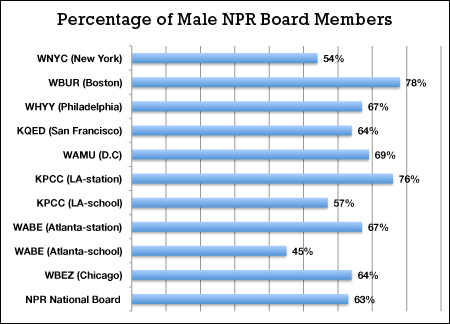
Beyond lacking occupational diversity, NPR’s governing boards also suffer from a lack of ethnic and gender diversity. One hundred eighty-six of the board members (72 percent) are non-Latino whites. Among members who are people of color, 31 are African-American (12 percent), 23 are Asian-American (9 percent), 12 are Latino (5 percent) and one person is of Middle Eastern descent. Male board members outnumber female members two-to-one, with 170 men constituting 66 percent of the boards, while 88 women were 34 percent. (Six members’ ethnicities and one member’s gender were unidentifiable.)
FAIR also took a look at NPR’s national board of directors. While a majority of the 17-member board is made up of NPR station managers with backgrounds in public media, the other board members have strong ties to the corporate sector. This includes NPR CEO Jarl Mohn, who has held executive positions in commercial media (E!, MTV and VH1). And NPR Foundation chair Howard Wollner is a retired Starbucks senior vice president. All four of the so-called “public members” represent the corporate elite; three of them are financial industry executives.
Male NPR board members outnumber women 10 to 6 (63 percent male). Fifteen of the board members are white (94 percent, more ethnically homogeneous than any of the station boards studied), while only one—Caryn Mathes—is African-American.
Another FAIR study, by Michael Tkaczevski (7/15/15), found that NPR commentary segments on leading news shows are likewise dominated by white men. The study, looking at Morning Edition, All Things Considered and the Weekend Edition shows from January through May 2015, found 14 regular commentators—people whose perspectives were aired more than once—in a total of 111 segments. Eleven of these commentators (79 percent) were men; 13 of the commentators (92 percent) were non-Latino whites.
FAIR has studied NPR’s commentators twice before, in conjunction with broader studies of NPR’s sources in 1991 (Extra!, 4–5/93) and 2003 (Extra!, 5–6/04). In 2003, 24 percent of regular commentators were women and 20 percent were people of color. In 1991, 7 percent were women and 4 percent—as in 2015, a single individual—was a person of color.
Most commentary involved art and entertainment criticism. Political commentaries have almost been eliminated from NPR’s news shows, replaced with weekly point/counterpoint segments featuring David Brooks and E.J. Dionne.
NPR ombud Elizabeth Jensen (NPR.org, 7/22/15) had an ambivalent response to the report, saying, “I find the specific numbers in the study somewhat arbitrary.” But she did acknowledge that “having overwhelmingly white viewpoints does not reflect enough of the country.”
Jim Naureckas is the editor of FAIR.org. Follow him on Twitter at @JNaureckas.