A White Supremacist Killer Is Less a ‘Terrorist’ Than Persons Unknown
When two bombs went off at the Boston Marathon on April 15, 2013, killing three and injuring hundreds, it was inevitably a huge story: A search of the Nexis news database for US newspapers on the next day turns up 2,593 stories mentioning the marathon, virtually all of them about the bombing. Of these, 887, or 34 percent, used some variant of the word “terrorism”—even though the bombers, let alone the bombers’ motivations, would not be known until days later.
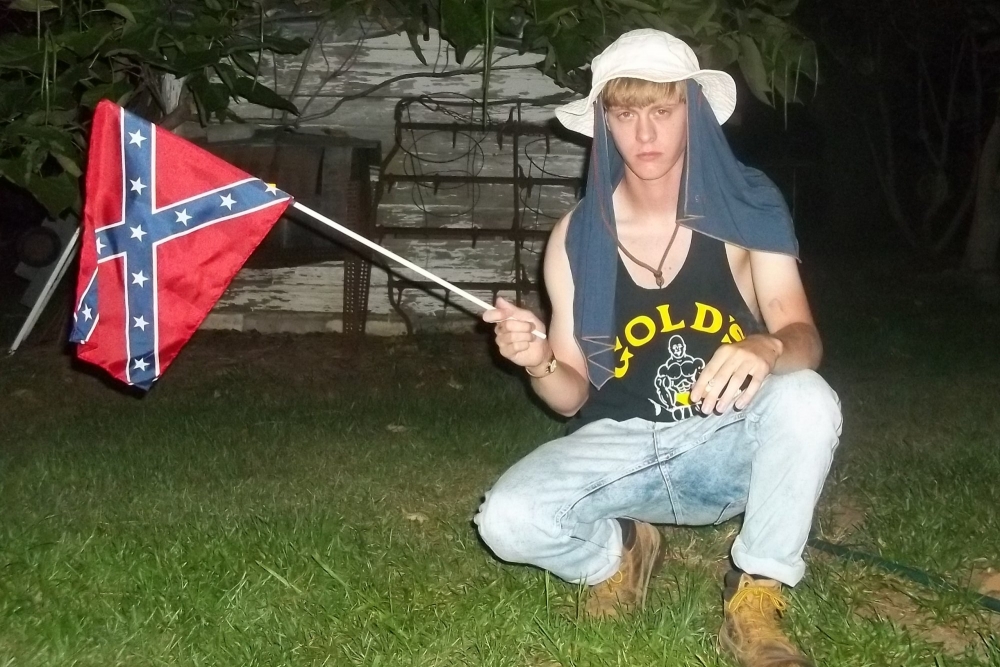
When nine people were killed at Emanuel African Methodist Episcopal Church on April 17, 2015, there were 367 stories in the next day’s papers that mentioned “Charleston” and “church,” according to Nexis—a big story, though not given the blockbuster treatment of the Boston Marathon bombing. Only 24 of these stories mentioned “terrorism”—just 7 percent, even though a suspect, Dylann Roof, was named on the first day, with evidence presented that he was motivated by a white supremacist ideology and a desire “to start a civil war” (Columbia, S.C. State, 6/18/15).
Non-Muslim Terrorists a Surprise—to Consumers of Corporate Media
Since the September 11 attacks, the New York Times (6/23/15) reported, “extremists have regularly executed smaller lethal assaults in the United States…. But the breakdown of extremist ideologies behind those attacks may come as a surprise.” The “surprise” is that more people are killed by “white supremacists, anti-government fanatics and other non-Muslim extremists than by radical Muslims”: 48 vs. 26 since 9/11, according to a study by the New America Foundation.
The Times suggests that “such numbers are new to the public.” But in a piece all about the “mismatch between public perceptions and actual cases,” the entity most charged with making sure these match–the news media–doesn’t get much scrutiny, except from “some Muslim advocates” who “complain” of media double standards.
There is research on this question; one study from University of Illinois communications professor Travis Dixon (Champaign/Urbana News Gazette, 6/23/15) found that while 6 percent of the FBI’s domestic terrorism suspects between 2008 and 2012 were Muslim, 81 percent of those described on national TV news were. That goes a long way toward explaining why there might be readers for whom reports of non-Muslim terrorism “come as a surprise.”
Reporting Fast Track’s Victory From the Corporate Lobbyist Perspective
After the Congress granted President Barack Obama fast-track authority to negotiate trade agreements, National Public Radio aired one report (Morning Edition, 6/25/15) on the legislative action that paves the way for corporate-friendly international deals like the Trans-Pacific Partnership (TPP). The report, by correspondent Yuki Noguchi, had three sources, each one a pro-fast track corporate lobbyist: the president of the Business Roundtable and the vice presidents of the National Retail Federation and the National Association of Manufacturers.
The thousands of labor, environmental and other public interest groups that strenuously opposed giving Obama fast-track authority were relegated to a one-line summary from Noguchi: “Labor and environmental groups criticized the fast-track deal, calling it worse than the North American Free Trade Agreement passed two decades ago.”
To which manufacturing lobbyist Linda Dempsey was allowed to retort: “The critics are just wrong.”
Greece’s Brutal Austerity Isn’t Enough for WaPo

In the wake of a resounding anti-austerity vote in Greece, the Washington Post‘s Griff Witte and Michael Birnbaum (7/6/15) reported that Greek Prime Minister Alexis Tsipras would now be “seeking to persuade European partners that Greece can be trusted to trim its spending, and get fresh bailout funds in return.” From 2010 to 2015, Greece has cut government spending from roughly 13 billion euros to 10 billion euros a year–cutting almost a quarter of its budget (and unsurprisingly driving the Greek economy into a depression, with unemployment stuck above 25 percent since the end of 2012). But this isn’t enough, apparently, to convince the Post of Greece’s willingness to “trim its spending” enough to merit a bailout.
Who Knew? George Will Believes in Recycling
Washington Post columnist George Will wrote a blistering attack on Chief Justice John Roberts’ recent ruling reaffirming the Affordable Care Act. From the column as it appeared in Investor’s Business Daily (6/25/15):
Roberts cites a doctrine known as “Chevron deference.”… As applied now by Roberts, Chevron deference obligates the court to ignore language that is not at all ambiguous but is inconvenient for the smooth operation of something Congress created.
Unfortunately for Will, Roberts actually rejected the Chevron doctrine. As the Supreme Court’s summary of Roberts’ ruling put it, “Chevron does not provide the appropriate framework here.”
So Will’s column underwent a slight rewrite by the time it appeared in its home base of the Washington Post (6/25/15); it now said that “Roberts invents a corollary to ‘Chevron deference,’” for instance. “As applied now by Roberts, Chevron deference obligates the court to ignore language….” morphed into “while purporting to not apply Chevron, Roberts expands it to empower all of the executive branch to ignore or rewrite congressional language.”
Why throw out a perfectly good column just because its initial premise was completely backward?
When Political Violence Comes From ‘White People Like Ourselves’
Most Americans are white, and we see white people like ourselves. When I see Dylann Roof, I remember being a white male his age, barely out of my teenage years and experiencing weird anger in a difficult time…. We can identify much more easily with who he is.
—Washington Post political analyst Philip Bump (“Why We Shouldn’t Call Dylann Roof a Terrorist,” 6/19/15)