


Millions of people across the United Kingdom are voting in an early general election on June 8.
For the first time in several decades, voters have the possibility of electing a staunch left-wing prime minister, Jeremy Corbyn. The popular and subversive Labour leader, a longtime anti-war activist and party outsider, has pledged to boost public spending, to nationalize utilities and railroads, and to halt imperialist military policies abroad.
Since Corbyn won the Labour leadership contest in a landslide victory in 2015, he has faced an incessant slew of attacks from the neoliberal Blairite wing of his own party—and from the corporate media that so frequently echo it.
When right-wing Prime Minister Theresa May announced in April, to the public’s surprise, that there would be a snap election in just two months, it was widely assumed that her Conservative Party would win with little opposition. Media outlets sure helped create this impression.
Analysis by Loughborough University’s Center for Research in Communication and Culture showed the breathtaking levels of anti-Corbyn bias in the British media during the campaign.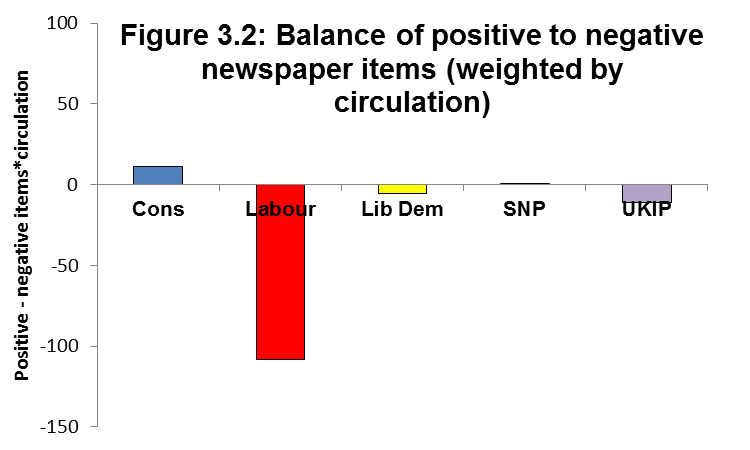
Despite the deluge of dishonest media mudslinging, Corbyn’s popularity gradually increased throughout the campaign, while May’s fell.
Days before the election, the British corporate media fell into a frenzy. Right-wing outlets went all out, disposing of any pretense of “balance” or “neutrality.”
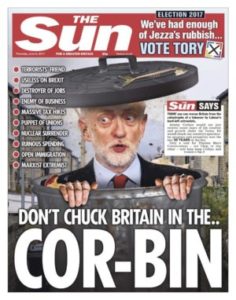
On election day, the cover of the right-wing Sun depicted Corbyn in a garbage can. “Don’t Chuck Britain in the Cor-Bin,” the tabloid implored voters. “We’ve Had Enough of Jezza’s Rubbish. VOTE TORY.”
The cover, a truly impressive example of propaganda in action, smeared Corbyn as “terrorists’ friend,” a “destroyer of jobs” and a “Marxist extremist” who will bring “massive tax hikes,” “nuclear surrender,” “ruinous spending” and “open immigration.”
One day before the election, the Rupert Murdoch–owned Sun ran a similarly outrageous cover that blared, “Jezza’s Jihadi Comrades,” claiming Corbyn “Was at Rally with Islamic Hate Mob.”
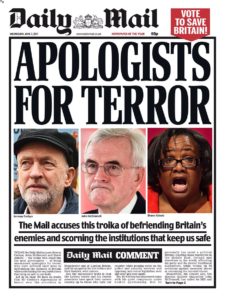
The right-wing Daily Mail, owned by the Viscount Rothermere, joined in the odious mudslinging. Its cover the day before the election declared, “Apologists for Terror,” and showed the faces of Corbyn and other prominent Labour officials. “VOTE TO SAVE BRITAIN!” it added.
On June 8, the Mail proclaimed that a vote for May would “Reignite British Spirit.” It added that “Corbyn will tax your work, your garden, your home and your inheritance.”
Across the ocean, right-wing US pundits borrowed similar smear tactics.
In the pages of Foreign Policy (6/7/17), hard-line war hawk Jamie Kirchick claimed it’s both “dumb” and “dangerous” to vote for Corbyn. The prestigious publication ludicrously let Kirchick call the leftist Labour leader a “terrorist-loving, Jew-baiting” hatemonger—dishonest claims that would verge on libel if they were not already so widespread.
(Kirchick has a history of such politically motivated lies. During the 2016 US presidential campaign, as one of Hillary Clinton’s most fervent right-wing supporters, Kirchick falsely smeared a dozen anti-war journalists and writers as supposed Trump fans.)
The press’ mendacious attacks on the socialist Labour Party head led supporters on social media to use the hashtag #LastMinuteCorbynSmears to mock the corporate media’s ridiculous bias.
More Nuanced Propaganda
More sophisticated anti-Corbyn propaganda appeared in newspapers like the New York Times. In an article aptly titled “For Britain’s Labour Party, a Mild Defeat May Be Worst of All” (6/3/17), the US newspaper of record expressed its barely concealed hope that Corbyn will lose, and badly.
The piece, by reporter Steven Erlanger, lazily echoed the views of the neoliberal Blairite wing of the Labour Party.
“Although some Labour moderates privately hoped that a cataclysmic defeat would sweep him away, now it looks as if the party will do well enough to maintain its uneasy status quo, and Mr. Corbyn and his proto-Marxist program will survive,” the Times wrote.
“But for Labour’s less ideological, more politically ambitious lawmakers, it would be nothing short of disaster, leaving them ‘to the thought of a decade out of power, of a whole career at Westminster without power,'” Erlanger lamented, quoting an expert on—wait for it—the Conservative Party.
The Times article is a case study in how to disguise an op-ed as reporting. It rehashed the hackneyed notion that left-leaning parties can only win elections by “moving to the center,” and made it very clear that it opposes not just Corbyn, but also his socialist policies.
Erlanger quoted another anti-Corbyn academic who mourned that, although Labour will likely lose the election, “I don’t think it will be bad enough…. There will be too many loopholes, so people can say, ‘OK, Jeremy wasn’t popular, but the policies are fine.'”
In the report, the Times quoted eight people: four professors, three voters, and a politician. Not a single person said anything positive about Corbyn. All eight were used to paint of a picture of the leftist Labour leader as unelectable and out of touch—a stereotype that simply does not reflect the polls.
As for the lone Labour member of Parliament quoted, Richard Burden, the Times made it clear he “is no fan of Mr. Corbyn’s.”
Erlanger concluded his story sliming Corbyn. He quoted a former Labour supporter who plans to vote Conservative: “I don’t like where it’s going, and I don’t trust Jeremy Corbyn to lead the country.”
None of this is surprising, considering the similar bias the Times showed against Bernie Sanders during his campaign against Hillary Clinton, whom the newspaper endorsed.
The Guardian’s Duplicity
The UK’s leading newspaper, the Guardian, was likewise duplicitous in its treatment of Jeremy Corbyn.
From the very moment the socialist renegade became a contender in the Labour leadership election, the Guardian has castigated him.
“If Jeremy Corbyn Wins Leadership Labour Faces ‘Annihilation’, Says Tony Blair,” blared a headline on August 13, 2015—the day before voting was to begin. That same day, the Guardian published an op-ed from the Iraq invader himself, titled, “Tony Blair: Even if You Hate Me, Please Don’t Take Labour Over the Cliff Edge.”
It was not until June 1, 2017, that the Guardian finally provided a space for its staff to pen openly pro-Corbyn coverage. British journalist Jonathan Cook took the leading British newspaper to task, highlighting its hypocrisy and just how long this took.
Cook accused of the publication of “a serious case of intellectual and editorial bullying,” noting “its editorial policy on Corbyn for two years has reflected the views of a tiny handful of insulated, over-paid editors, not the wider staff,” and has been “simply propagandizing on behalf of the Westminister bubble.”
“That is bad enough. But it is more serious still,” Cook went on:
The Guardian editors have helped to exclude voices of support for Corbyn from the only supposedly serious left-liberal newspaper in Britain, at a time when the country stands on the precipice of an election that could dramatically shape all our futures.
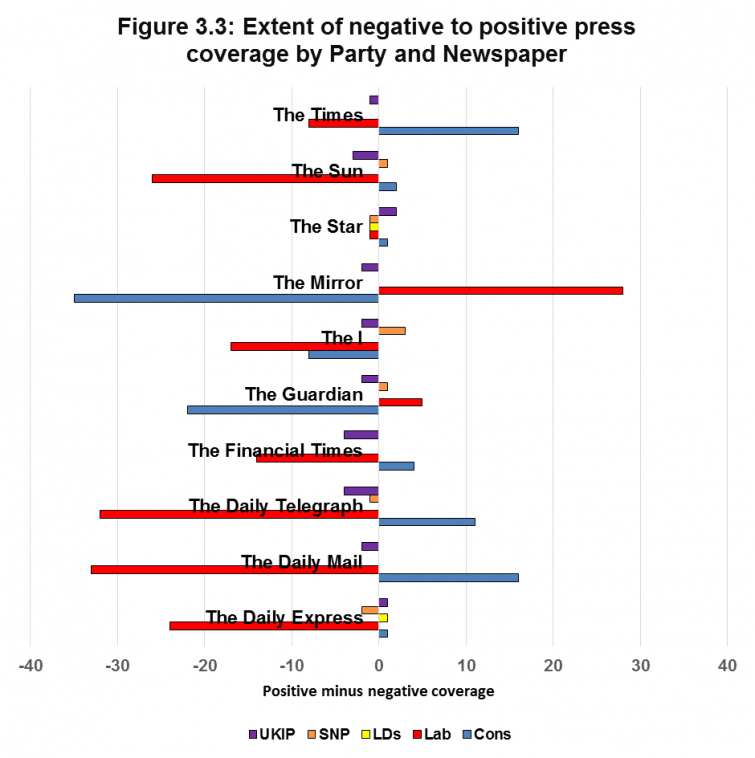
Truthfully, analysis from the aforementioned Center for Research in Communication at Loughborough University suggests that just two of 10 major British newspapers had net positive coverage of Corbyn. Even then, the Guardian‘s rating was just barely above zero.
In fact, on May 30—with less than two weeks before the election—the Guardian printed a cover story that implied Corbyn could be a dictator, absurdly reading, “Corbyn Tells Paxman: ‘I’m No Dictator’ in TV Debate.”
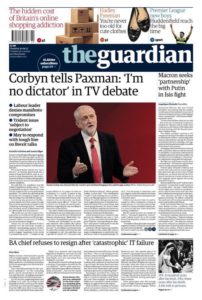
Only a few left-wing outlets have supported Corbyn, and even then very inconsistently.
Although widely portrayed as a left-wing paper, the Guardian takes an editorial line that largely mirrors the right wing of Labour—not unlike the New York Times‘ relationship with the Democratic Party.
Growing in the Polls
What exactly will happen in the election is unclear. Some analysts have speculated it could be a surprise, like the 2016 US presidential election.
What is clear is that, despite the relentless media attacks, Jeremy Corbyn’s popularity steadily increased throughout the brief campaign. After the Conservative-oriented Daily Telegraph (5/11/17) leaked Labour’s “left-wing manifesto”—leading its news report with “Jeremy Corbyn will take Britain back to the 1970s by nationalizing industries, forcing wage caps on businesses and giving huge power to the unions”—many voters actually responded positively to the party platform’s promises of defending the healthcare system, eliminating college tuition and raising taxes on the wealthy. By May 25, a Westminster poll found that Labour had closed the gap to within just 5 percent of the Tories. Corbyn surged 17 percent ahead of Theresa May in London.
In the week of the election, polls showed the parties had become neck and neck—dynamiting the hoary media trope that the Conservatives’ victory was “inevitable.”
Westminster voting intention:
CON: 41% (-2)
LAB: 40% (+3)(via @Survation / 02 – 03 Jun)
Chgs. w/ 27 May.— Britain Elects (@BritainElects) June 5, 2017
Corbyn’s popularity even continued to grow despite two attacks claimed by ISIS extremists. In the three weeks before the attacks, dozens of people were killed and injured by Salafi militants in Manchester and London.
Such attacks frequently hurt left-wing candidates and feed into right-wing “get tough” paranoia. But Corbyn responded to the incidents with criticism that is almost never heard in mainstream politics: He pointed out that imperialist Western foreign policy has fueled violent extremism.
In fact, Corbyn’s approval ratings went up. A poll found that a staggering 75 percent of British voters recognized that the Western wars in Iraq, Afghanistan and Libya exacerbated violent extremism and made blowback attacks more likely at home (Independent, 6/6/17).
Whatever the results of the vote in Britain today, it’s clear that as corporate media piled on and pilloried Corbyn, more and more average people grew to support him and his socialist policies.



I have little hope that Corbyn, like Sanders (“socialist” must always be placed in quotes with both, if we’re honest), will prove truly worthy of this vitriol, but I sorely wish to see him get the chance to prove me wrong.
Based on the polls, it appears the people are finally waking up to the corporate media’s deceptions. Crossing my fingers their votes match the poll results.
Great article.
Just stop reading newspapers. If you can’t do that, never pay to read any that are neoliberal/conservative mouthpieces (i.e. 90% of them).
We need to support independent journalism. For instance perhaps http://www.investigate-europe.eu/en/ is a good candidate.
I have to contest the use of the term “staunch left-wing” to describe Jeremy Corbyn. He really isn’t. He is certainly well to the left of any Labour leader since Michael Foot resigned in 1983, but he is not ‘left-wing’. His politics are somewhere on the boundary between being a socialist and being a social democrat. He is not a Marxist, nor a Communist, which would be the requirement for a ‘staunch left-winger’. He does not believe in turning all businesses into co-operatives managed by the workers, or in total shutdown of all parts of the private sector.
It is only the extremely narrow capitalist position of the current Overton Window in the USA and the UK that leads people in both countries to assume that ‘social democrat’ is another name for a Trotskyist. Even FAIR, understandably, is prone to this unknowing illusion.
great mythbusting piece by one of my favorite writers Ben Norton and well done as always FAIR. Yes the Britsh media I would say and the establishment is even worse there then the US. the British equivalalent to FAIR Media Lens http://www.medialens.org has done an excellent job the last several years of putting the British corporate/state press from the Guardian, to BBC, to Channel 4, ITV, Independent, New Statesmen, The Times and others into account. Pity Corbyn didn’t win in a landslide but let it be known he once twice his leadership and did better in the general election INSPITE of the media blitzkrieg on him.
A sound piece of journalism, Ben. If I myself were to analyse the effect of corporate media on the UK populace coupled with the rise of Jeremy Corbyn it would be this: that UK citizens have been taken for mugs by the corporate media, the neoliberals and conservative and have now seen what slavish support for their hubris-soaked policies and escapades has brought about – and the cost has been, and is increasingly becoming, high. They now look desperately for a politician that actually does appear to understand them, speaks their language and is consistent and have found one in Jeremy Corbyn. In a sense then, Corbyn is as much a product of conservatism and neoliberalism as his opposite numbers in Parliament. The difference is, though, that he is not one of them.