

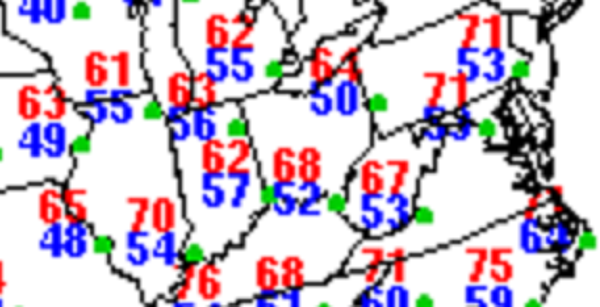
High and low temperatures recorded for December 14-15, 2015 (Source: NOAA)
As wave after wave of record-breaking high temperatures grips huge swaths of America, media coverage of the December warmth has rarely been willing to discuss its cause. Reporters may be willing to point to a monster El Niño, but hardly have mentioned it’s launching its assault off a higher baseline temperatures from human-caused climate change, resulting in some jaw-dropping record highs.
Of 259 newspaper stories that touched on December’s warmth between December 1 and 14, 25 made the link to El Niño, but only seven made the tie to climate change. Network news coverage has been no more willing to connect the dots. Of 67 mentions of December warmth, six linked it to El Niño, but only one talked about the climate connection.
Much of the East Coast and Midwest have seen record-breaking December warmth. Through December 12, nearly 700 warm records have been set, compared to only about 120 cold records, according to the National Centers for Environmental Information.
2015 is on pace to be the warmest year on record. October “marked the sixth consecutive month a monthly global temperature record has been broken and was also the greatest departure from average for any month in the 1,630 months of recordkeeping,” according to NOAA.

The Guardian (12/15/15) published a photo of cherry trees blooming in December in Washington, DC–but don’t think this has anything to do with global warming, the paper said. (photo: Bao Dandan/Xinhua Press/Corbis)
While this year’s El Niño is part of a natural cycle that’s regularly sent US temperatures soaring, it’s now coming off a launching pad that’s been raised by global warming. “Once you superimpose this natural [El Niño] cycle on greenhouse warming,” Kim Cobb of the Georgia Institute of Technology Cobb told Climate Central (1/3/13), “things just get worse.”
The combination of a natural cycle intersecting with a human-caused warming trend has led to some confusing coverage. For example, Holthaus’ Slate piece is headlined “Global Warming Isn’t Really to Blame for This Crazy Warm Weather,” but later he clarifies, “Climate change made this weekend’s warmth more likely, but it wasn’t the main driving force.”
As climate scientist Kevin Trenberth has said about the climate/weather link generally: “It is not a well-posed question to ask, ‘Is it caused by global warming?’ Or ‘Is it caused by natural variability?’ Because it is always both.”
Although all weather events take place in the context of a climate that’s been altered by pollution, research on the specific relationship between global warming and the El Niño cycle is still in its early stages. A 2014 study published in the journal Nature Climate Change (1/19/14) by a team of 17 researchers warned that global warming could double extreme El Niño events. “With a projected large increase in extreme El Niño occurrences, we should expect more occurrences of devastating weather events, which will have pronounced implications for 21st century climate,” said the authors. While other researchers say it’s too soon to draw conclusions, there’s some evidence to back this up: All three El Niños on record rated as “very strong” have come since 1982.
Media Sees Safety in El Nino
Even within newscasts that covered the Paris climate action agreement, reporters wouldn’t reference global warming’s role in record-breaking warmth. “Many forecasters point to El Niño, a weather pattern that develops from a warm Pacific Ocean,” Jamie Yuccas reported on the CBS Evening News on December 12, failing to even mention climate change within his story despite an anchor lead-in that mentioned Paris.
One of the few examples of open discussion of climate impacts came on the December 4 edition of CBS This Morning. “We have had 14 of the 15 hottest years in the past couple of years. 2015 was the hottest year on record,” Norah O’Donnell told co-hosts Gayle King and Charlie Rose. “We always celebrate warm temperatures in November and December, but really, that’s a problem,” replied King.
Why are journalists more willing to discuss El Niño than global warming? Since El Niño can’t be pinned on polluters, they feel they can discuss it and not be accused of taking sides on a hot-button issue. Of course, one could certainly question whether it’s “objective” to shy away from climate science simply because it’s controversial.
It’s important to question the coverage now, because this warm pattern isn’t going away—in fact, NOAA warns, it’s only just beginning.
Miles Grant is a progressive blogger and environmental communicator in Fairhaven, Massachusetts. He’s director of communications for the National Wildlife Federation (though his thoughts here are his own). Read more at The Green Miles and follow him on Twitter.



F.A.I.R. you are among the few sources of information I count on for what’s actually happening. I ask you to consider the possibility that there’s something more than carbon causing a change in climate.
For years I watched and shared a documentary from 2005 called “Holes in Heaven”. I’m well aware since that the mainstream media and debunking websites have ridiculed the program mentioned in this film. However, something does stand out on film, former director of public relations Rich Garcia says of the High Frequency Active Auroral Research program that “University Scientists are interested because they’re studying science and this is a major effect on the earth and so they want to know more about what it is and what it does”.
“A major effect on the earth”?
The program director is on film stating that a billion watts of radio energy, what is considered a “tight GW” is beamed into the Ionosphere. What effect do you think that much energy at a time over 20 years would have on the electric jet, the atmosphere?
Could it change the atmosphere and therefore the climate?
See the film even though its dated. Watch for what the personnel working in the program and the inventor of it say.
There’s no theory. There’s a clear possibility during it’s operation under US Navy and Air Force the program was used for more than research.
I didn’t intend to comment this much but to complete what I wrote, I’m asking F.A.I.R. to be the media that looks into what are the real factors that have altered the atmosphere. Can carbon change the climate as much as a billion watts of radio energy beamed into our atmosphere for over 20 years?
I’m not sharing the information from a theory. The personnel in the program stated what energy was used. I gather it’s over 20 years as the Department of Defense weapons tested the program in 1997. The program since closed in 2014. So that’s 17 years. It was patented in 1987 US Patent No. 4,686,605.
Will there be any media that reports and facilitates an honest discussion of it’s possible impact in the years of operation?