


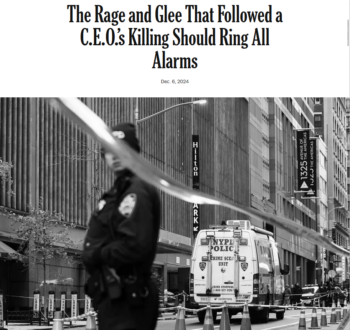
Zeynep Tufekci (New York Times, 12/6/24) “can’t think of any other incident when a murder in this country has been so openly celebrated.”
The early morning murder of UnitedHealthcare CEO Brian Thompson was met on social media with a “torrent of hate” for health insurance executives (New York Times, 12/5/24). Memes mocking the insurance companies and their callous disregard for human life abound on various platforms (AFP, 12/6/24).
Internet users are declaring that the man police believe to be the shooter, 26-year-old Luigi Mangione, is certifiably hot (Rolling Stone, 12/9/24; KFOX, 12/10/24). A lookalike contest for the shooter was held in lower Manhattan (New York Times, 12/7/24).
If so many people are unsympathetic at best in response to such a killing, that might be a reason to revisit why health insurance companies are so loathed. The rage “was shocking to many, but it crossed communities all along the political spectrum, and took hold in countless divergent cultural clusters,” the New York Times (12/6/24) noted. Mangione was reportedly found with an anti-insurance manifesto that stated “these parasites had it coming” (Newsweek, 12/9/24), echoing a resentment largely felt by a lot of Americans, and targeted fury at UnitedHealthcare specifically.
UnitedHealthcare has always stood out for exceptionally high rate of claims denial generally in the industry (Boston Globe, 12/5/24; Forbes, 12/5/24). For example, a Senate committee found that “UnitedHealthcare’s prior authorization denial rate for post-acute care jumped from 10.9% in 2020 to 22.7% in 2022” (WNYW, 12/7/24).
The Times (12/5/24) reported that the Senate committee found that “three major companies—UnitedHealthcare, Humana and CVS, which owns Aetna—were intentionally denying claims” related to falls and strokes in order to boost profits. UnitedHealthcare “denied requests for such nursing stays three times more often than it did for other services.”
Increasing dissatisfaction
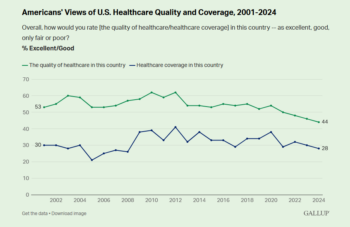
The perception of the quality of US healthcare has been on the decline since 2012 (Gallup, 12/6/24).
On top of that, Americans generally believe their insurance-centered system is a mess. Gallup (12/6/24) reported that “Americans’ positive rating of the quality of healthcare in the US is now at its lowest point in Gallup’s trend dating back to 2001.”
It continued:
The current 44% of US adults who say the quality of healthcare is excellent (11%) or good (33%) is down by a total of 10 percentage points since 2020 after steadily eroding each year. Between 2001 and 2020, majorities ranging from 52% to 62% rated US healthcare quality positively; now, 54% say it is only fair (38%) or poor (16%).
As has been the case throughout the 24-year trend, Americans rate healthcare coverage in the US even more negatively than they rate quality. Just 28% say coverage is excellent or good, four points lower than the average since 2001 and well below the 41% high point in 2012.
Ipsos (2/27/24) likewise found:
Most Americans are unsatisfied with the healthcare system, say the health insurance system is confusing and opaque, and many have skipped or delayed care because of a bad experience or the lack of timely appointments. A small, but not insignificant number, of Americans believe they have had a negative health outcome as result of their experiences within the healthcare system.
When this inefficient system doesn’t literally kill Americans, it can still kill them financially. “Almost a third of all working adults in the United States are carrying some kind of medical debt—that’s about 15% of all US households,” Marketplace (3/27/24) reported. It added: “This debt is also the leading cause of bankruptcies in the country.”
Many news outlets’ pontificators, however, were incensed that anyone would voice frustration with health insurance when an industry CEO has fallen.
‘Not the time to offer criticism’
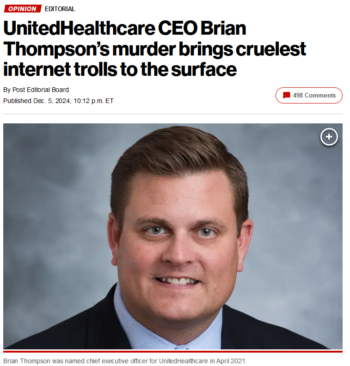
After Brian Thompson’s killing, the New York Post (12/5/24) condemned those on social media who “swooned over his killer, speculated on his motives, and wondered if Timothée Chalamet would play him in the movie.”
Responding to the memes and the jokes, many of which were more about the unjust health insurance system than support for vigilante murder, the New York Post editorial board (12/5/24) asked:
Do the jokes point to a society that has become so desensitized by the coarseness of online discussion, so disassociated from kindness, that a baying mob cheers a man’s murder and cries out for more?
And upon Mangione’s arrest, the Post (12/9/24) complained that on social media, “tasteless trolls showered praise on the Ivy League grad.” The Post (12/11/24) also fretted about fake “Wanted” posters for insurance company executives that the paper considered a “a fear-mongering social media stunt to incite hysteria,” adding that the “murder has also spawned a stream of merchandise sympathetic towards the 26-year-old being sold by online retailers, forcing Amazon to pull them from its website.”
Fox News (12/6/24) quoted one of its own contributors, Joe Concha, saying, “I think this encapsulates the far left’s worldview: If you run a company that isn’t to their liking, you deserve to die.” The network (12/7/24) praised Democratic Sen. John Fetterman of Pennsylvania for “tearing into” a New York article (12/7/24) that the outlet characterized as saying “resentment over denied insurance claims made…Thompson’s murder inevitable.”
The dismay was felt in other corners of right-wing media. At the Free Press (12/5/24), the brainchild of anti-woke crusader Bari Weiss, Kat Rosenfield wrote:
The people celebrating Brian Thompson’s murder by turning him into an avatar for everything wrong with the American healthcare system remind me of nothing so much as Hollywood screenwriters, cunningly manipulating an audience into cheering on unforgivable acts of fictional violence.
The National Review (12/4/24) huffed:
This is not the time to offer your criticisms of the health-insurance industry. And there is never a time to believe that corporate executives are, by their very nature, evil people who deserve to be killed. Yet that is what you’ll see if you go on social media right now and look at comments on news stories about this assassination.
Yet all of these outlets at the same time have run support for Daniel Penny, the man recently acquitted for killing a Black homeless man on the New York City subway (National Review, 6/17/23; Free Press, 10/20/24; New York Post, 12/4/24; Fox News, 12/6/24). These outlets likewise expressed support for Kyle Rittenhouse after he gunned down Black Lives Matter protesters (National Review, 11/19/21; Free Press, 11/17/21; New York Post, 11/19/21; Fox News cited by Media Matters, 11/11/21), and for George Zimmerman when he shot Trayvon Martin (National Review, 6/22/20; New York Post, 7/15/13; Fox News, 7/18/12). In other words, it’s fine to defend vigilantes when they kill unarmed Black people or anti-racist activists, but when a CEO’s life is taken, we must solemnly stay silent on the reasons why such a person might be targeted or why bystanders might not be crying.
Piers Morgan (New York Post, 12/10/24) made this clear when he said “I cheered when I heard” Penny’s acquittal, and felt “shocked and saddened when I saw the footage” of the Thompson shooting. “Those two reactions would surely be the correct and appropriate ones for anyone with an ounce of fairness and humanity in their heart,” he said—because Thompson was “a non-violent, non-threatening, non-criminal man in the street,” whereas Penny’s victim was “a dangerous, mentally ill, homeless man.”
Blame it on Medicare
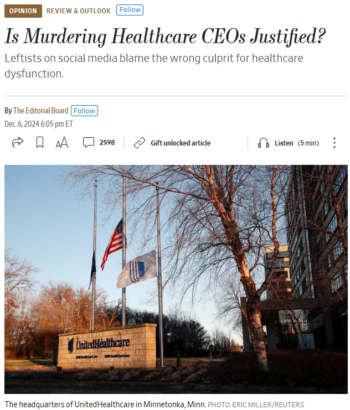
The Wall Street Journal (12/6/24) made the absurd claim that a medical system based on private insurance is better than any other kind of healthcare system.
It was the Wall Street Journal, the more erudite of Murdoch’s media properties, that really addressed the question of why people might hate health insurance companies. The anger was misdirected, the editorial board (12/6/24) said. Rather, we should look to federally funded healthcare if we want to get mad: “Medicare and Medicaid, two government programs, cover about 36% of Americans,” the paper observed; because they “pay doctors and hospitals below the cost of providing care…many providers won’t see Medicaid patients, resulting in delayed care.”
It’s an odd argument, given that people who receive Medicaid report being happier with their health insurance than people who get it through their employers or pay for it themselves—and people with Medicare are the happiest of all (KFF, 6/15/23). If the federal programs are underpaying healthcare providers, the obvious solution would be to increase funding for them—an initiative the Journal would be unlikely to support.
The board (Journal, 10/10/24) later dismissed critiques of the health insurance industry and passed off Mangione as a “disturbed individual” radicalized by the Internet and said it is “a dreadful sign of the times that Mr. Mangione is being celebrated.”
Journal editorial board member Allysia Finley (12/8/24) followed up by placing the blame on the Affordable Care Act (aka “Obamacare”). “Having insurance doesn’t change people’s behavior,” she wrote, but does “cause them to use more care.” The situation, she said, “has gotten worse since Obamacare expanded eligibility” for Medicaid. This portrait of US patients overusing healthcare like sweet-toothed children let loose in a candy store is belied by (among other things) the fact that Americans live 4.7 fewer years than the average of comparable countries (KFF, 1/30/24).
The Journal editorial went on to complain that “some providers prescribe treatments and tests that may be medically unnecessary,” and so “insurers have tried to clamp down on such abuse by requiring prior authorization.” While this “can result in delayed care that is medically necessary…it’s also how insurers control costs.”
In reality, doctors are complaining that insurance bureaucrats are impeding their ability to deliver needed healthcare because of this cost-slashing system (Forbes, 3/13/23). The American Medical Association found “94% of doctors say prior authorization leads to delays in patient care” (Chief Medical Executive, 3/14/23); “one in three doctors (33%) say prior authorization has led to serious adverse events with their patients.”
Journal editorialists appear to believe that doctors are jauntily giving away expensive blood pressure medicine and signing up patients for brain surgery for no particular reason, and the only thing that can stop this carnival of care is some bureaucrat who is trained to say “no.” The reality is that the private insurance system “saves insurance companies money by reflexively denying medical care that has been determined necessary by a physician,” as pediatrician William E. Bennett Jr. (Washington Post, 10/22/19) wrote. This is why people are so unsympathetic to Thompson, who was paid an estimated $10 million annually for imposing medical austerity on patients and providers (PBS, 12/7/24).
Pity the insurance giants
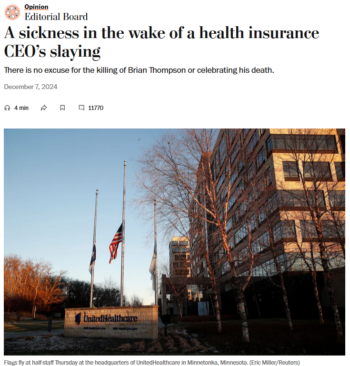
The Washington Post (12/7/24) criticized those who tried to use Thompson’s killing “as an occasion for policy debate about claim denial rates by health insurance companies.” (Note that both the Post and the Wall Street Journal used the same photo of flags at half-mast.)
Right-wing media weren’t the only ones engaging in scolding. At the Jeff Bezos–owned Washington Post, the editorial board (12/7/24) criticized those “who excuse or celebrate the killing,” as well as those “who do not countenance the killing itself” but “have nevertheless tried to treat it as an occasion for policy debate about claim denial rates by health insurance companies, an admittedly legitimate issue.” The Post added that debate was “fine in principle, but we’re skeptical that this particular moment lends itself to nuanced discussion of a complicated, and heavily regulated, industry.”
The editors nevertheless spent a lengthy paragraph explaining to readers that “controlling healthcare costs requires difficult trade-offs,” and that “even the most generous state-run health systems in other countries also have to face” these trade-offs. The editorial attempted to summon sympathy for
insurers, whose profits are capped by federal law, [and] must contend with consumer demand for ready access to high-priced specialists and prescription drugs—and, at the same time, premiums low enough that people can afford coverage.
Note that insurance company profits are “capped” by requiring them to spend at least 80% of premiums on claims, a percentage known as their loss ratio—but those claims can be paid to providers that are owned by the insurers themselves, “a loophole that makes loss ratio requirements meaningless” (Physicians for a National Healthcare Program, 7/16/21). United Healthcare has been particularly aggressive at this, which is part of the reason its “capped” profits soared to $22.4 billion in 2023.
As for the Post’s assertion that insurance providers should keep “premiums low enough that people can afford coverage,” KFF (10/9/24) found that “Family premiums for employer-sponsored health insurance rose 7% this year to reach an average of $25,572 annually, marking the “second year in a row that premiums are up 7%.” The Center for American Progress (11/29/22) found that employer sponsored insurance “premiums have risen above the rate of inflation and have outpaced wage growth” over the course of a decade. “Escalating grocery bills and car prices have cooled, but price relief for Americans does not extend to health care,” USA Today (10/9/24) reported.
The Post added that all this talk about how Americans are being tortured by the insurance system should wait until next year, “when Congress is to consider whether to keep temporary Obamacare enhancements that have boosted enrollment.”
It is easy to see the material interests of the Washington Post‘s owner at work. Jeff Bezos’ Amazon does not run a health insurance company, but it is fully entrenched in the for-profit medical system. It offers a health insurance marketplace through AmazonFlex, acquired the healthcare provider One Medical last year (NPR, 11/12/23; Forbes, 4/5/24), and offers a pharmacy and other health services.
As one of the world’s richest people, Bezos might have another reason to be worried about people cheering on the murder of CEOs: Amazon is often hated for its monopoly-like grip on online retail (FTC, 9/26/23), as well as charges of price-gouging (Seattle Times, 8/14/24) and union-busting (Guardian, 4/3/24).
‘Last or near last’
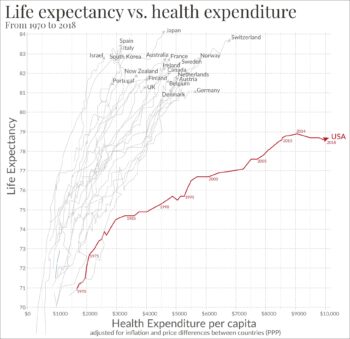
The failure of the US healthcare system in one chart: life expectancy plotted against healthcare spending.
The Washington Post‘s line about the comparable ills of “generous state-run health systems” echoed a similar argument from the Wall Street Journal‘s editorial, which concluded:
Government healthcare is a recipe for more care delays and denials. Witness the fiasco in the United Kingdom, where the Labour government reports that more than 120,000 people died in 2022 while on the National Health Service’s waitlist for treatment. To adapt a famous Winston Churchill phrase, private insurance is the worst form of healthcare, except for all others.
The statement that the British or European health systems are worse for people than the US private insurer–dominated system is simply false. Just months ago, the Commonwealth Fund (NBC, 9/19/24) found that the United States
ranks as the worst performer among 10 developed nations in critical areas of healthcare, including preventing deaths, access (mainly because of high cost) and guaranteeing quality treatment for everyone.
The US “ranked last or near last in every category except one,” precisely because
the complex labyrinth of hospital bills, insurance disputes and out-of-pocket requirements that patients and doctors are forced to navigate put the US second to last in administrative efficiency.
The Commonwealth Fund (CNN, 1/31/23) also found that
the United States spends more on healthcare than any other high-income country, but still has the lowest life expectancy at birth and the highest rate of people with multiple chronic diseases.
Healthcare providers in Mexico and Costa Rica are huge draws for Americans in need of care who can’t make it through America’s Kafkaesque system (NPR, 3/8/23). Spain and Portugal are attracting American retirees, and good low-cost health care is one incentive (Travel + Leisure, 6/20/24).
Retreat to the castle
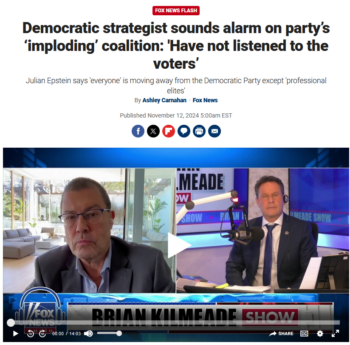
Apparently the CEOs that Fox News (11/13/24) is so concerned about don’t qualify as “professional elites.”
While the Washington Post’s position clearly falls in line with its material allegiance to a system where its owner sits at the apex, the positions from Murdoch are more interesting. As the Democratic Party has lost support among the working class (NPR, 11/14/24; USA Today, 11/30/24), Murdoch’s outlets have touted Donald Trump and the Republican Party as alternatives for working-class voters.
Murdoch and other purveyors of Republican propaganda have promoted the idea that Democrats serve only financial elites and Hollywood producers, and that protectionist policies under Trump will help US workers (New York Post, 7/16/24; Fox News, 11/13/24). Republicans were able to woo voters by complaining about the high price of gasoline and groceries under the Biden administration (CNBC, 8/7/24).
Now Murdoch outlets are fully retreating into their elite castle and telling the rabble to stop complaining about the lack of access to healthcare. The Republicans and their news outlets have worked hard to recharacterize themselves as something more populist, but the Thompson killing has brought back the old narrative that they are, proudly, the champions of the 1 Percent.





There seems to be some difficulty for some differentiate between the unnecessary and mindless killing of Brian Thompson and the health insurance system’s unconscionable financial rape 100’s of millions of Americans who struggle on a monthly basis to pay their premiums, knowing that failing to pay on time will guarantee that their coverage will be dropped.
It’s certainly very justifiable for these 100s of millions of Americans to hold their carriers in incredibly low esteem… They’re out and out hated by, I would safely say, the majority of policy holders. As angry as they are, apart from the surreal, out-of-wack world of social media, I would like to think that most people, if poled individually, would never condone Thompson’s murder.
Actually, I suspect many people would rationally condone the killing of a CEO – after all, the USA executes people for far less than what Thompson committed against helpless people. Ultimately, however, individual violence such as this is unlikely to achieve any substantial change in the capitalist system responsible for the catastrophic state of American healthcare. That change requires a mass socialist movement of the working class, a concept alien to the liberal views of FAIR writers.
As for his murder being “mindless”, it is clear that a great deal of thought and preparation went into it.
it’s actually very mindful. very demure.
I am being somewhat sarcastic, but it’s clear that this was most certainly premeditated and also planned, which is by definition not mindless at all.
And it wasn’t “right” or “just”, any more than ants infesting your apartment when there are crumbs left strewn about. Ants are not the answer to crumbs. Attracting ants does not fix the crumbs. They are a CONSEQUENCE. The slovenly behavior of these organizations has attracted “ants”. The infestation of “ants” is not an act of justice but a result of the conditions they themselves created. They only have themselves to blame, and they should suck it up and deal with it.
Nice deflective framing. While it’s true that a lot of people hate the insurance companies for denying coverage and fleecing people, you conveniently left out the other part: they also KILL tens of thousands of Americans either by denying coverage or cynically delaying it thus “waiting out” tons of elderly and infirm patients.
TL/DR: You forgot to mention that insurance companies and their executives MURDER scores of Americans for PROFIT.
Some people celebrate the death of mentally ill homeless people. I celebrate the death of health insurance CEOs. I’m not sorry.
Although I’ll never condone murder, I do welcome the conversation this story has sparked. Many people are questioning, probably for the first time, why a service industry like Healthcare is for-profit. We don’t require a profit from our firefighters or police force.
My friend said the shooter should have ran for Congress and changed the system from the inside. I had to remind him that MLK told us a riot is the language of the unheard. And as pur justice system has decided that corporations are people & money is speech… what other avenues of recourse do we have?
It’s easy enough to kill landlords and ceos and preserve state capitalism. Mao did it.
Isn’t it a funny coincidence that as a new regime is installed in DC dependent on outside capital that they start fighting with domestic capital?
Isn’t it funny that CNN plays their part boosting the signal of this middle class tantrum?
Isn’t it funny that Fair writers think this is something outside of the system happening? Did you even read project 2025, who are the villains of this fake populist movement ? It’s capitalist infighting.
Agree. See the lower-middle left.
https://www.globalresearch.ca/wp-content/uploads/2016/05/left_gatekeepers1.gif
Read a spam site? No
Actually comment on the content (whether you think the CIA funding through Ford and Rockefeller is real corruption of content, false information altogether, or less significant in terms of content-creation by the recipients than implied by the data in the image) than throw a hissy fit and call the infographic a “spam site”
“The Post added that debate was “fine in principle, but we’re skeptical that this particular moment lends itself to nuanced discussion of a complicated, and heavily regulated, industry.”
Right. Let’s wait til the anger dies down and then not have that discussion.
This would be a solid article, if not for Ari Paul/FAIR’s inability to stop lying about Kyle Rittenhouse, who was attacked by three white people who showed up in the vicinity of BLM demonstrations. He absolutely did not “gun down” anyone, he was running away from them. Ari Paul, stop lumping him in with smug lunatics like George Zimmerman, you know damn well Rittenhouse wasn’t a racist vigilante out for blood. You could have even included him as an example of the right-wing media’s hypocrisy towards shooters in general, but no, you HAD to lie. FAIR isn’t paying you to do this, and I highly doubt even your “paymasters” at the CIA ask you to write that way — and the rest of you can just calm down because the truth is the CIA spreads so much money around to control the narrative in general that occasionally liberals and leftists can apply for grants richies like Soros give out for TAX-DEDUCTION PURPOSES, not because “the CIA controls the left”. Should the left talk about this unfortunate reality of the nonprofit-industrial complex? Of course they should, and on rare occasion they do. But they should talk about it more, especially if leftists are getting in the bad habit of dismissing infographics they don’t like as “spam sites”.
But again, I’m not convinced anyone is making Ari Paul lie like this. He just lies. I wish he wouldn’t, it hurts the rest of his writing by association, and he writes well about important subjects like the ongoing slaughter of Palestinians at the hands of the Zionist regime of Israel. Of course in order to be taken seriously moving forward, he’d have to ADMIT he lies and explain himself before he could be forgiven and trusted again.