

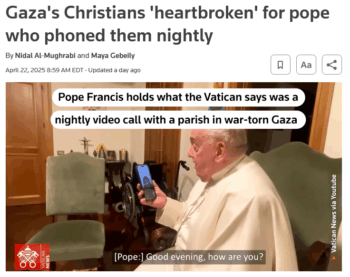
Reuters not only had a stand-alone story (4/22/25) about Palestinians’ response to Francis’ death, but included his advocacy for Gaza in its main obituary (4/21/25).
The obituaries for Pope Francis in the leading US newspapers ignored the late pontiff’s commitment to the Palestinian people and the acute suffering in Gaza in the last years of his life. Many of them ran separate pieces that highlighted Francis’ concern for Gaza and the response of Palestinians to his death, but they failed to mention these aspects of his papacy in the lengthy obituaries that summed up his life.
Born Jorge Mario Bergoglio in Argentina in 1936, Francis was the first Jesuit and the first Latin American to be pope. When he died at the age of 88, his leadership as a social justice pontiff was heralded widely.
“For Francis, the poor are ‘at the heart of the Gospel,’ and throughout his pontificate, he affirmed this by deed and word,” said the Catholic magazine America (4/21/25). His liberal philosophy addressed many pressing issues, “from climate change to global poverty, war and violence, LGBTQ+ people and women’s roles in the church,” said Sojourners (4/21/25).
Toward the end of Francis’ life, the head of the Catholic Church focused his attention on ongoing genocide in Gaza. “He used to call us at 7 p.m. every night. No matter how busy he was, no matter where he was, he always called,” George Anton, spokesperson for the Church of the Holy Family in Gaza, told NPR (4/22/25). Reuters (4/22/25) ran the headline, “Gaza’s Christians ‘Heartbroken’ for Pope Who Phoned Them Nightly.” AP (4/21/25) called these communications his “frequent evening ritual,” noting that this “small act of compassion made a big impression on Gaza’s tiny Christian community.”
Francis was generally sympathetic to addressing political and human rights for Palestinians, and under his watch the Vatican recognized the state of Palestine (BBC, 5/13/15). He “suggested the global community should study whether Israel’s military campaign in Gaza constitutes a genocide of the Palestinian people” (Reuters, 11/17/24). In his final Easter message, issued the day before his death, he called for a ceasefire in Gaza to end a conflict that “continues to cause death and destruction, and to create a dramatic and deplorable humanitarian situation” (Truthout, 4/21/25).
‘Privileged a politicized version’
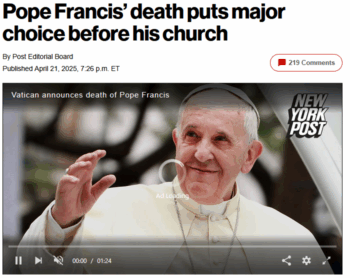
As well as his call for an inquiry into charges of genocide in Gaza, the New York Post (4/21/25) didn’t like that Francis “took a very standard leftist line on President Trump, decrying his plans for mass deportation of illegal immigrants.”
Not everyone in the press approved of this act of compassion when recalling his life and church leadership. In an editorial, the New York Post (4/21/25) criticized the “leftist” positions of the “deservedly beloved figure,” complaining that Francis “even went so far as to call for an investigation of Israel over its nonexistent genocide in Gaza.”
When it came to Francis’ support for Middle East peace generally, the Jerusalem Post (4/22/25) said in an editorial, “Time and again, Israel expressed dismay at the Vatican’s tendency to elevate Palestinian narratives while brushing aside Israeli concerns.” It complained that “the Vatican’s posture under Francis consistently privileged a politicized version of the Palestinian story over the complex reality on the ground.”
But rather than criticizing Francis’ attention to Gaza, the lengthy obituaries in the most prominent US newspapers ignored his advocacy for Palestinian rights entirely.
‘Excoriated modern-day colonizers’
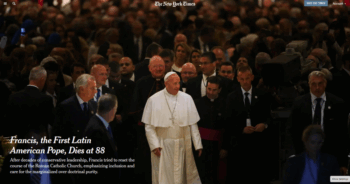
The New York Times‘ obituary (4/21/25) for Francis was almost 7,500 words long—but none of them were “Gaza.”
The New York Times’ obituary (4/21/25), by Jason Horowitz and Jim Yardley, did note that “he repeatedly denounced violence and, after an initial reluctance to take sides in the war in Ukraine, spoke out in support of Ukraine.”
It also reported that Francis’ travels included “focusing on exploited and war-torn parts of Africa, where he excoriated modern-day colonizers and sought peace in South Sudan.” It continued:
In 2019, Francis got on his hands and knees before the warring leaders of South Sudan’s government and its opposition, kissing their shoes and imploring them to make peace. In 2023, in declining health, he traveled to the capital city, Juba, to upbraid them on their lack of progress.
“No more bloodshed, no more conflicts, no more violence and mutual recriminations about who is responsible for it,” Francis said in the gardens of South Sudan’s presidential palace. “Leave the time of war behind and let a time of peace dawn!”
Yet regarding his outspoken concern for Gaza, the Times found room for not a word.
‘Sometimes took controversial stances’
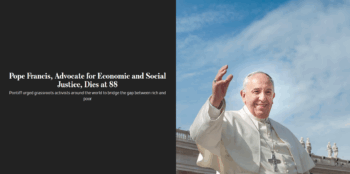
The Wall Street Journal (4/21/25) said Francis “sought to refocus the Catholic Church on promoting social and economic justice”—but his focus on Gaza could not be acknowledged.
Obituaries at other major US newspapers also failed to include Francis’ Palestine focus. A lengthy obituary in the Washington Post (4/21/25), for example, noted that the pope’s first official trip was to the “Italian island of Lampedusa, a burdened way station for refugees seeking sanctuary in Europe from conflicts in North Africa and the Middle East,” a nod to the fact that he offered a home to migrants in need. But it didn’t mention Gaza.
The Wall Street Journal’s obituary (4/21/25) didn’t say anything about the topic either, though it said that Francis
made a priority of improving ties with the Islamic world, washing the feet of Muslims on Holy Thursday, visiting nine Muslim-majority countries and insisting that Islam was, like Christianity, a religion of peace.
The same is true with AP‘s obituary (4/21/25), which likewise commented instead that he “charted new relations with the Muslim world by visiting the Arabian Peninsula and Iraq.” USA Today’s obituary (4/21/25) said Francis “sometimes took progressive or controversial stances on pressing issues, such as same-sex couples and climate change,” but it didn’t bring up Gaza.
By contrast, it was not hard to find references to Gaza in Francis’ obituaries in major non-US English-language outlets. The British Guardian (4/21/25) noted, “During his recent period in hospital, he kept up his telephone calls to the Holy Family church in Gaza, a nightly routine since 9 October 2023.” The Toronto-based Globe and Mail (4/21/25) included Palestine in a list of war-ravaged places Francis prayed for, and devoted most of a paragraph to his nightly Gaza calls. Reuters (4/21/25), headquartered in London and owned by Canada’s Thomson family, noted that Francis’ last Easter Sunday message “reiterated his call for an immediate ceasefire in Gaza—a conflict he had long railed against.”
Though the major US obituaries all ignored Gaza, the same outlets published separate articles on Francis and Gaza. USA Today (4/21/25) ran “Pope Francis Used Final Easter Address to Call for Gaza Ceasefire.” The Wall Street Journal (4/23/25) had “Pope Francis Kept Up Routine of Calling Gaza Until the End.” For the New York Times (4/22/25), it was “Even in Sickness, Pope Francis Reached Out to Gaza’s Christians.” AP (4/21/25) offered “Pope’s Frequent Calls to a Catholic Church Made Him a Revered Figure in War-Battered Gaza,” an article that appeared on the Washington Post‘s website (4/21/25).
These stand-alone pieces are welcome, and spotlight the importance of the Gaza crisis to Francis. But the official obituaries in these major outlets are meant to stand as a permanent record of Francis’ life and career. By relegating Francis’ compassion for Palestine to sidebars, as though it were only of transient interest, US outlets eliminated a central aspect of his papacy from that record.




The corporate media’s accounts of Bergoglio’s life and prosperous career in the Catholic church also omit his utter failure to even attempt substantial change in it. That church is still wealthy beyond all dreams of avarice: it is the world’s largest landlord and its wealth is in the hundreds of billions of dollars. Bergoglio’s career in Argentina under the military junta led to many well-substantiated accusations of collaboration with the dictatorship to rid the country of its ‘leftist elements’ (as did that church in Europe during WWII and afterwards when it enabled Nazis to flee using its infamous rat run).
Bergoglio’s words about peace, poverty and justice were no more than performative gestures. In reality, he happily met, embraced and spoke warm words to far-right, brutally exploitative techbros including Tesla’s Elon Musk, Amazon’s Jeff Bezos, Apple’s Tim Cook, and Facebook’s Mark Zuckerberg. From WSWS:
“Bergoglio was implicated in the 1976 kidnapping of Jesuit priests Orlando Yorio and Francisco Jalics, whom he allegedly failed to protect, and was accused of withholding support for their social work in Buenos Aires slums—a factor that led to their detention.
The military junta also systematically kidnapped babies born to women in torture centers, placing them with regime-aligned families. Survivors, including Estela de la Cuadra, testified that Bergoglio provided a handwritten note to her father in 1978 to inquire about her missing pregnant sister, only to learn the baby had been taken by the regime. This contradicted Bergoglio’s 2010 court claim that he was unaware of baby thefts until after the dictatorship. Bergoglio testified in 2010 to address these allegations, though survivors criticized his evasive responses and refusal to appear in open court initially.”
The white knighting abusers need you to take sides on how bad they want to rescue each others victims. Ari eats up the pagentry of it all.
Business media aren’t reporting on magic feet baths. This is because of, uh, something something capitalist democracy…