

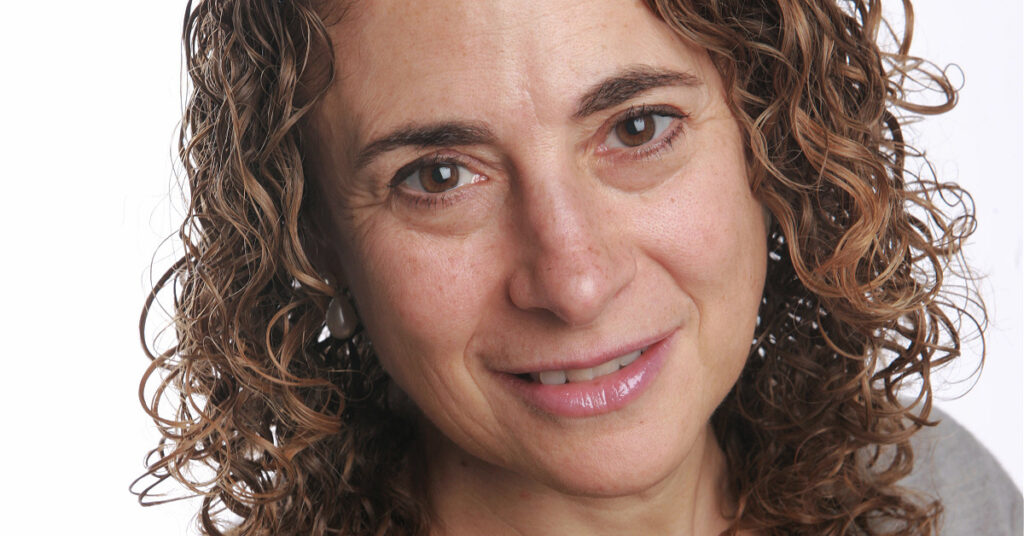
Janine Jackson interviewed Kaiser Health News‘ Elisabeth Rosenthal about the troubled vaccine rollout for the January 15, 2021, episode of CounterSpin. This is a lightly edited transcript.
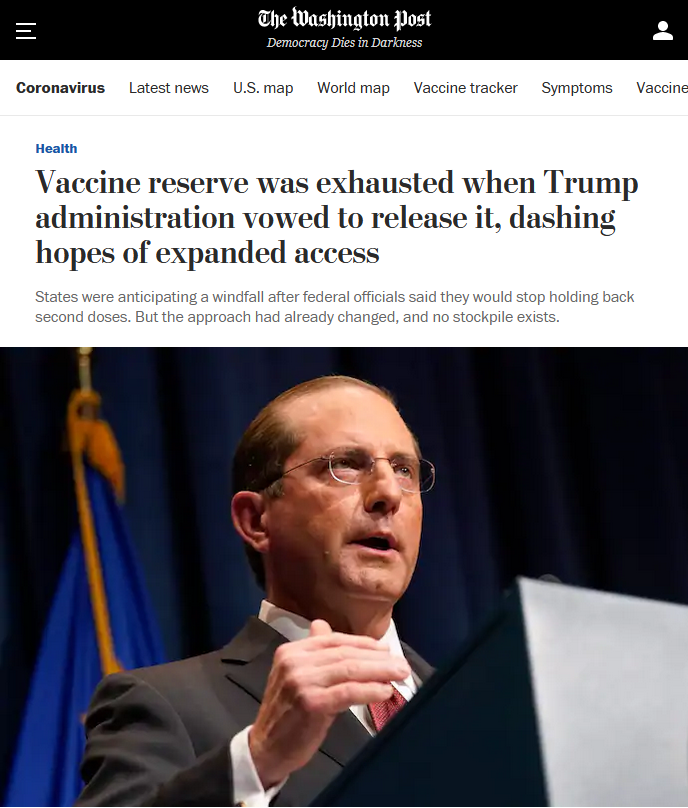
A day after Health and Human Services Secretary Alex Azar said the administration would be releasing all of the federal government’s Covid vaccine reserves, officials admitted that these reserves were nonexistent (Washington Post, 1/15/21).
Janine Jackson: Having for weeks held back doses of the Covid-19 vaccine, the federal government announced this week that not only is it releasing all of it now, but states will be penalized for not using it quickly enough. Health and Human Services Secretary Alex Azar claimed that this was always the plan, that states have “ample funding” to roll out the vaccines to the public, and that there was “never a reason” for prioritizing any groups like healthcare workers, or the frontline workers, overwhelmingly low-waged people of color, who have been disproportionately sickened and killed.
It’s just the latest opportunity for reporters to use words like “stunned” and “perplexed” in describing the response of state and local officials to the vaccine rollout, which would have been challenging at the best of times—and these sure aren’t those.
Joining us now to talk about what we’re seeing is Elisabeth Rosenthal, longtime journalist, now editor-in-chief at Kaiser Health News, and author of the book, An American Sickness: How Healthcare Became Big Business and How You Can Take It Back. She joins us now by phone from Washington, DC. Welcome to CounterSpin, Elisabeth Rosenthal.
Elisabeth Rosenthal: Thanks for having me here.
JJ: You see phrases in stories like, “The administration of vaccines has met with delays and roadblocks.” That passive voice is safe. But the opposite of that isn’t necessarily finger-pointing, another word we’re seeing a lot. It’s just trying to understand where the breakdowns or flaws in the system are, so they can be addressed. I think it’s understood that this process was going to present challenges, as we say, but what would you identify as the primary factors that have made it more confusing, more chaotic, than it needed to be?
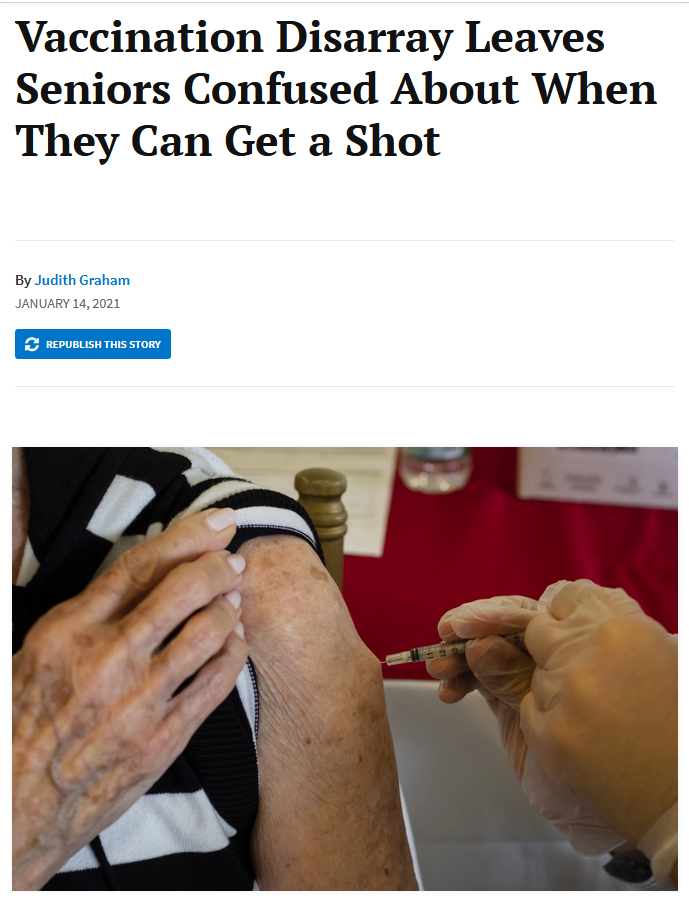
ER: Sure. I always say this is not rocket science; it’s complicated logistics, but not even that complicated. The basic problem is a lack of central strategy. You can argue that a lot of different kinds of algorithms should dictate who gets the vaccine. And instead of deciding nationally, with the best experts, how we want to do it, basically the feds have sent it to the states, the states decide how they want to allocate it to the counties, the counties decide how they want to allocate it to hospitals, and likewise to nursing homes and CVS. And it’s just predictable chaos without a central plan which people can trust.
And the newest wrinkle in this today, which I have smoke coming out of my ears for, is all these governors and mayors have announced that, OK, starting this week, January 11, folks over 75, or over 65, will be able to sign up for the vaccine. Well, good luck with that. I compare it to trying to get a delivery from Whole Foods during the beginning of the pandemic; you have to be tech savvy, sitting there when the slots are released, refreshing your web browser. That is a crazy way to do a vaccine program.
And I think one thing that would have made this whole thing better was a central strategy, where everyone knew where they stood. And if someone says to me, “OK, you’re going to get your vaccine in April,” I can be OK with that, because I can at least know exactly when and where it’s coming, rather than this current turmoil, where we have—literally, these are the stories we are hearing at Kaiser Health News today, where I’m currently editor-in-chief: A doctor’s office will get a call from a hospital saying, “Hey, we have six extra doses, send your staff over here,” or there’ll be an announcement at a Giant supermarket saying: “Hey, we’ve got four extra doses. Come one, come all.”
You hear of a one nursing home getting everyone vaccinated, and another one 10 miles away, which is presumably not as well-connected, or in a different county that’s doing things differently, having no idea when they’re getting that vaccine. So that introduces chaos, introduces anger. And we just have to be slow and plodding and systematic about the way we do this, in a rapid way. So how’s that for a challenge?
JJ: And particularly at a time when public trust is obviously going to be paramount, you have to trust that there is a plan. But first I wanted to say, it can be hard for some people to see the unfairness in that “first come, first served”; it sounds like it’s equitable. Of course, it’s not at all equitable, both in terms of, as you say, having to be tech savvy enough to get in line on the website, or sign up and then know when you’re supposed to show up to someplace. But also, of course, a lot of folks—we’re talking about undocumented workers, we’re talking about homeless people, a lot of the folks who should be getting vaccinated—they’re just left out entirely. There’s no incentive, in that sense, to reach them, particularly if the federal government is going to be counting how quickly you can say you’re vaccinating folks.
ER: Yes. And I think we know there’s more vaccine skepticism, generally, in those populations, which makes it even more troubling. Boy, you have to be good at playing the game of accessing healthcare in the US. As you said, you need to be tech savvy. So what does that mean? It means maybe 80-year-olds are not as good as the 65-year-olds, or an 85-year-old who has a 30-year-old grandson who can snag an appointment is in much better shape. So you’re kind of favoring the well-educated, well-connected, well–hooked up to the internet. And then, PS: We’ve seen in some states, like New York, where you officially get an appointment, but it’s not really timed, so there are these long lines. So many people, particularly low-income people, have to work, so they need an appointment time if you want this to go smoothly, or good weekend and evening times. There are ways to do this well, and other countries are doing so, but we are not.
JJ: Well, but you say “central plan,” what are you, some kind of Communist?
ER: [laughing] No, not at all.
JJ: Your book is about the businessification of healthcare. I wonder what role you see that playing in all of this, in terms of the development of the vaccines and their distribution?
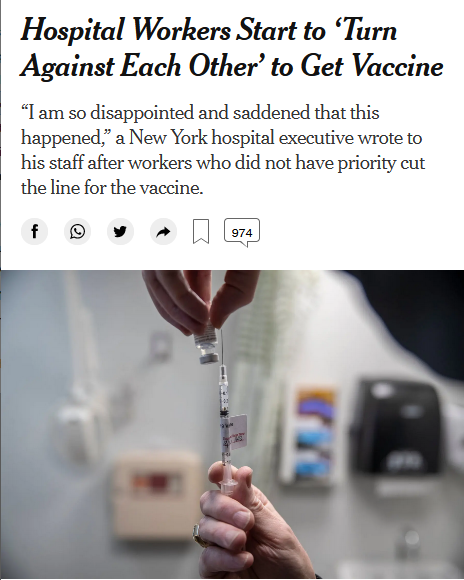
ER: Well, no, I’m certainly not a Communist or a socialist, but being a capitalist doesn’t mean you don’t plan; it should mean the opposite, right? But instead of planning, having a government plan, we’ve let every company—and I will call hospitals “companies” for the purpose of this interview—and doctor’s office go it on their own, and nursing homes.
So, for example, what did many hospitals in New York do? There was a great New York Times article about this: They gave it to their entire staff, including people who’d been working from home for the last eight months.
Now, that’s what a company would do: You would protect your own before you protected your vulnerable patients. A hospital that really cared about its community would say, “Yes, we want these frontline workers who have Covid exposure to be vaccinated. But then, next, we’re going to look to our vulnerable cancer patients, who may be in here every week for chemotherapy, or our vulnerable people with bad lung disease.” And we did not see that happening at many, many hospitals.
JJ: I think part of the problem was the setup: A vaccine was presented as “the light at the end of the tunnel” for a scientifically under-informed and to some degree politicized public; it was going to be something that would put an end to arguments about what we needed to do societally, since we could do this thing individually–or not, you know.
ER: Yes.
JJ: In a way, “public health,” as a thing—kind of like democracy—it seems is being tested.
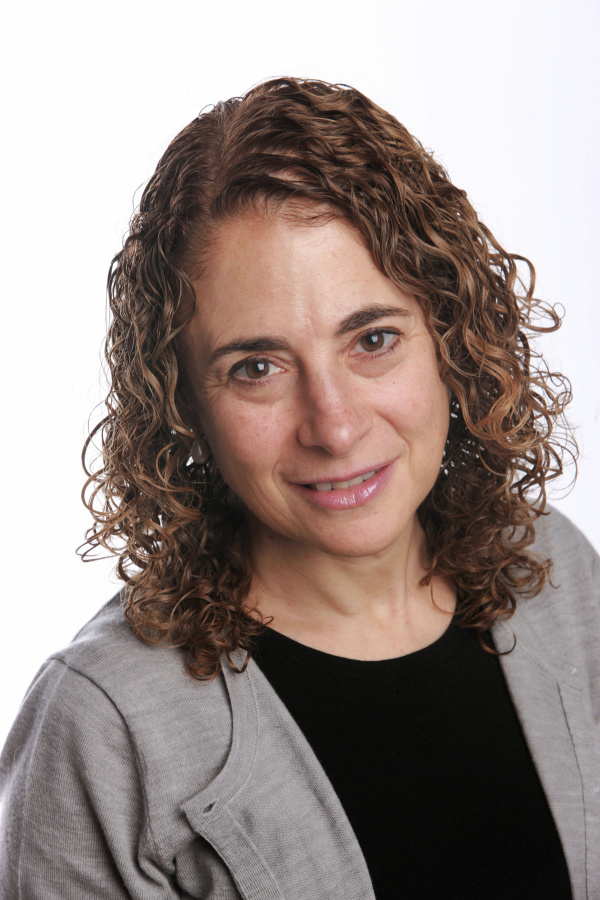
Elisabeth Rosenthal: “We have chosen the most profitable form of ending the pandemic, which is a vaccine…. This is the only solution, given how out of control we’ve let this become, as a result of not being good at public health.”
ER: Yes, we have chosen the most profitable form of ending the pandemic, which is a vaccine. And, you know, the fact that we’ve gotten vaccines at record pace, I’m not going to say that’s a bad thing; it’s a good thing, and that was one way to solve the problem. But why can these other countries be more methodical and systematic? It’s partly because they have central planning, but it’s partly because Covid never got out of control there. So we are desperate for a solution; this is the only solution, given how out of control we’ve let this become, as a result of not being good at public health. And so there’s a kind of feeding frenzy for how to distribute it and who should get it, and survival of the fittest, in a way—and that’s not very good.
JJ: Not the way to do it. Well, I wonder, are there things that you think reporters could maybe do more of, could maybe do less of, in covering Covid and the vaccine?
ER: I’ve written that I thought the public service announcements should be scarier, because Covid is scary, if you get a bad case. I think we believe in this, like, “Let’s be good neighbors, think about your grandma.” That didn’t work. We saw it all over the country, we’ve had Covid exploding, because we didn’t do the right public health things.
So I think, lessons learned is, we really need to reinforce our public health system, make the CDC and the FDA scientific, not political, organizations. And then at this point, yes, we will be depending on a vaccine, mostly, to get us out of it, but that doesn’t mean you should stop the social distance and masking.
And a lot of people are, you know, the classic American thing, “Well, which vaccine is the best? I only want the best.” I think the answer so far is any one that’s out there looks pretty good—and, you know, different countries are using different ones—but when it’s your turn, you should take what’s available. That would be my advice as a journalist and as a former physician, and it’s what I intend to do.
JJ: We’ve been speaking with Elisabeth Rosenthal, editor-in-chief at Kaiser Health News. Her book is called An American Sickness: How Healthcare Became Big Business and How You Can Take It Back, out from Penguin Press. Elisabeth Rosenthal, thank you very much for joining us this week on CounterSpin.
ER: Thanks for having me.


Somebody’s god forbid “socialism” should infect our thinking on public health.
Ask the Cubans how that’s worked for them.
Um … wait a tick …
Sure, but a central strategy would have stood in the way of a vaccine black market, which no one seems to be raising.
Interesting point. I wonder how viable such a black market would be, given the considerable logistic challenges in storing vaccines which require extremely low temperatures in order to maintain their viability.
The Oligarchy is deliberately attempting to cull the “herd” of “useless eaters,” while the Uniparty’s Congresstitutes perform a politicized Impeachment Kabuki (round two). While our ruling class has done nothing but bicker endlessly, China built a series of 1000+ bed hospitals, each in under a fortnight. Compare to the US response. Our government has been criminally negligent, and this entire crisis reveals the fundamental reality that our government would is more concerned with global hegemony and forever wars than it is with the health and well-being of our populace.
Solution #1
Lock down for 3 weeks. No? Why?
Are you crazy? That means we can’t make money!
Solution #2
Bottleneck? Open up the vaccine patent to all companies.
But…but…that means we can’t make money!
Money trumps your life…make no mistake. And our participation in this decadence makes us all guilty…
According to Wikipedia,
“The surgeon general of the United States is the operational head of the U.S. Public Health Service Commissioned Corps (PHSCC) and thus the leading spokesperson on matters of public health in the federal government of the United States.”
The PHSCC apparently has 6,100 uniformed, highly trained professional staff in it, but for the life of me I cannot find out what either they or the Surgeon General himself has been doing during the pandemic, or will be going forward. The media never even bothers to mention them!
I would greatly appreciate it if FAIR could get to the bottom of this.
2400 years ago Hippocrates noted that people who spent more time outdoors in the sun were healthier than those who spent much time indoors. He applied this observation by prescribing “sunbaths” as a cure. In the late 1800s people with tuberculosis from the northeast were sent to the south west for a sunshine cure and a healthy diet. Many of them were completely cured. We now know that vitamin D is produced within skin cells is catalyzed by the action of ultra-violet B sunlight on a precursor. Soon after it was discovered in 1913, it was postulated that it had immune function.
At the start of the lockdown, Dr. Tom Frieden urge people to get their vitamin D level up to 50 ng/ml and get on with life. He made that statement in the context that late winter when vit D levels are lowest is when respirator viruses outbreaks are most common. He was not the first to say this. In the past half century there have been over 20,000 scientific papers published on the role of vitamin D, and it goes far beyond bones and immunity.
That would be the tencent a day solution to this virus and many others. The government could have a program to test people’s vit D for free and prescribe the appropriate dose to get their level to the 50 ng/ml mark and furnish it for free which would be much cheaper and safer than a vaccine. Along with that suggestions bout a healthy lifestyle so that all the cofactors needed by the body for vit D to do its disease protection job and many others. But no as the interviewee said the most profitable for Big Pharma (and least effective for the public) solution has been chosen. For Public Health to promote vit D and a healthy lifestyle would be true public health. It is so disappointing that that message is not being put in the public discussion. In fact, I have had mention of vit D result in my post on other websites deleted and was even banned by one website for repeatedly trying to have it included in the discussion. My Democratic congressman is one of those who would not allow the role of vit D and a healthy lifestyle to be brought up in an online town hall.