The linguistic gymnastics needed to report on police violence without calling up images of police violence is a thing of semantic wonder. The case of Ohio Deputy Richard Scarborough shooting and killing 16-year-old Joseph Haynes inside a courthouse checked off nearly all the pro-police propaganda tropes:
1. ‘Officer-Involved Shooting’
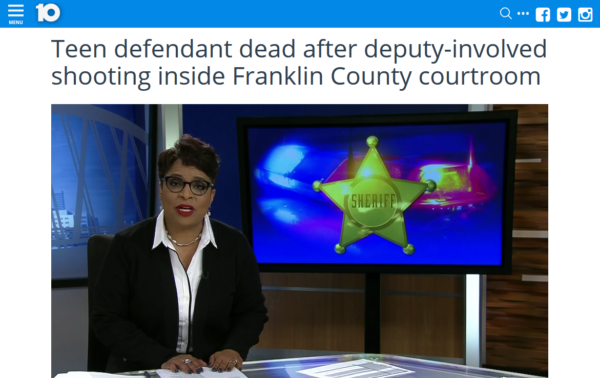
Copspeak involves passive language designed to deflect and obscure responsibility.
The most overused of copspeak cliches, “officer-involved shooting”—or in this case, “deputy-involved”—appeared in headlines reporting Haynes’ killing, as in “Teen Defendant Dead After Deputy-Involved Shooting Inside Franklin County Courtroom” (WBNS-10TV, 1/17/18).
The purpose of “officer-involved” is to obscure responsibility. A bizarre construction, it does not appear in other contexts. (Can one imagine the headline, “Man Dead After Gang Member–Involved Shooting”?) It’s a thought-terminating cliche, a ready-made assemblage of words that does the thinking for the reader in service of a political end—in this case, protecting the police from bad PR.
2. Smearing the Victim
The 16-year-old Haynes was referred to as a “defendant” (the complete summation of his position in life), and his juvenile record was mysteriously leaked to the press in a matter of hours after his death. As FAIR has noted before (3/4/15, 3/22/17), any dirt on victims of police violence seems to be made readily available to the media (most often by the organization responsible for their death, the police), while, as in this case, the identity of the officer “involved” is initially kept private—an arrangement that protects state institutions while pathologizing their victims as malevolents who had it coming. (Only the tail end of coverage later revealed Scarborough’s name, at which point he was praised for his “good work record”—AP, 1/23/18.)
3. A Vague ‘Altercation’
Frequently when a police officer shoots and kills someone, a department spokesperson claims there was an “altercation” that preceded the killing. “Altercation” is a term broad enough to cover anything from two parties yelling at each other to deadly combat, which is exactly the point. In this case, the police claimed Haynes’ killing followed an “altercation” of unspecified severity and symmetry: “A 16-year-old boy was fatally shot by a deputy in an Ohio courtroom after an altercation involving the victim’s family, according to authorities,” the New York Post (1/17/18) reported.
It was unclear even in later coverage what the “altercation” in the Haynes case entailed, but certainly when the news was fresh, when the bulk of reporting appeared, this single word did a lot of work to justify the killing of an unarmed 16-year-old to the public—with little or no skepticism by media.
4. The Organization That Did the Killing as Sole Source
Virtually all the initial reports of Haynes’ killing quoted only the police and had no word from his family. One CNN report (1/17/18) was nonstop quotes by the police, who drove the narrative entirely. It would have been easier if CNN had just had the police department write up the story for them.
5. Obscuring—or Omitting—Who Killed Whom
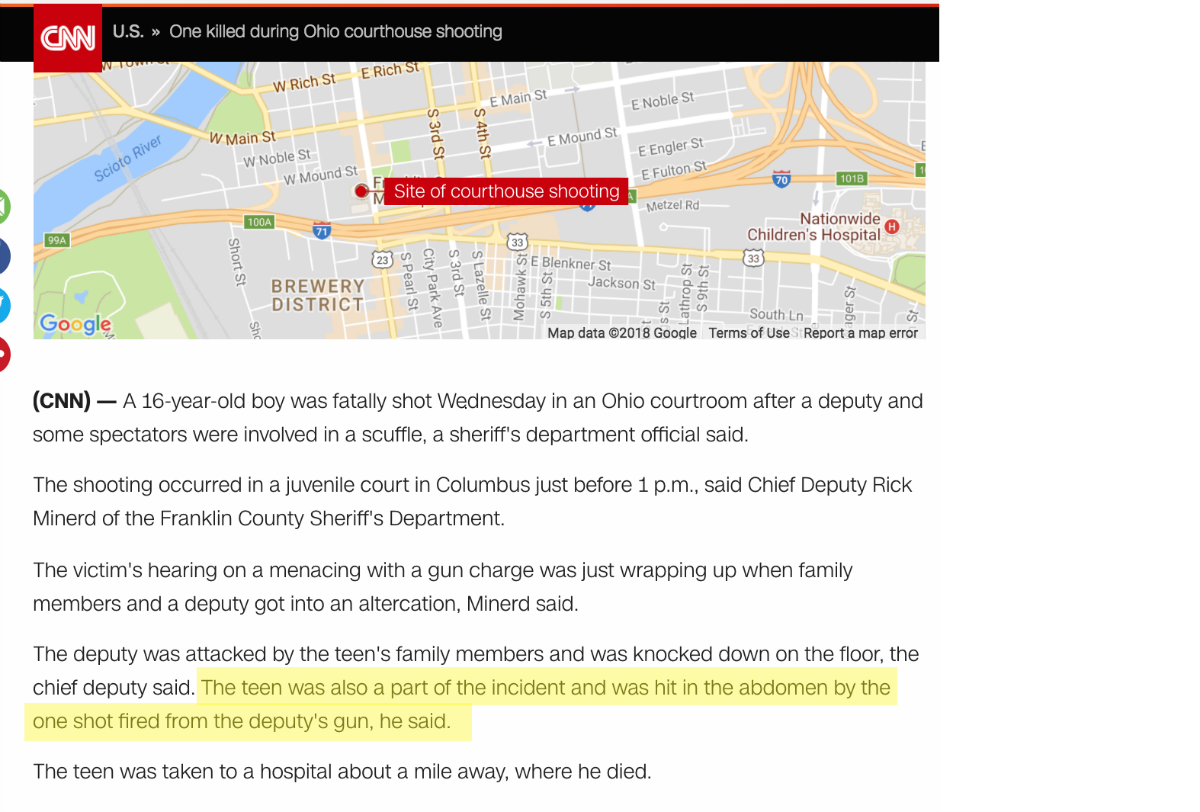
CNN (1/17/18): “The teen was also part of the incident and was hit in the abdomen by the one shot fired from the officer’s gun.”
The same CNN piece goes four paragraphs before saying who actually died. (Nor does the headline, “One Killed During Ohio Courthouse Shooting,” provide any specifics.) Even then, it’s unclear who did the killing. The teen, “part of an incident,” was “hit in the abdomen by one shot from the deputy’s gun,” apparently an autonomous entity.
A report by ABC13 (1/18/18) took it one step further, writing an entire article that never says, in any way, that a police officer shot and killed someone. A news report logs 120 words about an incident and none of them, strung together, actually explain the reason for the report’s existence.
6. Rogue Weapons
CNN reported: “The teen was also a part of the incident and was hit in the abdomen by the one shot fired from the deputy’s gun, he said.”
Notice the teenager isn’t shot by the deputy, but by his gun. The passive, sterile language reads like a police report, because that’s exactly what they’re rewriting. Crime reporters for the most part mimic the dehumanizing language of the police—up to the use of “hit in the abdomen” over “shot in the stomach.” Facing a story about a child whose life has just been instantly erased, beat reporters do their best impression of a jaded forensic medical examiner on Law and Order.