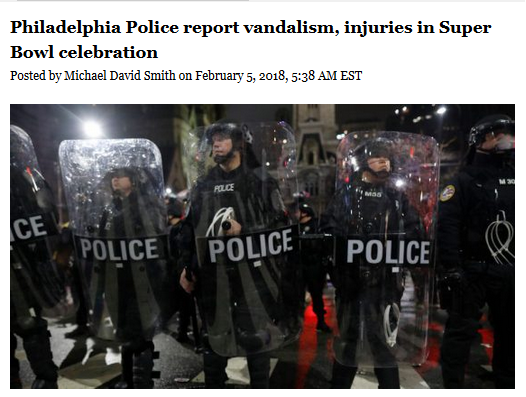
After the Philadelphia Eagles mounted an exciting and improbable underdog victory over the New England Patriots on Super Bowl Sunday, Philly fans poured into the city’s streets to celebrate. Fires were set, some stores were broken into, and drunk people fought and caroused across the city. Crowds of (overwhelmingly) white male fans climbed poles, leapt off of building awnings, uprooted lamp posts and generally caused mayhem and havoc across the City of Brotherly Love. The celebration ended Monday morning with only four arrests, and with what NBC Sports (2/5/18) described vaguely as “vandalism and injuries.”
Despite the fact that the property destruction in the aftermath of the unrest was similar in scope to the damage caused by protests against police killings of young black men over the past three years, only the latter were described as “violence.”
The New York Times February 5 headline, for example, was “Philadelphia Erupts in Celebration, and Unruliness, After Victory.” But in 2016, the Gray Lady (8/14/16) described “a night of violence” in Milwaukee after a police shooting of an unarmed black man sparked angry protests, in a piece originally headlined “Violent Crowd Confronts Police in Milwaukee After Fatal Shooting.”
FAIR analyst Adam Johnson used Reuters reports to point out the discrepancy: “Philadelphia Fans Set Fire, Damage Property After Super Bowl Win,” read the wire service’s headline (2/5/18) on post-Super Bowl chaos; in September (9/15/17), similar activities after the acquittal of white St. Louis police officer Jason Stockley in the killing of African-American Anthony Lamar Smith were described as protests that “turned violent for a third night running.”
The St. Louis protests were also described as “violent” by AP (9/17/17), whose reporter described a grim scene in which protesters “refused to disperse” and broke windows. The same kind of behavior in Philadelphia was couched in far different language when AP (2/5/18) reported on the Eagles win, where city officials “had some cleaning up to do” after fans “turned unruly overnight.” “Smashing department store windows, looting a gas station convenience store” and hitting cops with bottles were described as the actions of “rowdies.”
Philadelphia’s NBC10 (9/16/17) posted the AP story on St. Louis, amplifying its focus on a “spasm of violence.” By contrast, the local channel had one reference to Philly’s post–Super Bowl chaos on the site’s homepage on Monday night (2/5/18): a video entitled “Philadelphia Happy After Eagles Super Bowl Victory.”