

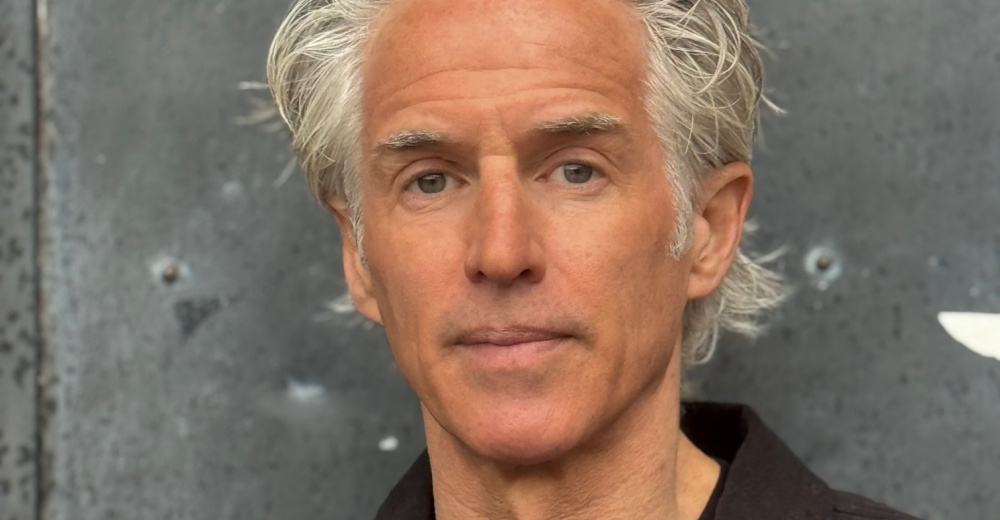
Janine Jackson interviewed author Jules Boykoff about the World Cup and sportswashing for the May 15, 2026, episode of CounterSpin. This is a lightly edited transcript.
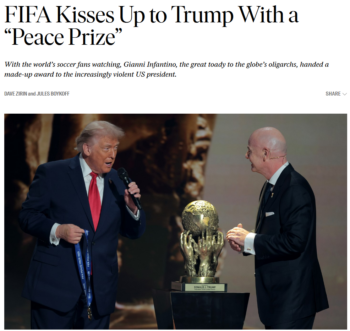
Janine Jackson: With FIFA, the governing body of association football, concocting a FIFA Peace Prize—described as “recognizing individuals for exceptional contributions to peace and unity”—in order to award it to Donald Trump; along with revelations of corruption, collusion, bribery, involving official bodies and executives; and now ticket prices for this year’s World Cup being called not just excessive, but “extortionate,” you might say more folks are following football (or soccer) these days, but not so much as fans. Though, certainly, there are still plenty of fans, a great number of whom will be arriving here in my area in a few weeks time.
Sports has always been a big part of news media, but typically segregated into its own section on stats and personalities, ignoring the economic, social and environmental impacts sports have always had. Think about cities enticed into building new arenas with promises of jobs and commerce that never arrive.
Jules Boykoff has been following the relationships of sport and society for years now. He’s a former professional soccer player himself, and a critic and writer now teaching political science at Pacific University. He is author of a number of books, including What Are the Olympics For? from Bristol University Press. He’s here to discuss his latest, Red Card: The 2026 World Cup, Sportswashing and the FIFA Greed Machine. It’s out now from OR Books. He joins us now by phone from Sarajevo. Welcome back to CounterSpin, Jules Boykoff.
Jules Boykoff: Thanks, Janine. It’s great to be with you.
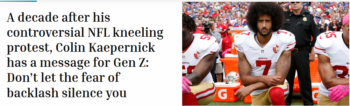
JJ: Well, if we could start with a little bit of deep history. You will still see reporting—think Colin Kaepernick—that presents politics as a distraction from sports, or an interference in it. But not only is that not true now, the idea of sports being bound up with power and nationalism goes way, way back, doesn’t it?
JB: Absolutely. Sports are politics by other means, and soccer certainly is that. It’s the world’s biggest sport. And there’s loads of money that is flowing through the football, or soccer, system. Anybody who tells you that sports aren’t political, or that soccer isn’t political, may well be making money off of the sport. I mean, that’s kind of how it works.
If you take the shorthand from a fellow political scientist named Harold Lasswell, he said that politics are who gets what, where and when. And that’s definitely one way of thinking through the World Cup here that’s coming up. Who’s getting what, who’s getting where, and when are they getting it?
And it seems to me that FIFA, the world’s governing body for soccer, is making off like a bandit in this tournament. They’re talking about making $11 billion from this tournament alone. That’s more than any other sporting event in world history, and they’re teaming up with Donald Trump to do it.
Gianni Infantino, the president of FIFA, has embraced politics at every step of the way, in this sort of BFF romance that he has with President Trump, as you mentioned, giving him the FIFA Peace Prize. He showed up at Melania’s opening screening in Washington, DC, of her film. And he’s been there every step of the way to really give President Trump pretty much whatever he wants, and that’s political.
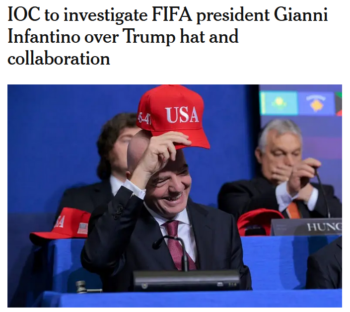
He even showed up recently at the so-called Board of Peace meeting, wearing a MAGA-style cap, a red cap that had 45 and 47, and giving the thumbs up. If that’s not political, I don’t really know what is.
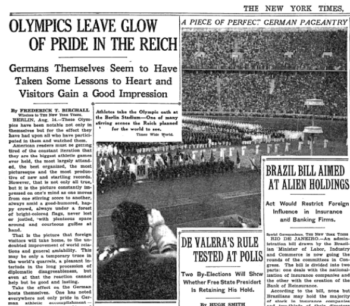
JJ: Yeah, it’s wild. But I want to put a pin in the fact that if you go back to the New York Times in 1936, you will see, with reference to the Berlin Olympics, the headline “Olympics Leave Glow of Pride in the Reich.” So there’s a deep-seated history of the use of sport for political and propagandistic ends, which you talk about. But then you add in commercialization, then you add in truckloads of money, and it becomes this particular new phenomenon that is the core of this book’s conversation. So I would ask you to explain, what is “sportswashing”?
JB: Absolutely. So “sportswashing” is when political leaders use sports to deflect attention from chronic social problems and human rights woes at home, to try to make themselves look important or legitimate on the world stage, to try to burnish their own individual reputation or the country’s reputation, while also setting up opportunities for political and economic gain.
And elements of it go way back in history. If you think about Berlin Olympics, 1936 and Hitler, now they’re called “Hitler’s Olympics,” he put aside his Nazi paraphernalia just for the Olympic Games itself, and then brought it right back out after the Olympics. And it kind of worked, in the sense that numerous journalists who showed up in Berlin, who knew full well that there was a whole campaign against Jewish people, against Roma folks and others, and they looked around and didn’t see that happening, and they gave glowing coverage of the events.
And so media have long played a really important role in elements of deflecting attention from your problems.
And it’s not just that it sets up opportunity for money-making, it also sets the stage for war. If you shimmy forward in history, and you look at a really good example of sportswashing from the 21st century, and you look at Vladimir Putin, who hosted both the 2014 Winter Olympics in Sochi and then the 2018 Men’s World Cup, you can see that he used those events to gain enormous popularity domestically inside of Russia, and he didn’t waste any time using that power. In fact, between the Olympics that he hosted in 2014 and the Paralympics that he hosted, that’s when he invaded Crimea, when his popularity was sky high.
And so politicians throughout history have used sports to increase their popularity at home, and definitely Donald Trump has plans to do that.
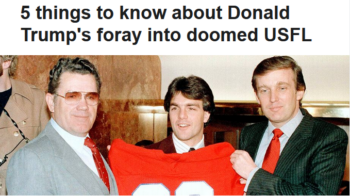
So now if we look at the 2026 Men’s World Cup, and you think about how important sports have always been to Trump, I mean, he owned a football team, back decades ago, and he’s talked about how this World Cup, as well as the upcoming Olympics in Los Angeles, are really important to his presidency and his legacy. He has ever more incentive now to cling to sports as a sort of political life raft while his ratings go down with the general public, while this ongoing Iran War, alongside Israel, is giving him grief, and people don’t like it. And so he has ever more incentive to cling to sports, and I think that’s what we’re going to see here over the next month.
JJ: And the term “sportswashing,” I think it’s important to understand that it’s not just somebody like Mussolini, or even somebody like Trump, trying to use sports to deflect. There are other players involved. It doesn’t work if there’s not kind of a system there, right?
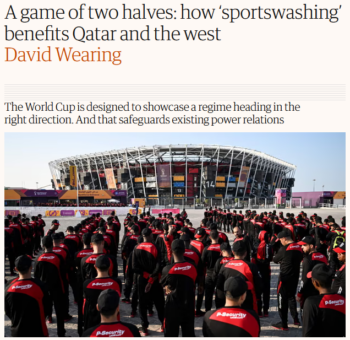
JB: Absolutely. And one thing I think is really important to point out is that journalists, as well as academics, have often used the term “sportswashing” just to sort of waggle a finger at those “other people” from Russia, from Qatar, from Saudi Arabia. But the truth of the matter is that it can happen in the United States, it can happen in London, it can happen pretty much anywhere. And I think that’s one of those sort of ethnocentric labels that’s been applied, and that really we need to get away from.
So I’d be really interested to see during this World Cup, and then in the lead up to the Los Angeles Olympics in 2028, whether journalists wake up to that reality, and start using “sportswashing” to describe what we’re seeing with Trump.
JJ: Let’s get a little bit into what the different elements of it are, because I think folks will hear, “Oh, there’s big money trading hands, and there’s a thing that little people are outside of.” But the point is that it’s much bigger, that it includes political and environmental and economic impacts that go well beyond just one event at one time. There’s a lot of stuff that happens here that folks should be concerned about.
JB: Absolutely. These are mega events. They’re called mega events for a reason, and when one of these sports mega events like the World Cup rolls into your town, they roll over the toes of lots of existing activist efforts. The World Cup brings with it gentrification, it brings with it displacement, it brings with it greenwashing.
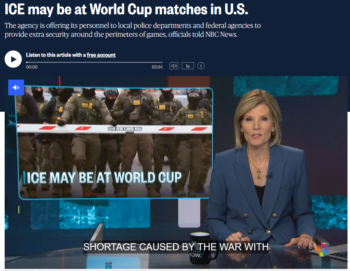
I’m really glad that you brought up greenwashing, because that’s one of the reasons why a lot of fans around the world, soccer fans, have essentially been watching this World Cup through their fingers. Obviously this event, the upcoming World Cup, has been stained by controversy, like the eye-watering ticket prices that we’ve been reading about in the newspaper, the question of Iran’s participation while the president of the United States, one of the host countries, threatens war crimes against it; or the role that US Immigration and Customs Enforcement may or may not play in policing the event.
But lost in that political pyrotechnics is a fiasco that carries as much long-term peril as any, and that’s the tournament’s staggering contribution to runaway climate change. FIFA is one of the biggest purveyors of greenwashing, talking a big sustainability game, but then actually not following through.
The 2026 World Cup is going to be the most polluting World Cup ever. They made it bigger, from 32 teams to 48 teams, and the geographical expanse of the United States, Canada and Mexico means that people are going to be flying everywhere. And it’s got a huge amount of emissions when it comes to airfare that just dwarfs previous tournaments. And so greenwashing is another spectacle that we’re seeing in action here with this 2026 World Cup.
JJ: I would ask you also to talk about the labor impact, the worker mistreatment that can often accompany these mega events.
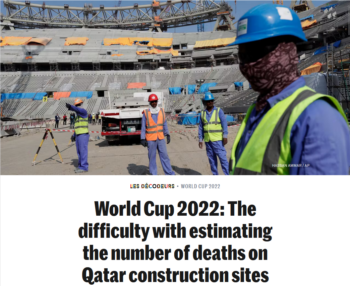
JB: Worker mistreatment is a huge element of these events. I think a lot of your listeners will have heard of the 2022 Qatar World Cup, where thousands of migrant workers were brought to Qatar to build the stadiums and other venues, hotels, for that World Cup. Thousands of them died, thousands of them died. I mean, that should be staggering. There were also numerous deaths getting ready for the Russia World Cup.
And in the United States, we’re not seeing that, because there’s not as much stadium construction. In fact, there’s no stadium construction for this event, but what we are seeing is workers rising up and asking big questions about whether ICE will be present at the stadiums.
For example, you look at UNITE HERE Local 11 in Los Angeles, and they’ve been very outspoken on behalf of their members, but they do not want ICE to be there. FIFA gathers all sorts of information and data about workers in all of these venues. FIFA says that it’s about security, but in reality, they’re not promising that they won’t hand over that data to groups like Immigration and Customs Enforcement, or the US federal government and President Donald Trump. And so there’s actually the threat of a strike right now at one of the stadiums in Los Angeles, where around 2,000 of these workers are a member of that local. And so I’m glad to say that this is also a place for fightback. This is a chance, when the whole world is watching, to make gains.
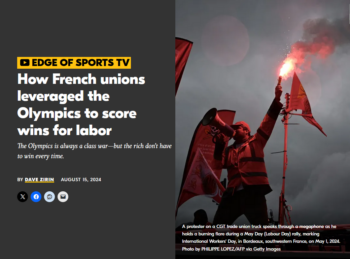
To give another example, 2024, and this is the Olympics and not the World Cup, but I was in Paris with the great sports writer Dave Zirin, and we interviewed a train driver there who explained to us how his union threatened to go on strike, and he got an incredible boost in his wages; he’s going to get to retire earlier. Essentially every self-respecting union in Paris threatened to go on strike during the game.
So the labor issue has two sides, at least in places where it’s legal to organize. It is an opportunity to make some gains ahead of the event. So the thing is, Janine, it takes organization, and I’m pleased to see that we’re seeing groups organizing, unions organizing, especially in Los Angeles, to fight against the injustices that are all too often bricked into these sports mega events.
JJ: You talk about how, in basic terms, the World Cup and these mega events induce a state of exception, and that’s what we’re looking out for. It’s like all other rules go by the wayside, and suddenly we’re supposed to not care about them, and that’s the important thing to focus on.
So I would ask you, specifically looking at the World Cup 2026, which I’ve already been told that I should try to work from home because my office is near Penn Station, and they’re going to be rerouting trains and lots of things are going to be disrupted, but what should we be looking for in terms of the coverage, in terms of questions asked or unasked, as we go into this latest mega event?

JB: There’s no question about it that sports mega events like the World Cup do bring this state of exception, where the normal rules of politics don’t apply. And while it creates enormous amounts of inconvenience and enormous amounts of profits for groups like FIFA, and their corporate sponsors there for the World Cup, it does present opportunities for people to push back against it.
And that’s what we’re seeing in cities around the United States right now. Los Angeles is a good example, not just the union, but a group called NOlympics LA has been organizing against the World Cup. They’ve been active since 2017, and they continue to be active today.
And so I guess the thing about the World Cup, it is the most popular sport in the world, soccer, and I feel like we need to just slow down and say, we shouldn’t let FIFA be able to steal this from us; this is the people’s game, and they are turning it into the plutocrats’ game.
And, yes, they’re walking off with profits, but they shouldn’t get to steal all the joy from us, and they’re doing their darnedest to make this a joyless World Cup. But that doesn’t mean we can’t come together with our friends, and celebrate these incredible worker athletes who are going to be toiling under incredibly difficult conditions. Let’s not forget they’re hosting this event in the hottest months of the summer, and where they’re going to do these water breaks, which for FIFA just means another opportunity to show commercials.
And so there are moments where we can come together as people, and push back against these real injustices in the sport. And I guess that’s what I’m going to try to do this summer, is come together with friends, get organized and try to push back.
JJ: While we’re talking about this corruption of FIFA, and all of the many interferences in sports, I just wanted to ask you, OK, now we insert gambling! That’s got to not be a great mix to add. How do you think that sports betting, and the legalization of sports betting—that’s obviously another piece of this.
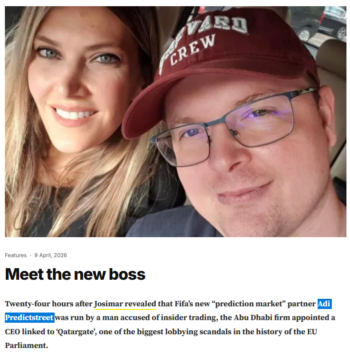
JB: Sports gambling and sports betting is an absolute scourge on sports, and it’s really ruining lives, and it’s also ruining the experience of watching sports. FIFA, it will not surprise anybody, has pulled up and teamed up with a new, extremely shady gambling outfit, very shady group of people, that’s not even registered in most places.
So FIFA is definitely getting in on the gambling industry as well, and again, this is another one of those pushback points. There’s a really important soccer magazine called Josimar, which has come out with numerous studies about how FIFA, but also other groups out in the football world, have embraced sports gambling, to the detriment of the sport and to the detriment of humanity. So I highly recommend this alternative soccer magazine, based in Norway, called Josimar, if you want to learn all about the scourge that’s all over sport, but especially soccer right now.
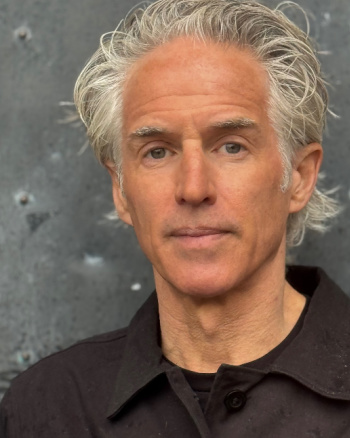
Jules Boykoff: “The FIFA World Cup provides us with a chance to actually come together for real, and defend our communities against an invading force that is FIFA.”
JJ: Absolutely. I’ll just say finally, existentially, sports has been a savior for many outside-of-power people around the world, as is what you’re saying. So I just want to end, underscoring: It’s not that the thing is awful, it’s that almost every beautiful thing we have, some people will try to exploit, and that doesn’t mean that we have to abandon what we love, but we might have to work to reclaim it.
JB: Yeah. We need not devote ourselves to the death of complexity. We can appreciate the athletic brilliance on the field of play this summer at the World Cup, but that definitely doesn’t mean we have to sit idly by while the government carries out raids against people who might be just wanting to attend a match. So I think that the FIFA World Cup provides us with a chance to actually come together for real, and defend our communities against an invading force that is FIFA.
JJ: We’re going to end on that note. We’ve been speaking with Jules Boykoff. The book is Red Card: The 2026 World Cup, Sportswashing and the FIFA Greed Machine. It’s out now from OR Books, and I want to thank you so much for joining us this week on CounterSpin, Jules Boykoff.
JB: Thanks, Janine.


Leave a Reply