

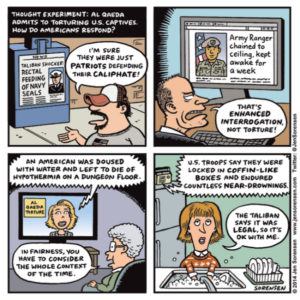
 There’s an interesting headline in the Washington Post (12/16/14):
New Poll Finds Majority of Americans Think Torture Was Justified After 9/11 Attacks
Now, that’s not really what the Washington Post/ABC poll (12/11-14/14) found. The actual question was, “All in all, do you think the CIA treatment of suspected terrorists was justified or unjustified?” To which 59 percent said it was justified.
In another question, the poll asked, “Do you personally think the CIA treatment of suspected terrorists amounted to torture, or not?” There 49 percent said it was torture.
(Note that “suspected terrorist” does a lot of work in these questions; keep in mind that one of the Senate Intelligence Committee report’s key findings was that many of those tortured had no connection to terrorism.)
So the numbers indicate that at least 10 percent of respondents said CIA treatment of “suspected terrorists” was torture and that it was justified—but probably not too many more than that, unless you expect that a lot of people told the pollster that the way the CIA didn’t torture those prisoners was unjustifiable.
So, really, the poll most likely found that a small minority of Americans thought torture was justified after 9/11. In other words, pretty much the opposite of what the Washington Post‘s headline said.
Of course, you could say that waterboarding, sleep deprivation, “rectal feeding” and so on are certainly torture, regardless of whether people recognize that it is. In that case, you could say that a majority of those polled thought torture was justified—even though a hefty majority of those would probably deny that it was torture. And FAIR has been arguing that media should take this approach to torture for more than a decade now (Action Alert, 5/14/04).
The trouble is, the Washington Post has a policy against using the word “torture” in that way. “After the use of the term ‘torture’ became contentious,” says Post national editor Cameron Barr (FAIR Blog, 12/9/14), “we decided that we wouldn’t use it in our voice to describe waterboarding and other harsh interrogation techniques authorized by the Bush administration.”
For the headline to be accurate, it can’t be the people who were polled calling it torture—because a majority didn’t call it that, let alone call it that and approve of it. It has to be the Post calling it torture—”in our voice,” as Barr said.
Why change their policy for this story? The obvious answer is that the use of the word “torture” here makes it seem less contentious: We tortured some folks, and most people are fine with that.
So the Post‘s policy is not to use torture in its own voice—except in contexts where it makes torture seem better. You’d almost think that they just like torturing people there.




From the post: “So the numbers indicate that at least 10 percent of respondents said CIA treatment of “suspected terrorists” was torture and that it was justified …”
The minimum number according to this poll who believe both that the CIA tortured and that it was justified is 8 percent of respondents, not 10 percent.
I found reading the Post was torture a years ago but was able to free myself. Is George Will still calling global warming a hoax?
WaPo tortured the hell out of those stats in order to get a favorable result!
In the case of the WaPo staff, “Rectal Feeding” would not be torture, it would the norm since they only have two working parts, their mouth and their rectum; both completely interchangeable.
Fabulous cartoons! Could you please make some more, one for each of the 12 (and not ten, as we now know) torture EITs ?
@ Pamela: The cartoon above is by Jen Sorensen. I don’t know the lady, but I do know she’s the best political cartoonist working today, and that the NYT, which should have grabbed her years ago, still remains oblivious to her work.
As I have long said, John Philip Sousa should demand his march back. WaPo does not deserve that masterpiece.