


Nicolas Maduro
It’s no secret that the Washington Post editorial page was quite alarmed by Venezuela’s shift to the left under former President Hugo Chavez. The Post–like the rest of elite US media (Extra!, 11/05)–was an unrelenting critic of Chavez’s policies.
Some things haven’t changed.
In a scathing editorial (9/20/14), the Post went after Chavez’s successor Nicolas Maduro, calling him an “economically illiterate former bus driver” because he “rejected the advice of pragmatists” and will continue to pursue policies that are ruining what was “once Latin America’s richest country.”
During the Chavez years, the most important economic story was the rapid gains by the country’s poor (FAIR Blog, 12/13/12); what the Post remembers as the good old days were when prosperity was not so widely shared.
The Post‘s real point is that the United States should do something significant to oppose the human rights abuses under Maduro–most especially the crackdown on anti-government protests earlier this year. The Post cites a Human Rights Watch report to make its case, and the solution was as clear as the editorial headline: “Venezuela Doesn’t Deserve a Seat on the UN Security Council.”
It turns out that Venezuela is a candidate for one of the rotating seats on the Security Council, and the Post thinks it’s time to block that from happening:
Next month Venezuela will stand for a seat on the UN Security Council, where it would be able to advocate for allies such as Syria, Iran and Cuba. Though unopposed, the Maduro government must win the votes of two-thirds of the General Assembly in a secret ballot. The Obama administration could help itself and send a message to Mr. Maduro by rounding up the 65 votes needed to keep Venezuela off the Security Council.
The Post‘s editorial page seems to reserve this kind of thing for Latin American leftists; as we noted last year (FAIR Blog, 6/25/13), the Post called Rafael Correa the “autocratic leader of tiny, impoverished Ecuador,” and recommended the United States use trade deals to punish that country “to demonstrate that Yanqui-baiting has its price.”
But if the Post‘s argument is that human rights abusers should be blocked from the Security Council, then one might assume the paper has made the same case against, let’s say, Saudi Arabia. That country was up for a spot last year; it surprised many observers by rejecting the position, and Jordan, another US-allied monarchy, took its place (Reuters, 12/6/13).
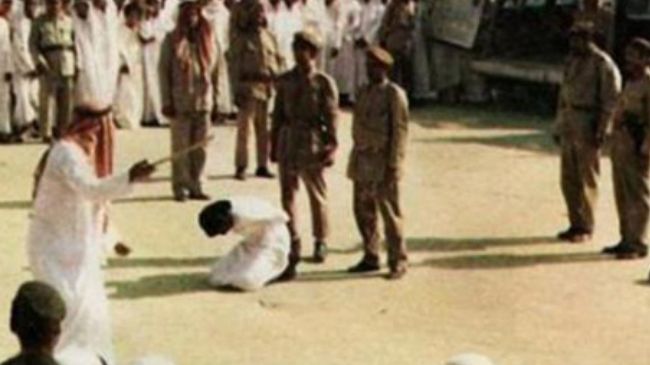
Beheading people for “sorcery” is not considered a disqualifying human rights violation when it’s performed by an official ally like Saudi Arabia.
Both of those countries have records worth condemnation, if the Post were really interested in such matters. According to Human Rights Watch World Report 2014, Jordanian law “criminalizes speech deemed critical of the king” and other government officials, its penal code offers “reduced sentences for perpetrators of ‘honor crimes,'” and police torture remains a serious problem.
Saudi Arabia’s deplorable record is probably better known; it’s been in the news recently because the Islamic State’s gruesome beheading videos are a reminder that the Saudi government still considers that to be an acceptable form of punishment; the UN (9/9/14) reports that at least eight people were beheaded in August “for nonviolent crimes including drug-smuggling and sorcery. Other offenses resulting in beheading have reportedly included adultery and apostasy.”
Did those countries’ deplorable human rights records prompt the Post to call for preventing them from a seat on the UN Security Council? Evidently concern for human rights is more important when the country in question is an Official Enemy, the kind of place where some lowly bus driver can be elected president.
P.S. The Post published a letter (9/24/14) from the charge d’affaires of the Venezuelan embassy, which noted that “Venezuelans are proud to belong to a democracy that allows former blue-collar workers to rise to the top.”



Prosperity shared?????????? Are you kidding me????? It’s morons like you with your iPhones and iPads criticizing capitalism. Granted capitalism is a terrible system…..except for all the others!!!!!!
Peter Hart,
We love FAIR. We are starting a new Progressive FM Radio show.
We want FAIR to contribute an HOUR SHOW. Can you manage a show, or would you rather have us to call you for expert testimony?
William Floyd
We all know the Corporate Lords and Masters do not like the idea that anyone who isn’t already rich and pouring money into the Lords and Masters Pockets getting any type of power.
It will be interesting the day when a ‘Corporate Napoleon’ takes the helm and decides to show the “Lords and Masters” a remake of the French Revolution.
Question: are Syria and Iran actually “allies” of Venezuela? Cuba, yes, but the other two? That’s not a rhetorical question; I’m actually asking. It seems to me, Venezueal and Cuba have been engaged in producing societies with a greater, less concentrated, distribution of wealth. Can the same be said of Iran and Syria?
Er, was Maduro actually elected, or did he succeed Chavez on the latter’s death? I thought he succeeded him, and hadn’t heard about him actually running for the Presidency on his own. Maybe I missed something?
I’ll tell you what. When US politicians and their media mouthpieces lie they go straight for the Hitler: the bigger the more likely to be believed. Venezuela perhaps – never been there, and of course with our media not by that route either – once was one of South America’s richest countries. For the 1%. But setting that aside, I have little doubt it is as “rich” now. Human Rights Watch? As if that NGO has any credibility after feting Madeleine “the price is worth it” Albright. “Next month Venezuela will stand for a seat on the UN Security Council, where it would be able to advocate for allies such as Syria, Iran and Cuba.” In other words whomever’s not with the the corporate gangsters of the elite US and western global war of terror [for oil and its wealth]. Granted capitalism is a system whose logical end is extinction. The commentator echoes Churchill’s comment about democracy. Does he also echo Churchill thusly: “I do not understand this squeamishness about the use of gas. I am strongly in favour of using poisoned gas against uncivilised tribes [in Mesopotamia]”? It’s an interesting question about Iran and Syria. Exercising the Arab proverb that my enemy’s enemy is my friend it would seem so. That they are both looking down the barrel of the guns of the dying imperial monster ought make them shiver against each other for their survival. Maduro succeeded Chavez upon his death and then won election.
I can’t help thinking of the poor souls in Guantanamo, and those on death row, not to mention the women and children at the receiving end of our stone strikes. Why is beheading any “more” barbaric? It isn’t.
Duncan, there was an election in Venezuela and Maduro was returned as president.
Mke the Mutti:i It’s morons like you with your iPhones and iPads criticizing capitalism. Sorry, Mike, this MORON has no iphone or ipad. I would much rather live in a country without such junk, including my own computer, where everyone has health care, housing, education, and food.
Maduro was elected president by a very narrow margin of 1.5% of the votes cast (comparable to some recent US presidents, I think). This contrasts with, for example, General al-Sisi, who supposedly won 96% of the vote in Egypt’s last presidential election. Which margin of victory sounds more convincing to you?
Yeah, what’s wrong with those Venezuelans — can’t they elect a ‘responsible’ politician like an empty-headed grade-B movie actor, or a feckless rich-boy scion (who got “gentlemen’s Cs” in grad-school) like the WaPo and other conservative US papers are so proud of?
Rather annoyingly, the chargé d’affaires seems to have missed his own country’s point.
Whatever one may say about modern Venezuela, real democracy means ordinary people, in this case from their barrios, getting together to organise. Later they elect a person from these, their own ranks, to implement their policies. That is a real democratic action, whatever one may say about it, for better or worse.
In the Western model of democracy, our ‘representatives’ already represent us—what is ‘best and brightest’ about us and our nation—they have been to universities to receive their degrees in existing politics and business, and all that remains is to go to Washington to elect themselves as heads of state, whether congress or writers of Washington’s papers, etc. They then insist that their version of democracy must be the ‘democracy’ imposed in other countries too, by us or by their own ‘best’–such is the Post’s version of democracy. So how could the Venezuelan people elect a person they, the Washington Post’s leaders, don’t want? That does not make sense to them. And it is not democratic; it is bad. And this belief amongst those in the West is near universal, such is our understanding of democracy. Your democracy is bad. Mine good.
This is the difference to which the chargé d’affaires ought to have pointed. Instead he merely implies that the words describing the ‘bus driver’ as ‘economically illiterate’ are mistakes, since this ordinary man has ‘risen to the top’. But in doing so, not only does he suggest a wish to share the West’s concept of democracy and society but that Venezuelans have actively complied with this model here. They have done so, and the WaPo is incorrect only about that, applying its beliefs to Venezuelan democracy correctly, though mistaken.