FAIR Study: Sunday Talkshows Downplayed Criticism During Trump’s Second Transition
In 2024, when Trump’s rhetoric and cabinet picks became even more extreme, fewer Sunday show guests voiced criticism of Trump and his cabinet than in 2016.
FAIR is the national progressive media watchdog group, challenging corporate media bias, spin and misinformation.


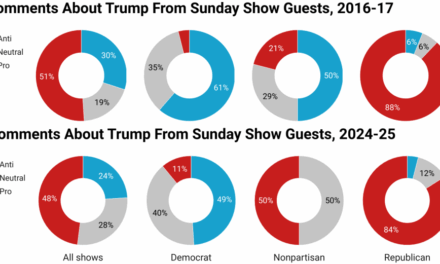
In 2024, when Trump’s rhetoric and cabinet picks became even more extreme, fewer Sunday show guests voiced criticism of Trump and his cabinet than in 2016.

Musk’s Twitter is keeping certain information out of the public view—information that just happens to damage the presidential ticket he supports.

Russiagate skeptics share what they saw as the worst moments or biggest failings during the 22-month spree, and their tips for moving forward.

The conspiratorial mindset seeing Russia behind everything has little to do with evidence-based reality, and is increasingly a tool to demonize the establishment’s political enemies.

It’s possible to believe that Russia intervened in the 2016 election on behalf of Trump without thinking that this is remotely comparable to Pearl Harbor.

What counts as “far left” to the Washington Post, the newspaper owned by Jeff Bezos, the world’s richest human?

By placing the Russia story at the head of reporting about the Trump administration, CNN, MSNBC and other major news outlets have fostered the impression that they view other stories affecting real people’s lives—including climate, healthcare cuts and the travel ban—as being of lesser importance.

The New York Times’ Thomas Edsall declares “the end of left and right as we knew them.” But how well did he know them?

Jonathan Chait’s argument is that the voters who switched from Obama to Trump had conservative social views—so if Democrats need to do anything to win in 2020, they should move to the right on race and immigration policy.

Why is it so important to corporate media commentators that presidential legitimacy not be questioned? By and large, they are part of and identify with an establishment whose fragility is all too evident.

A “fake news phenomenon” that cannot, by definition, include mainstream media is a power-serving tautology that shields US corporate media from scrutiny and encourages citizens to simply trust some outlets (we’ll tell you which ones) rather than think critically.

The New York Times offers Democrats a strategy that goes after rural, whiter, more conservative voters—presumably by being more conservative—vs. a strategy of counting on demographics to deliver victory to a party focused on social and environmental issues.

Whatever story there is to be told about Russia and the 2016 election, corporate media have squandered the credibility it would take to tell it.

In the wake of this loss, some of the more hardcore Clinton partisans have chosen, in lieu of self-examination and internal criticism, to simply lash out at the voters they failed to win over.

Faced with a unique and unprecedented threat in Trump, attempts to find “balance” between Trumpism and wholly unrelated phenomena to its left were tone deaf, and at times bordered on apologies for fascism.

So who do we blame for Trump—the age group that voted for Clinton by the widest margin, or the ones that voted for Trump? If you’re the Washington Post, the biggest Clinton backers are responsible for Trump, naturally.

It seems likely that the omission of Frank Bruni’s name—a familiar one, of course, to regular readers of the New York Times op-ed page—was a deliberate choice.

The idea that Sanders had not been “properly examined” was pure dogma, asserted by pundits with hardly any critical thought. It was a major contributing factor to the Democrats not nominating someone who, by available measures, was a stronger candidate than Clinton.

How should the media be covering these races, and how should public opinion be measured and absorbed? What kind of debates between candidates would actually matter? These are the valuable questions that media organizations should be asking themselves.

That a group of Cold Warrior hacks would publish such a blacklist is not a surprise; that one of the most established names in American news would uncritically parrot it was.

