Grading the States’ Coronavirus Control
The New York Times’ graphics aren’t helping to hold state governments responsible; they’re actually obscuring which officials have implemented an effective anti-coronavirus strategy.
FAIR is the national progressive media watchdog group, challenging corporate media bias, spin and misinformation.



The New York Times’ graphics aren’t helping to hold state governments responsible; they’re actually obscuring which officials have implemented an effective anti-coronavirus strategy.

It would indeed be worrisome if people were ending up in the hospital despite observing lockdown restrictions, but there’s no reason to think from the information provided in a new survey that that’s the case.

The New York Times graphics department has done some great work translating the data of the Covid-19 pandemic into visual form, allowing readers to get an intuitive sense of the scope and course of the outbreak. Their “Real Coronavirus Death Toll in Each State” (5/5/20) is not a good example of that great work. […]

CNN should note that accepting a 60–70% infection rate means accepting a million deaths or more, assuming a fatality rate of 0.5%—which may be a conservative estimate.

What the New York Times describes as being “as successful in controlling the virus as most other nations” really means having the tenth-worst per capita death toll from the coronavirus in the world.

More testing is good, but media shouldn’t let states use it as an excuse for out-of-control viral transmission—or as cover for a premature reopening of the economy.

It’s possible that the response to the coronavirus’ pronounced lethality and asymptomatic infectiousness—a drastic physical separation necessary to prevent a quickly mounting death toll—means that Covid-19 will not be a normal disease with a steep arrival curve and an equally sudden departure.

Media can be most helpful right now by investigating and reporting how the virus is continuing to spread.

The reality is that it’s very hard to hide an epidemic. Stopping a virus requires identifying and isolating cases of infection, and if you pretend to have done so when you really haven’t, the uncaught cases will grow exponentially.
It’s a savvy businessperson who can get the New York Times to publish a free advertisement on their behalf. So kudos to L. Gordon Crovitz, former publisher of the Wall Street Journal, who convinced the Times (1/21/20) to run a column under his byline that included this pitch for his company’s services: Advertisers such as […]

Please tell the Associated Press to include a serious warning about the dangers of Covid-19, based on CDC guidelines, in its standard description of the coronavirus.

It’s vital to provide accurate information, particularly about the outbreak’s growth, and especially when you are one of the outlets that officials and opinion-shapers are likely to look to for guidance when making decisions and recommendations about the drastic measures needed to halt the coronavirus.

There is no more important question in the coronavirus crisis than how to get off the path led by Italy and onto the track of countries like Singapore.

Election Focus 2020: Even when you assume that Bernie Sanders supporters won’t vote as much as they say they will, and will vote when they say they won’t, Sanders still wins

Election Focus 2020: While some coverage is still stuck in denial on Bernie Sanders, for the most part corporate media have moved on to the next stage of grieving, which is anger.

Election Focus 2020: Please contact NBC and tell them to correct a February 2 graphic showing two of four Democratic candidates losing to Trump.
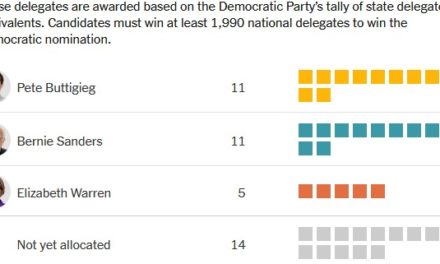
Election Focus 2020: Declaring that great centrist hope Pete Buttigieg has won something is something that corporate media are clearly eager to do—even in an exceedingly close race in which, rather famously, not all the votes have been counted yet.

An Atlantic essay’s main complaint about Chinese propaganda seems to be that Beijing is better at it than Washington.
What’s changed between 1974 and 2019? The biggest transformation was the realization of the longstanding Republican dream of a right-wing media network.

The theme of Richard Cohen’s final Washington Post column was how lucky he’s been in his career. And it’s been lucky for us at FAIR, too, in a sense—few in the media business have provided us with as much material over the years as he as.

